Showing Posts From
Egyptology
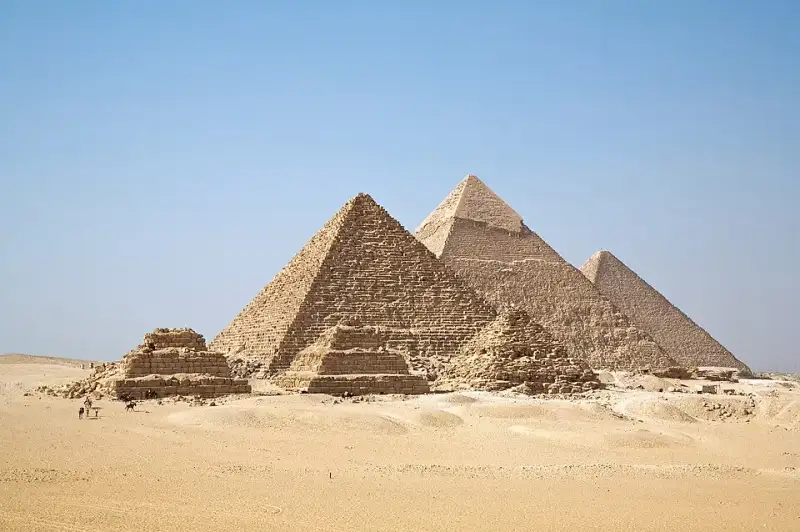

There is a timeless Arab proverb that whispers through the shifting sands of the Sahara: "Man fears Time, yet Time fears the Pyramids." Standing as an eternal sentinel on the rocky Giza plateau, the Great Pyramid of Giza is not merely a structure of stone; it is the ultimate manifestation of human ambition, organization, and spiritual devotion. For over 4,500 years, it has captured the imagination of travelers, conquerors, historians, and scientists alike. As the oldest and only largely intact member of the Seven Wonders of the Ancient World, it continues to surrender its secrets slowly, bridging the seemingly insurmountable gap between the dawn of human civilization and the cutting edge of modern technology. #GreatPyramid #AncientEgypt The Dawn of the Fourth Dynasty: The Vision of Khufu To understand the Great Pyramid, one must first understand the era that birthed it. The Old Kingdom of Egypt, spanning roughly from 2700 to 2200 BC, was a period of unprecedented prosperity, political stability, and centralized administration. At the heart of this golden age was the Fourth Dynasty, a lineage of god-kings who wielded absolute power over the Nile Valley. When Khufu (known to the Greeks as Cheops) ascended the throne around 2589 BC, he inherited a kingdom perfectly poised for monumental undertakings. His father, Sneferu, had already perfected the art of true pyramid building, experimenting with structures like the Bent Pyramid and the Red Pyramid at Dahshur. Khufu, however, envisioned a resting place that would dwarf anything the world had ever seen. To execute this vision, Khufu likely appointed his nephew, the vizier Hemiunu, as the chief architect. Hemiunu was tasked with orchestrating a logistical masterclass, coordinating resources, manpower, and engineering on a scale that defies modern comprehension. The resulting monument would serve not just as a tomb to house the pharaoh's mummified remains, but as a resurrection machine designed to launch Khufu's soul into the heavens to join the imperishable stars. #Khufu #History A Colossus of Stone: Scale, Dimensions, and Materials The sheer scale of the Great Pyramid is staggering. Upon its completion around 2560 BC, the structure reached a breathtaking height of 146.6 meters (481 feet), a record it held for nearly 3,800 years until the completion of the Lincoln Cathedral spire in England in the 14th century. Today, stripped of its protective capstone (pyramidion) and its outer casing, it stands at approximately 138.5 meters (454 feet). The base of the pyramid covers an immense 13 acres, roughly the size of ten American football fields. It is estimated to contain around 2.3 million blocks of stone. The core of the pyramid was constructed using roughly hewn, yellowish limestone quarried directly from the Giza plateau. However, the inner chambers required materials of far greater durability. Massive blocks of pink granite, some weighing up to 80 tons, were meticulously quarried in Aswan and transported nearly 800 kilometers down the Nile River to construct the King's Chamber. Originally, the entire structure was encased in highly polished, blindingly white Tura limestone. These casing blocks were cut with such extreme precision that a knife blade could not be inserted between the joints. When struck by the relentless Egyptian sun, the Great Pyramid would have shone like a brilliant, earthbound star, visible from mountains miles away. #Architecture #WondersOfTheWorld The Master Blueprint: Engineering and Alignment Beyond its sheer mass, the Great Pyramid is a marvel of mathematical precision and astronomical alignment. The structure is aligned almost perfectly to true north, with a margin of error of merely 3/60th of a degree. How ancient Egyptian surveyors achieved such astounding accuracy without the use of a magnetic compass remains a subject of intense debate. Most Egyptologists believe they utilized stellar observations, tracking the circumpolar stars, particularly Thuban, which served as the pole star during that epoch. The leveling of the massive bedrock base is equally miraculous. The maximum deviation from a perfect horizontal plane across the entire 13-acre foundation is a mere 2.1 centimeters (less than an inch). The lengths of the four sides at the base—each stretching over 230 meters—vary by only 58 millimeters. Such incredibly tight tolerances would challenge even modern construction firms equipped with laser levels and GPS technology. The mastery displayed here speaks to a civilization that possessed a profound understanding of geometry, structural engineering, and sheer perseverance. #Giza #Archaeology The Workforce: Dispelling the Myths of Antiquity For centuries, popular culture and the accounts of classical historians like Herodotus propagated the myth that the Great Pyramid was built by the blood, sweat, and tears of millions of brutalized slaves. Modern archaeology has resoundingly dispelled this misconception. The true builders of Khufu’s monument were a highly organized, deeply skilled workforce of Egyptian citizens. Excavations led by prominent Egyptologists such as Mark Lehner and Zahi Hawass have uncovered the remnants of a vast workers' village situated just south of the Giza plateau. This bustling ancient city housed between 20,000 and 30,000 people, including master masons, quarrymen, overseers, bakers, brewers, and physicians. The archaeological record reveals that these workers were well-fed, consuming a high-protein diet of beef, sheep, and copious amounts of bread and beer. Skeletal remains found in the nearby workers' cemetery show healed bone fractures and signs of surgical procedures, indicating that laborers injured on the job received advanced medical care. Working on the pharaoh's pyramid was likely considered a civic duty and an act of religious devotion, a national project that unified a relatively young civilization. #Egyptology #AncientEgypt The Logistics of Immortality: Construction Theories Perhaps the most enduring mystery of the Great Pyramid is the exact method of its construction. How did a Bronze Age society, lacking iron tools, pulleys, or wheels, raise millions of colossal stones hundreds of feet into the air? While countless theories abound, most mainstream archaeologists agree that a system of ramps was utilized. The debate centers on the configuration of these ramps. A straight external ramp extending from the quarry to the top would have eventually needed to be larger than the pyramid itself, making it highly impractical. A zigzagging or spiraling external ramp is more plausible, though it would have obscured the corners of the pyramid, making the precise alignment difficult to maintain. In recent years, the French architect Jean-Pierre Houdin proposed a revolutionary theory: an internal ramp system. Houdin suggests that the lower third of the pyramid was built using a short external ramp, while the remainder was constructed from the inside out via a spiraling, ascending internal tunnel. Evidence from non-invasive microgravimetry surveys has shown low-density anomalies spiraling within the pyramid's core, lending tantalizing credence to Houdin's hypothesis. #Architecture #ScanPyramids Journey into the Underworld: The Internal Layout While most pyramids possess a relatively simple internal structure, the Great Pyramid boasts an incredibly complex network of passages and chambers. The original entrance, located on the northern face about 17 meters above ground level, was perfectly sealed and hidden beneath the casing stones. Today, tourists enter through the "Robber's Tunnel," a jagged passage supposedly carved out by the forces of the Arab Caliph Al-Mamun in the 9th century AD. The original entrance leads to the Descending Passage, a steeply inclined corridor that cuts straight through the masonry and plunges deep into the bedrock beneath the plateau. At the terminus of this passage lies the Subterranean Chamber. Rough, irregular, and distinctly unfinished, the purpose of this chamber is debated. Was it the original intended burial chamber, abandoned due to a change in plans, or a symbolic representation of the underworld? The Ascending Passage and the Queen's Chamber About 28 meters down the Descending Passage, an intersection branches upward. This is the Ascending Passage, originally blocked by massive granite plugs that Al-Mamun's men had to bypass by tunneling through the softer surrounding limestone. Following the Ascending Passage brings one to a level horizontal corridor that leads to the so-called Queen's Chamber. This name is an Arabic misnomer, as Egyptian queens were typically buried in smaller, separate pyramids. The exact function of this chamber, which sits precisely on the east-west axis of the pyramid, remains elusive. It features a distinctive corbelled niche in its eastern wall, which may have once held a ka statue—a spiritual receptacle for the pharaoh's soul. Fascinatingly, the Queen's Chamber contains two narrow "air shafts" in its northern and southern walls. Unlike the shafts in the King's Chamber above, these do not penetrate the exterior of the pyramid. In the 1990s and 2000s, robotic rovers equipped with cameras explored these shafts, discovering mysterious limestone doors adorned with copper pins, hinting at undiscovered spaces lying just beyond. #Archaeology #GreatPyramid The Grand Gallery and the King's Chamber Continuing up the incline from the Ascending Passage, the narrow tunnel suddenly erupts into an architectural masterpiece: the Grand Gallery. Stretching nearly 47 meters long and soaring 8.6 meters high, this towering corridor features a magnificent corbelled vault. Each successive course of stone projects slightly inward, smoothly distributing the crushing weight of the millions of tons of stone pressing down from above. At the top of the Grand Gallery lies a small antechamber, originally equipped with a series of massive granite portcullis slabs intended to seal the tomb forever. Beyond this final defensive mechanism is the ultimate destination: the King's Chamber. Constructed entirely of smooth, unadorned blocks of Aswan granite, the King's Chamber is a room of solemn, stark beauty. Near the western wall sits a large, lidless granite sarcophagus. The sarcophagus is slightly wider than the entrance passage, proving it must have been placed in the chamber during the pyramid's construction, long before the ceiling was completed. When early explorers finally reached this chamber, they found it empty. Whether it was looted in antiquity, or whether Khufu's true body lies elsewhere, remains one of history's great unsolved mysteries. #Pharaohs The Relieving Chambers and the Mark of the King Above the flat granite ceiling of the King's Chamber lies a brilliant feat of engineering designed to protect the room from collapsing under the pyramid's immense weight. There are five low, claustrophobic "relieving chambers," stacked one atop the other, culminating in a peaked, gabled roof of massive limestone blocks. In the 1830s, the British explorer Major-General Richard Howard Vyse blasted his way into these hidden chambers using gunpowder. There, amidst the ancient dust, he discovered something extraordinary: red ochre graffiti left by the original work gangs. The graffiti included names of the crews, such as the "Friends of Khufu Gang." Most importantly, the marks contained the royal cartouche of King Khufu himself. This discovery provided the definitive, undeniable proof linking the Great Pyramid to the second pharaoh of the Fourth Dynasty. The Ship of the Sun: Khufu's Solar Barque The magnificent scale of Khufu's funerary complex was not limited to the pyramid itself. In 1954, archaeologists working at the base of the southern face uncovered a sealed pit carved into the bedrock. Inside, dismantled into exactly 1,224 pieces, lay an astonishingly well-preserved ancient cedar ship. Known as the Khufu solar barque, this 43-meter-long vessel was meticulously reconstructed in a process that took over a decade. It was likely built as a ritual vessel, a magical vehicle designed to carry the resurrected king across the heavens alongside the sun god Ra. It stands as the oldest, largest, and best-preserved vessel from antiquity, showcasing an incredible mastery of ancient shipbuilding. #History The Stripping of the Casing and the Ravages of Time If the Great Pyramid was intended to be eternal, it has certainly suffered the ravages of time and human opportunistic destruction. For millennia, the pyramid retained its smooth, white outer casing. However, in 1303 AD, a massive earthquake centered in Crete violently shook the region, loosening many of the outer Tura limestone blocks. Subsequent rulers, including the Bahri Sultans of Egypt, recognized the pyramid as a convenient, ready-made quarry. The casing stones were systematically stripped away to build the mosques, fortresses, and palaces of a growing Cairo. Today, only a handful of the original casing stones remain in place at the very base, a small glimpse into the breathtaking perfection of the pyramid's original form. The rough, stepped profile we see today is actually the inner structural core of the monument. #Giza Modern Science Meets Ancient Stone: The ScanPyramids Project One might think that after 4,500 years and centuries of intense archaeological scrutiny, the Great Pyramid has yielded all its secrets. Remarkably, this is not the case. In the 21st century, technology has opened an entirely new chapter in Egyptology. In 2015, an international team launched the ScanPyramids project. Bypassing the destructive methods of earlier explorers, the team utilized muon radiography—a technique that measures cosmic particles raining down from space. Since muons pass through empty spaces easier than dense rock, detectors placed inside and around the pyramid can map its internal structure without moving a single stone. The results have been paradigm-shifting. In 2017, the team announced the discovery of the "Big Void," an enormous, previously unknown space located directly above the Grand Gallery. Measuring at least 30 meters in length, its purpose remains a profound mystery. Is it a relieving chamber? A secondary gallery? A hidden storeroom? Furthermore, in 2023, the team confirmed the existence of another hidden space: the North Face Corridor, located just above the original entrance. Endoscopic cameras inserted through tiny joints in the stones revealed an empty corridor with a chevron ceiling, untouched since the day the pyramid was sealed. These breathtaking discoveries remind us that the Great Pyramid is still a living puzzle. #ScanPyramids #Archaeology Conclusion: The Eternal Sentinel The Great Pyramid of Giza is an architectural triumph that transcends the boundaries of its era. It represents a profound convergence of faith, science, administration, and pure human willpower. While Khufu built it to conquer death and secure his place among the stars, he achieved a different kind of immortality. He created a legacy written in millions of tons of stone, a monument that has stood watch over the rise and fall of countless empires. As modern technology allows us to peer deeper into its solid heart, the Great Pyramid continues to challenge our understanding of our ancestors. It demands respect, inspiring awe not just for its monumental size, but for the ingenuity of the minds that conceived it and the hands that built it. As long as humanity continues to gaze upon the Giza plateau, the Great Pyramid will stand as the ultimate testament to what we can achieve when we dare to build for eternity. #GreatPyramid #History #Egyptology #AncientWonders Related InsightsUnraveling the Mysteries of Stonehenge: A Monolithic Marvel of the Ancient World Ghosts of the Tower of London: Betrayal, Blood, and Royal Secrets The Secrets of the Colosseum: Surviving Rome's Bloody Arena{ "@context": "https://schema.org", "@type": "FAQPage", "mainEntity": [ { "@type": "Question", "name": "What is the main focus of The Great Pyramid of Giza: A Timeless Monument to Human Ingenuity?", "acceptedAnswer": { "@type": "Answer", "text": "Explore the fascinating history, architectural brilliance, and modern scientific discoveries surrounding the Great Pyramid of Giza, the last surviving Wonder of the Ancient World." } }, { "@type": "Question", "name": "Who authored the comprehensive guide on The Great Pyramid of Giza: A Timeless Monument to Human Ingenuity?", "acceptedAnswer": { "@type": "Answer", "text": "This detailed article and its insights were carefully researched and authored by Liam Carter." } }, { "@type": "Question", "name": "Where can I find more related content about History?", "acceptedAnswer": { "@type": "Answer", "text": "You can explore more articles, detailed reviews, and similar insights by browsing the Related Insights section at the bottom of this article or visiting our dedicated History category page." } } ] }