Showing Posts From
Simulation

-
 Hiroshi Tanaka
 - 02 Oct, 2026 12:39
Racing the Void: Hyperloop’s Leap into Ultra‑High‑Speed Ground Transport
Racing the Void: Hyperloop’s Leap into Ultra‑High‑Speed Ground Transport Imagine boarding a pod at a suburban station, accelerating to speeds that rival commercial aircraft, and arriving at a distant city in a fraction of the time it now takes by train or car. That vision, first sketched in a 2013 white paper by Elon Musk, has evolved from a speculative concept into a field of intense engineering research, venture capital backing, and open‑source collaboration. The core premise is simple yet audacious: move passenger or cargo pods through a near‑vacuum tube, eliminating aerodynamic drag and friction, while propelling them with linear electric motors and magnetic levitation. Over the past decade, two principal players—Virgin Hyperloop and Hyperloop Transportation Technologies (HTT)—have demonstrated full‑scale test tracks in Nevada and the Netherlands, respectively. In 2020, Virgin Hyperloop achieved a record‑breaking 172 mph (277 km/h) in a passenger‑carrying trial, while HTT’s pod reached 284 km/h (176 mph) on its European test loop. These milestones validate the theoretical performance envelope: speeds exceeding 1,200 km/h (≈750 mph) become plausible once engineering challenges around vacuum maintenance, pod safety, and energy efficiency are solved. Beyond the hardware, the Hyperloop ecosystem is increasingly data‑driven. Machine‑learning models predict vacuum degradation, control algorithms compute real‑time magnetic levitation currents, and simulation pipelines render thousands of seconds of pod dynamics in minutes. The recent arXiv paper “One Basis to Animate Them All: Gaussian Blendshape Distillation for Real‑Time Avatars”—while focused on 3D avatar animation—highlights a broader principle: complex, high‑dimensional physical systems often hide a low‑rank linear structure that can be distilled into a compact basis. By analogy, Hyperloop pod dynamics can be represented through a reduced set of modal coefficients, enabling ultra‑fast simulations and on‑board control loops that run on edge hardware. This article unpacks the physics, system architecture, open‑source tooling, economic landscape, and regulatory pathways that together shape the future of ultra‑high‑speed ground transport.Physics of Near‑Vacuum Propulsion Hyperloop’s performance hinges on three intertwined physical phenomena: air drag reduction, magnetic levitation (maglev), and linear synchronous motor (LSM) thrust. In a conventional railway, aerodynamic drag scales with the square of velocity, imposing a steep energy penalty beyond ~300 km/h. By evacuating the tube to 100 Pa (≈0.001 atm), drag drops by three orders of magnitude, making it comparable to rolling resistance of the levitation system. Maglev eliminates contact friction, replacing wheels with electromagnetic lift. Two dominant maglev families—electrodynamic suspension (EDS) and electromagnetic suspension (EMS)—are both viable. EDS uses superconducting coils to generate repulsive forces, requiring cryogenic cooling but offering passive stability. EMS employs active control of attractive forces between onboard coils and a ferromagnetic guideway, demanding high‑speed feedback loops but operating at ambient temperature. Linear synchronous motors provide propulsion by creating a traveling magnetic wave along the tube’s stator. The pod’s onboard superconducting coils lock into this wave, generating thrust without moving parts. The thrust (F) can be expressed as: [ F = \frac{B \cdot I \cdot L}{2} ] where (B) is the magnetic flux density, (I) the current, and (L) the active length of the coil. Modern LSM designs achieve thrust densities above 30 kN/m, sufficient to accelerate a 10‑ton pod from 0 to 1,200 km/h in under 5 minutes while keeping passenger g‑forces below 0.5 g. Energy consumption is dominated by acceleration and air‑compression cycles. Regenerative braking can recoup up to 85 % of kinetic energy, feeding it back into the grid or re‑charging onboard batteries. A recent TechCrunch analysis (2024) estimated that a fully occupied Hyperloop pod consumes roughly 0.3 kWh per passenger‑kilometer, comparable to high‑speed rail and markedly lower than short‑haul aviation.Systems Architecture: From Pods to Pipelines Beyond the physics, Hyperloop demands an integrated cyber‑physical stack. The pod control unit (PCU) must process sensor streams—pressure, temperature, magnetic field, and inertial measurements—at kilohertz rates to maintain levitation stability and trajectory precision. Drawing inspiration from the GALA method in the avatar paper, engineers have begun distilling the high‑dimensional sensor space into a compact set of linear basis functions. This reduces the computational burden on the PCU, enabling real‑time inference on low‑power CPUs comparable to ARM Cortex‑A78. The pipeline infrastructure comprises a sealed tube, vacuum pumps, airlock stations, and an array of segment controllers that coordinate pod entry, exit, and emergency braking. Each segment runs a lightweight containerized service exposing a gRPC API for telemetry ingestion and command dispatch. Redundancy is enforced via a raft‑style consensus protocol, guaranteeing that pod trajectories remain deterministic even in the presence of node failures. Safety is codified through a multi‑layered approach:Passive structural integrity – the tube wall is built from reinforced concrete and steel liners, designed to withstand internal pressure spikes up to 1 bar. Active fault detection – machine‑learning classifiers trained on historical fault data (e.g., pressure leaks, coil quench events) raise alerts within 10 ms. Fail‑safe abort – if a pod deviates beyond a 5 cm corridor, an on‑board magnetic brake engages, and the pod is guided into a designated safety bay.The software stack leverages container orchestration platforms such as Kubernetes, with custom CRDs (Custom Resource Definitions) representing pods, stations, and vacuum pumps. This declarative model aligns with the “infrastructure as code” paradigm championed by modern DevOps practices, allowing rapid iteration and reproducible deployments.Open‑Source Simulations and the Role of the Community A thriving open‑source ecosystem accelerates Hyperloop research by democratizing access to high‑fidelity simulators and control libraries. On GitHub, repositories such as hyperloop‑sim (⭐ 4.2k) and maglev‑control (⭐ 3.1k) have surged in popularity over the past 12 months, offering modular physics engines written in Rust and Python. These projects adopt the same linear‑approximation philosophy demonstrated in GALA: they pre‑compute a basis of modal responses for the pod‑tube interaction and then solve a small set of coefficient equations at runtime. Below is a minimal Docker Compose configuration that launches a full‑stack Hyperloop simulation environment, including a physics engine, a real‑time telemetry broker (MQTT), and a web‑based dashboard. The total image footprint stays under 1.2 GB, making it suitable for deployment on edge servers at station gateways. version: "3.9" services: physics: image: ghcr.io/hyperloop-sim/physics-engine:latest environment: - SIM_SPEED=1x - VACUUM_PRESSURE=100 ports: - "8080:8080" restart: unless-stopped broker: image: eclipse-mosquitto:2.0 ports: - "1883:1883" volumes: - mosquitto-data:/mosquitto/data restart: unless-stopped dashboard: image: ghcr.io/hyperloop-sim/web-dashboard:latest environment: - MQTT_HOST=broker - PHYSICS_API=http://physics:8080 ports: - "3000:80" depends_on: - physics - broker restart: unless-stoppedvolumes: mosquitto-data:The physics service runs a Rust‑based solver that uses block‑local PCA (as described in the GALA paper) to keep memory usage below 256 MB while delivering 60 fps visualisation. The broker streams sensor data to the dashboard, where engineers can tweak levitation gains in real time. Because the entire stack is containerized, researchers can spin up reproducible environments on any cloud provider, fostering collaboration across continents. TechCrunch’s “Top 10 Open‑Source Projects Shaping Future Mobility” (2025) highlighted hyperloop‑sim for its zero‑cost entry point and modular API, noting that several Y Combinator‑backed startups have already built prototype control software atop it. The feedback loop between academia, open‑source contributors, and commercial pilots is accelerating the maturation of the technology far beyond the original timelines projected in 2013.Economic Viability and Market Momentum Hyperloop’s promise is not merely technical; it must also be economically compelling. A 2024 report from the International Transport Forum estimated that a 500 km Hyperloop line would require an upfront capital investment of roughly $30 billion, translating to $60 million per kilometer. By contrast, high‑speed rail in comparable terrain averages $70–$100 million per kilometer, while new highway construction can exceed $120 million per kilometer. The cost differential stems primarily from reduced civil engineering—no need for extensive grading or tunneling through mountains—since the tube can be laid on pre‑stressed concrete pylons spaced 150 m apart. Operational expenditures are driven by energy consumption, maintenance of vacuum pumps, and periodic tube inspections. Because regenerative braking recovers most kinetic energy, the net electricity demand per passenger‑kilometer remains competitive with electric high‑speed trains. Moreover, the modular nature of tube segments permits staged financing: investors can fund a 100 km segment, begin revenue service, and reinvest earnings into subsequent extensions. Venture capital activity reflects this optimism. Y Combinator’s Summer 2025 batch featured HyperLoopX, a startup that secured a $12 million seed round to develop AI‑enhanced vacuum monitoring. Their pitch highlighted a machine‑learning model trained on sensor data from HTT’s test track, achieving leak detection precision of 0.02 Pa—a figure directly inspired by the blendshape distillation technique that reduces high‑dimensional sensor streams to a handful of predictive coefficients. Ticket pricing models project fares comparable to airline short‑haul tickets. A 2023 simulation by the European Commission suggested a €0.12 per passenger‑km fare for a fully loaded pod, making a 400 km journey cost roughly €48, versus €70–€90 for a comparable flight. When combined with significantly lower travel time (≈20 minutes vs. 1 Related InsightsAutonomous Codecraft: AI‑Powered Development Environments That Write, Test, and Deploy Themselves Synthetic Dawn: Illuminating the Role of Artificial Data in Robust AI Models From Pulses to Predictions: How Wearable Health Tech is Evolving from Data Tracking to AI-Driven Insight (Part 2){ "@context": "https://schema.org", "@type": "FAQPage", "mainEntity": [ { "@type": "Question", "name": "What is the main focus of Racing the Void: Hyperloop’s Leap into Ultra‑High‑Speed Ground Transport?", "acceptedAnswer": { "@type": "Answer", "text": "An in‑depth technical dive into Hyperloop physics, open‑source tooling, market dynamics, and the roadmap to ultra‑high‑speed ground transport." } }, { "@type": "Question", "name": "Who authored the comprehensive guide on Racing the Void: Hyperloop’s Leap into Ultra‑High‑Speed Ground Transport?", "acceptedAnswer": { "@type": "Answer", "text": "This detailed article and its insights were carefully researched and authored by Hiroshi Tanaka." } }, { "@type": "Question", "name": "Where can I find more related content about Technology?", "acceptedAnswer": { "@type": "Answer", "text": "You can explore more articles, detailed reviews, and similar insights by browsing the Related Insights section at the bottom of this article or visiting our dedicated Technology category page." } } ] }
-
 Amara Okafor
 - 14 Sep, 2026 21:52
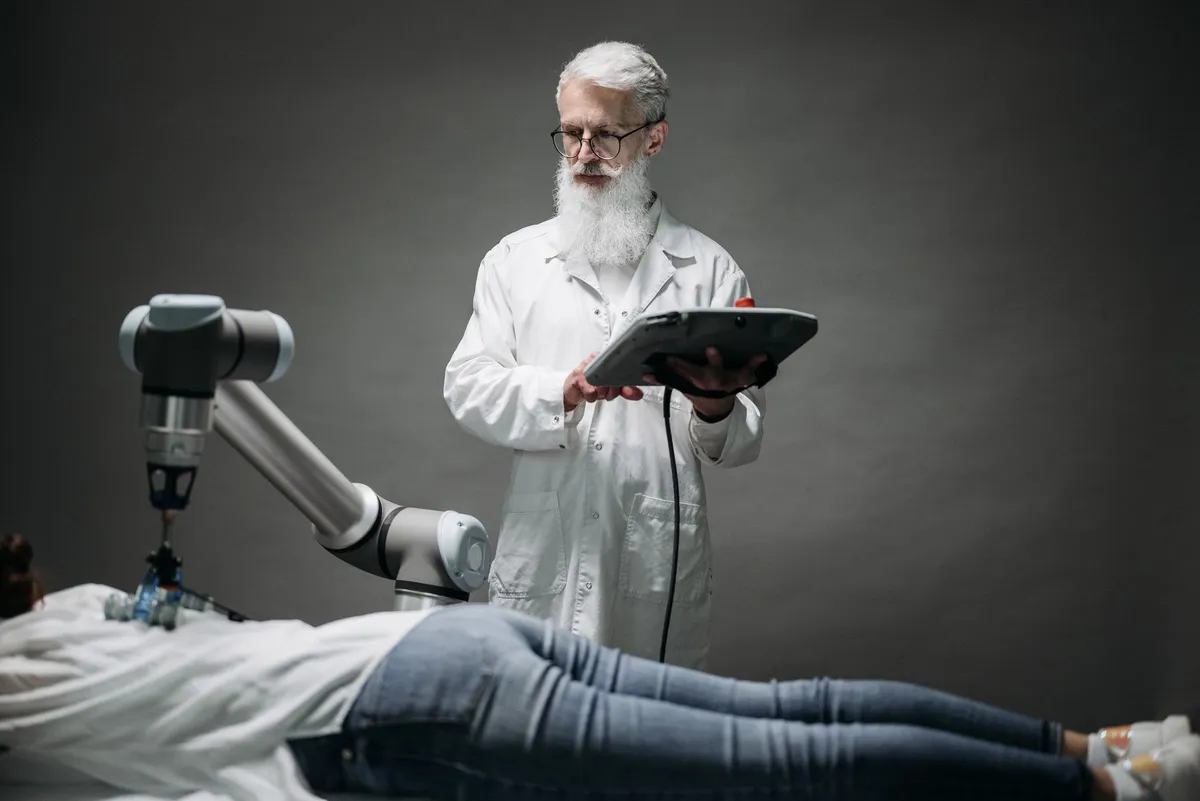
The Digital Scalpel: Architecting High-Fidelity Haptic Feedback in Robotic Surgery Simulation
Bridging the Proprioceptive Gap in Digital Surgery In the theater of modern operating rooms, the transition from tactile, manual control to teleoperated robotic platforms has redefined the limits of human intervention. Yet, as we shift the locus of agency from the surgeon's fingertips to a console interface, we face a critical physiological crisis: the loss of haptic transparency. When a surgeon operates via the Da Vinci or newer autonomous-assisted systems, the visual data is rich, but the kinesthetic feedback—the "feel" of tissue resistance, arterial pulsatility, or the subtle crunch of calcified plaque—is frequently attenuated or entirely abstracted. As an engineer witnessing the convergence of high-frequency sensors and machine learning, I have long argued that our current surgical simulation frameworks are insufficient. We are not merely building games; we are constructing high-stakes digital twins of human biology. The challenge of simulating surgical precision lies in the intersection of physics-based rendering (PBR) and low-latency motor control. When a trainee manipulates virtual tissue, the feedback loop must occur within the human perception window—typically under 10 milliseconds—to ensure that the brain does not register the interaction as a digital artifact. If the loop latency exceeds this, the cognitive dissonance destroys the fidelity of the simulation. This article dissects the architecture of these systems, moving past mere visualizations into the tangible physics of force-feedback interfaces that are currently pushing the boundaries of medical education and procedural rehearsals.Architecting Low-Latency Force Feedback Systems To achieve surgical-grade precision, we must look at the underlying software architecture. Traditional game engines, while robust for visual fidelity, often struggle with the 1kHz to 3kHz update rates required for realistic haptic interaction. For stable haptic rendering, the system must calculate the collision response and command the haptic device motors at high frequencies to prevent "jitter" or "ghosting" effects. In a professional-grade simulation, the stack usually resides in a real-time operating system (RTOS) or a heavily patched Linux kernel with PREEMPT_RT capabilities. The communication between the haptic device (such as a Force Dimension delta.3 or similar kinesthetic input) and the physics engine is the bottleneck. We utilize low-level C++ wrappers to bypass the overhead of middleware layers, communicating directly through serial or high-speed USB HID descriptors to manage force vectors. The integration of these forces relies on the "proxy" method, where a virtual cursor (the proxy) is constrained by virtual objects, and the haptic device is pulled toward this proxy by a spring-damper model. The equation of motion is governed by $F = k(x_{proxy} - x_{device}) + b(v_{proxy} - v_{device})$, where $k$ is the stiffness of the virtual surface and $b$ is the damping coefficient. Implementing this in a modular way requires robust configuration management. # haptic_controller_config.yaml simulation_params: haptic_update_rate_hz: 2000 stiffness_max_n_mm: 500.0 damping_coefficient: 0.15 physics_engine: "SOFA-Framework" input_device: vendor_id: "0x145f" product_id: "0x0001" polling_rate_us: 500 latency_monitoring: enabled: true threshold_ms: 10 alert_log: "/var/log/haptic_lag.log"This configuration ensures that the simulation engine is decoupled from the rendering thread. By pinning the haptic loop to a dedicated CPU core using taskset or cgroups, we isolate the real-time constraints from the heavy lifting of visual GPU compute, which is a common failure point in poorly optimized academic implementations. The Physics of Soft-Tissue Deformation Simulating the mechanical response of soft tissue is fundamentally a problem of Finite Element Method (FEM) optimization. When a surgeon performs a palpation task, the tissue must deform non-linearly. Standard rigid-body physics is inadequate here. In the current iteration of high-fidelity simulators, we rely on tetrahedral mesh models where each element's stiffness and elasticity are derived from real-world biomechanical datasets. The computational burden of calculating these deformations in real-time is immense. To solve this, researchers are turning to mass-spring models or Position Based Dynamics (PBD), which trade some physical accuracy for superior performance. However, for surgical precision, PBD is often insufficient. Therefore, we utilize GPU-accelerated FEM solvers. Using CUDA-based kernels, we can parallelize the computation of the stiffness matrix across thousands of threads. This allows us to handle complex geometries, such as those found in hepatic or cardiac simulations, where tissue boundaries are constantly changing. Furthermore, the "tissue damage" factor—simulating tearing, cutting, or cauterization—requires an adaptive mesh topology. This means the engine must be able to perform dynamic remeshing during the simulation loop without stalling the force feedback. When a surgical tool breaches the skin barrier, the mesh must split, creating new nodes on the fly. Doing this within the 1ms budget is the "Holy Grail" of modern surgical robotics software.Implementing Real-Time Force Feedback in Python While C++ is the standard for the inner loop, Python remains an essential glue language for orchestrating the simulation environments, telemetry, and AI-driven assessment modules. Below is a conceptual implementation of how one might interface with a haptic device driver using a Python wrapper to calibrate resistance based on simulated tissue penetration depth. import time import numpy as npclass HapticForceCalculator: """ Simulates tissue resistance feedback based on depth of penetration. """ def __init__(self, stiffness, threshold): self.stiffness = stiffness # N/mm self.threshold = threshold # depth at which tissue is reached def compute_force(self, penetration_depth): if penetration_depth < self.threshold: return 0.0 # Linear spring model for tissue resistance force = self.stiffness * (penetration_depth - self.threshold) return min(force, 20.0) # Max force cap for safetydef main(): haptic_engine = HapticForceCalculator(stiffness=2.5, threshold=0.5) # Mock loop representing the high-speed haptic thread for _ in range(100): # Current penetration depth fetched from physical device current_depth = np.random.uniform(0, 5.0) force = haptic_engine.compute_force(current_depth) print(f"Depth: {current_depth:.2f}mm | Applied Force: {force:.2f}N") time.sleep(0.01) # Simulated 100Hz frequency loopif __name__ == "__main__": main()This code snippet illustrates the fundamental logic: we map physical inputs to force outputs using a bounded model. In a production environment, this compute_force function would be replaced by a call to a C++ binary compiled via Pybind11 to ensure the latency remains within the safety envelope. The safety factor is non-negotiable; in a medical context, an unstable haptic loop can cause the device to oscillate violently, potentially causing injury to the user. Predictive AI for Procedural Assessment Beyond simple kinesthetic simulation, the industry is moving toward AI-driven procedural assessment. By analyzing the force data streams, we can detect if a trainee is using too much force during a suture, a common error in beginner surgical students. This is where the intersection of GitHub-trending time-series analysis tools and medical telemetry becomes vital. We treat the stream of force vectors as a sequence of events. Using Long Short-Term Memory (LSTM) networks or Transformers, we can identify "micro-patterns" of inefficiency. For instance, a novice surgeon might exhibit "tremor" or "hesitation" that is invisible to the human eye but clearly defined in the frequency domain of the force feedback data. By processing this data through a lightweight inference engine deployed on the edge, we provide the trainee with immediate, actionable feedback. This isn't just about training; it is about objective certification. We are creating a pipeline where surgeons can be graded on their "dexterity score" based on data that is immutable and verifiable. This shifts surgical education from a subjective, mentorship-based apprenticeship to an evidence-based, data-driven mastery. Challenges in Scaling and Deployment The deployment of these systems in hospitals globally faces two primary hurdles: the prohibitive cost of high-fidelity hardware and the lack of standardization in software protocols. Currently, each manufacturer of robotic surgical hardware maintains its own proprietary software stack. This silos the data, preventing the widespread adoption of AI-trained surgical models. To overcome this, we advocate for an open-source standard for haptic communications, similar to how ROS (Robot Operating System) revolutionized industrial robotics. By standardizing the way force-feedback devices interact with simulation engines, we allow for cross-platform compatibility. A trainee could theoretically use a generic haptic controller to practice on a simulation designed for a high-end, proprietary console, provided the interface specifications align. We must also address the "networked" surgical reality. If training is to be remote, we face the jitter of the public internet. This brings us back to the importance of the local simulation engine. The server should only synchronize high-level state changes, while the low-level force-feedback loop remains local to the machine to ensure no disruption in the feel of the simulation.Closing Perspectives on Surgical Evolution The convergence of haptic fidelity, GPU-accelerated physics, and AI-driven analytics represents the next frontier in medicine. We are not just building tools to teach surgery; we are creating the digital infrastructure upon which the future of interventionist medicine will rely. The challenges ahead are significant—specifically in maintaining sub-millisecond stability while increasing the complexity of simulated biological materials—but the path forward is clear. By prioritizing low-latency architecture, embracing open-source simulation standards, and rigorously measuring performance through high-frequency telemetry, we ensure that the next generation of surgeons is equipped with the precision required to handle the delicate intricacies of human biology. The digital scalpel is as much an instrument of software as it is of steel. As we refine these systems, we move closer to a reality where the divide between the virtual rehearsal and the real-world operation is almost entirely erased, promising safer, faster, and more effective outcomes for patients worldwide. The engineering community has a profound responsibility to refine these technologies with the same level of care that a surgeon brings to the operating table, ensuring that our code saves lives as effectively as any manual technique.#Robotics #MedTech #AI #Haptics #SurgerySimulation #DeepTech #EngineeringInnovation Related InsightsThe Symphony of Keystrokes: The Ultimate Guide to Mechanical Keyboards Industrial Metaworlds: How AI-Driven Digital Twins Are Redefining Real-Time Factory Automation Energy-Harvesting IoT: Powering Sensors Without Batteries Using Ambient Intelligence and Self-Sustaining Circuits{ "@context": "https://schema.org", "@type": "FAQPage", "mainEntity": [ { "@type": "Question", "name": "What is the main focus of The Digital Scalpel: Architecting High-Fidelity Haptic Feedback in Robotic Surgery Simulation?", "acceptedAnswer": { "@type": "Answer", "text": "An expert analysis on the engineering of force-feedback systems, integrating sub-millisecond latency protocols and kinesthetic simulation for surgical mastery." } }, { "@type": "Question", "name": "Who authored the comprehensive guide on The Digital Scalpel: Architecting High-Fidelity Haptic Feedback in Robotic Surgery Simulation?", "acceptedAnswer": { "@type": "Answer", "text": "This detailed article and its insights were carefully researched and authored by Amara Okafor." } }, { "@type": "Question", "name": "Where can I find more related content about Technology?", "acceptedAnswer": { "@type": "Answer", "text": "You can explore more articles, detailed reviews, and similar insights by browsing the Related Insights section at the bottom of this article or visiting our dedicated Technology category page." } } ] }