Showing Posts From
Systemarchitecture
-
 David O'Connor
 - 16 Sep, 2026 11:38
The Silent Urban Revolution: Architecting Agentic Societies for Autonomous Last-Mile Delivery
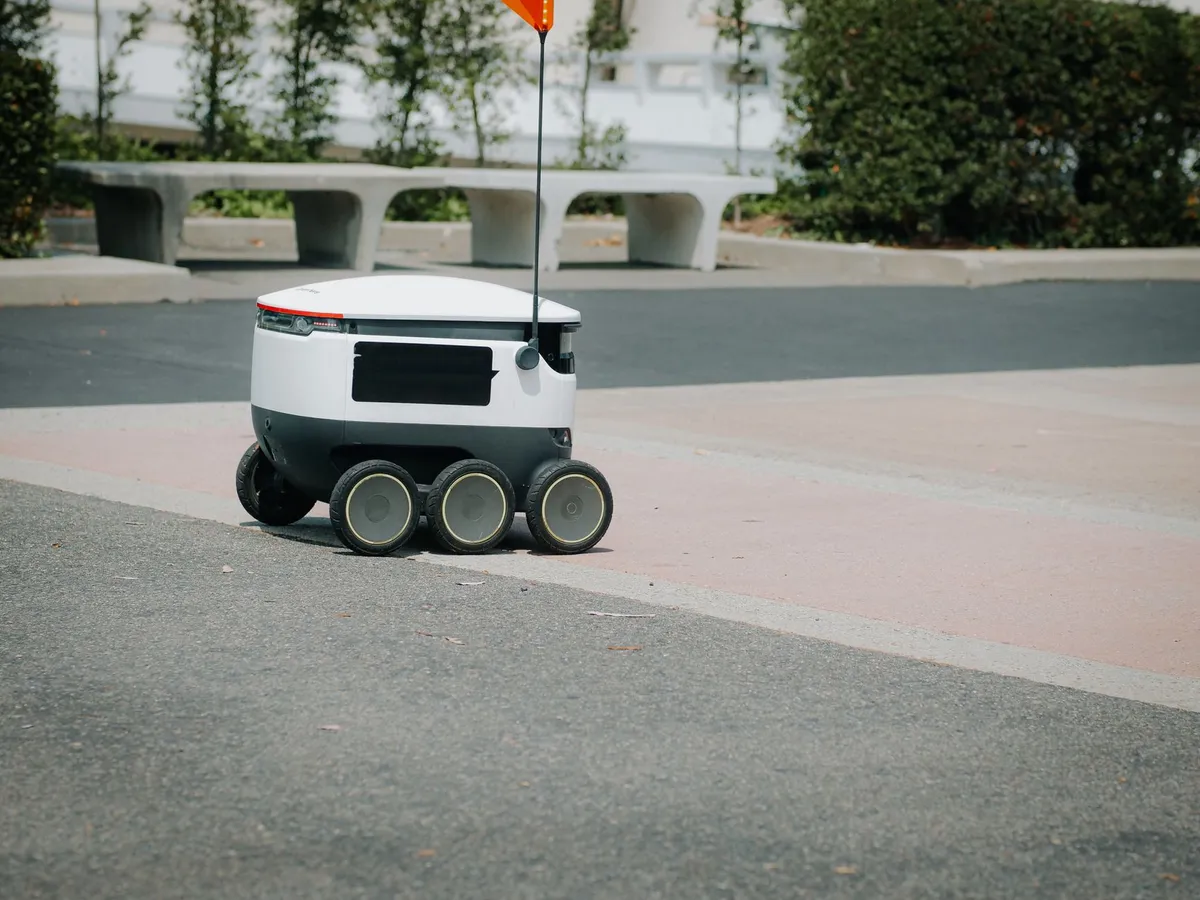
The Concrete Jungle's New Inhabitants The cadence of urban delivery is shifting beneath our feet. For decades, the "last mile" has remained the most expensive and inefficient node in the global supply chain, tethered to the constraints of human labor, traffic congestion, and the volatility of unpredictable urban environments. As we pivot toward an era of dense, autonomous micro-logistics, we are not merely deploying robots; we are birthing an "agentic society." These systems, comprised of autonomous fleets navigating public walkways, must balance high-fidelity spatial awareness with the complex social dynamics of shared spaces. Imagine a sidewalk crowded with pedestrians, cyclists, and automated couriers. Each robot operates on behalf of a principal—a delivery service, a retail aggregator, or a local merchant—whose objectives may only partially align with those of its peers. The core challenge is no longer just obstacle avoidance; it is the orchestration of decentralized agents in an environment where trust is non-existent, communication is unreliable, and the cost of a "social" error—such as blocking a wheelchair ramp or failing to yield—carries severe societal and legal weight. To succeed, we must move beyond simple reactive control loops. We are entering the age of World-Action Models (WAMs) that can predict future states with granular precision, coupled with social harnesses that enforce behavioral constraints, ensuring that the efficiency of micro-logistics does not come at the cost of urban order. Navigating the World through Modality-Autoregressive Intelligence At the heart of modern robotics lies the transition from pure pixel-based observation to modality-rich reasoning. Traditional approaches, which rely heavily on massive RGB frame buffers, often suffer from high computational overhead and suboptimal spatial understanding. Our current research trajectory, specifically through Modality-Autoregressive (ModAR) frameworks, suggests that the future of micro-logistics lies in denoising latent modalities—such as point tracks, DINO features, and depth maps—before committing to an action. By leveraging ModAR, we enable robots to simulate future trajectories with significantly higher success rates while reducing training FLOPs by orders of magnitude compared to pretrained video-model counterparts. In an urban delivery context, this is transformative. A robot equipped with ModAR does not just "see" an approaching pedestrian; it tracks point-features across depth planes, allowing for the anticipation of human intent in dense crowds. The computational efficiency of ModAR is critical for edge deployment. Because these models can run on localized, power-constrained hardware, we avoid the latency pitfalls of cloud-dependent decision-making. By conditioning future actions on previous modality generations, the agent maintains a fluid, autoregressive world model that adjusts in real-time to the chaotic, stochastic nature of city sidewalks. Implementing the Social Harness Layer Autonomous agents, despite their competency, are susceptible to failure when interacting with others whose objectives deviate from their own. An "honest" robot might attempt to optimize for delivery speed, while a faulty agent—or one incentivized for disruptive behavior—could effectively stall traffic flow. To mitigate this, we propose a multi-layered social harness. This harness acts as an intermediary, sitting between the agent’s internal execution logic and the raw communication primitives (the "speech" layer). The social harness provides three critical functions: proactive failure prevention, runtime invalid message detection, and post-facto forensic accountability. In a micro-logistics network, this means every communication—whether it is a sensor-sharing handshake between two robots or a trajectory negotiation—is mediated through a set of social constraints defined at the architecture level, not the agent level. import torch import torch.nn as nnclass SocialHarnessLayer(nn.Module): """ A behavioral constraint engine for autonomous delivery agents. Enforces compliance with safety protocols and social norms. """ def __init__(self, agent_id, compliance_threshold=0.95): super().__init__() self.agent_id = agent_id self.threshold = compliance_threshold def validate_trajectory(self, proposed_path, environment_context): # Check against local safety primitives (e.g., collision with static obstacles) if not self._check_static_bounds(proposed_path): return False, "Violation: Static constraint collision" # Inspect for socially disruptive intent (e.g., high-speed maneuvering in crowds) if self._detect_social_disruption(proposed_path, environment_context): return False, "Violation: Social throughput interference" return True, "Success" def _detect_social_disruption(self, path, context): # Implementation of social norm heuristic checks # Returns True if the path disrupts pedestrian flow return False By decoupling the "personal harness" (private objectives) from the "social harness" (system-wide norms), we enable a modular infrastructure where individual robot manufacturers can iterate on their control policies without compromising the collective stability of the logistics network. Infrastructure Deployment and Edge Orchestration Deploying these agents in a live urban theater requires more than just high-quality AI; it requires a robust, scalable orchestration layer. We must move away from monoliths and toward micro-services, where the robotic agent acts as a compute node. Using a combination of Kubernetes (K3s) for orchestration and lightweight message queuing, we can manage global fleet status while keeping safety-critical decisions local to the device. The deployment configuration below demonstrates how we might isolate the social harness container from the primary vision-action model, ensuring that even if the ModAR layer experiences a kernel panic or model degradation, the social safety supervisor remains operational, forcing the robot into a "fail-safe" stop state. # docker-compose.yaml for edge delivery units version: '3.8'services: perception-modar: image: micro-logistics/modar-engine:v2.1 deploy: resources: limits: memory: 4096M command: --model-type DINO_DEPTH_V4 --gpu-count 1 social-harness: image: micro-logistics/social-safety-harness:v1.0 restart: always environment: - TRUST_BOUNDARY_POLICY=STRICT - LOG_LEVEL=DEBUG volumes: - ./logs:/var/log/harness depends_on: - perception-modar comms-bridge: image: ros2/foxy-base network_mode: "host" environment: - RMW_IMPLEMENTATION=rmw_cyclonedds_cppThis architecture ensures that communication primitives—the "speech"—are monitored. In an agentic society, if an agent transmits data that violates the social harness (e.g., an incorrect obstacle-free flag designed to trick a competitor), the social harness logs the incident, triggers a cryptographic proof of the violation, and immediately severs the agent's interaction capability within the local cluster. Challenges in Multi-Agent Trust and Verification The most significant hurdle to widespread urban delivery is the "Trust Boundary." When different logistics providers (e.g., Amazon, DoorDash, or local autonomous fleets) share the same physical infrastructure, their underlying agents may have misaligned incentives. One company might prioritize battery life, while another prioritizes transit speed. In such a mixed environment, agents must negotiate for path priority. Without a standardized social harness, these negotiations become game-theoretic minefields. An agent could spoof sensor data to gain priority in a crowded crosswalk. To solve this, we rely on immutable logs. By appending all negotiation headers to a local lightweight ledger, we enable post-facto investigation. If a collision occurs, the social harness log acts as a black box that cannot be tampered with by the agent's principal, providing the necessary audit trail for legal and insurance reconciliation in an automated city environment.Furthermore, our experiments indicate that agents benefit from predicting multiple future modalities rather than just the next RGB frame. This is because RGB data is prone to aliasing in high-glare or low-light urban settings. By prioritizing semantic features and point tracks, we create a more robust "world model" that is significantly less likely to succumb to the sensory manipulation that faulty agents might attempt. The "social harness" essentially acts as a runtime verification filter on these world-action predictions. Future Research Directions: Beyond Local Constraints The realization of a fully autonomous agentic society requires significant advancements in decentralized consensus protocols. Currently, we are testing the efficacy of "Federated Learning for Social Norms," where fleets update their collective understanding of urban etiquette—such as how to behave near construction zones or outdoor dining areas—without transmitting sensitive private context. The next frontier for ModAR and social harnesses lies in cross-modal alignment. We are investigating how to incorporate LLM-based reasoning (Large Language Models) to interpret human semantic gestures, such as a hand wave or a nod from a pedestrian. However, this introduces the danger of "Prompt-Injection" at the edge, where a human might try to spoof the robot’s intent. The social harness must therefore extend its capabilities to parse input signals for malicious intent, treating human interaction as a potential security vector. As we look toward 2030, the integration of 6G communication standards will provide the bandwidth necessary for real-time, cross-fleet model synchronization, further tightening the social harness. The goal is to reach a state where the logistics grid is invisible to the pedestrian, operating with the fluidic grace of a school of fish, despite being composed of thousands of autonomous, independently-owned nodes. We are not just building delivery robots; we are encoding the future of urban civil society into the silicon and code of the machines that navigate our streets. The Synthesis of Order and Autonomy The trajectory of robotics in micro-logistics is no longer a matter of hardware miniaturization or raw compute power. We have reached a point where the bottleneck is interaction. By implementing Modality-Autoregressive World-Action Models, we solve the efficiency problem—creating agents that can perceive, predict, and move with unprecedented agility and minimal training costs. By overlaying a robust, multi-layered social harness, we solve the trust and security problem, providing the essential infrastructure needed for agents to coexist in a competitive, heterogeneous ecosystem. The transition from isolated automated experiments to an integrated, agentic urban society depends on our ability to enforce order without stifling the rapid, autonomous decision-making required for real-time logistics. The proposed architectures demonstrate that we can indeed create a "social safety net" for AI. These systems allow for granular auditing, robust runtime verification, and the prevention of malicious exploitation, all while maintaining the sub-millisecond response times required for urban safety. As these technologies mature, we will see the last mile evolve from a chaotic mess of human-error-prone delivery vehicles into a structured, silent, and highly efficient network of autonomous agents, fundamentally rewriting the economics of urban commerce and setting the benchmark for the next decade of robotics deployment in our cities.#AI #Robotics #Logistics #EdgeComputing #Cybersecurity #SoftwareEngineering #FutureTech Related InsightsQuantum Repeaters & Satellite Links: Building the Unhackable Internet of Tomorrow The Ultimate Guide to Custom PC Building: Forging Your Digital Masterpiece Algorithmic Sovereignty: Deconstructing the DAO Paradox in On-Chain Governance{ "@context": "https://schema.org", "@type": "FAQPage", "mainEntity": [ { "@type": "Question", "name": "What is the main focus of The Silent Urban Revolution: Architecting Agentic Societies for Autonomous Last-Mile Delivery?", "acceptedAnswer": { "@type": "Answer", "text": "Exploring the intersection of World-Action Models and social agent frameworks to revolutionize urban micro-logistics at scale." } }, { "@type": "Question", "name": "Who authored the comprehensive guide on The Silent Urban Revolution: Architecting Agentic Societies for Autonomous Last-Mile Delivery?", "acceptedAnswer": { "@type": "Answer", "text": "This detailed article and its insights were carefully researched and authored by David O'Connor." } }, { "@type": "Question", "name": "Where can I find more related content about Technology?", "acceptedAnswer": { "@type": "Answer", "text": "You can explore more articles, detailed reviews, and similar insights by browsing the Related Insights section at the bottom of this article or visiting our dedicated Technology category page." } } ] }

-
 Kerem Talu
 - 10 Sep, 2026 11:23
The Architecture of Agency: Navigating the Ethical Frontier of Embodied AI and Hardware-Aware Intelligence
The Silent Revolution of Semantic Intent The narrative of artificial intelligence often retreats into the comfortable abstraction of Large Language Models (LLMs) reciting poetry or summarizing legal documents. However, we have entered the era of physical consequence. When an AI system transitions from predicting the next token in a string to predicting the next physical torque of a robotic joint, the stakes shift from intellectual inaccuracy to tangible hazard. As a researcher witnessing the convergence of Silicon Valley’s rapid iteration cycles and the rigorous academic constraints of embodied intelligence, I find that we are moving toward a period where "responsible innovation" is no longer a marketing slogan—it is a functional requirement of the stack. We are currently seeing the emergence of models like Show-Harness, which demonstrate that we don’t need to reinvent the wheel for every robotic embodiment. By creating semantic interfaces that bridge the gap between foundation Vision-Language Models (VLMs) and hardware-level action, we are unlocking robotic utility at an unprecedented velocity. Yet, this velocity brings friction. If a VLM, trained on the biased corpora of the open web, is granted the "hands" to manipulate physical space, we are effectively baking those societal biases into the actuators of our industrial and personal assistants. The quest for fairness, therefore, is not just about refining the training set; it is about establishing robust control interfaces that provide accountability at the point of action. As we push toward high-concurrency architectures, such as those modeled by PASCAL for parallel scans, we must ensure that our compute optimization techniques do not obfuscate the decision-making pathways of the agents themselves.The Semantic Bridge and the Bias Feedback Loop The fundamental challenge in deploying VLM-based agents lies in the grounding problem. Standard VLMs are excellent at "knowing" that a cup exists, but they often lack the fine-grained physical intuition to handle it safely across diverse embodiments. The Show-Harness framework addresses this by creating a semantic action space. By abstracting the robotic movement into discrete units, we allow the foundation model to focus on intent while delegating physical execution to deterministic interpreters. However, from an ethical standpoint, the "semantic interface" is a high-risk surface area. If the agent’s semantic understanding of a "person" is colored by latent bias—perhaps over-indexing on certain demographics due to imbalanced training data—the interpreter’s deterministic grounding could lead to discriminatory physical behaviors. We are seeing this in the wild within GitHub repositories where fine-tuned models are deployed for edge robotics. When we reduce the "cost" of deployment to a few GPU-hours, we remove the friction that previously acted as a safeguard against premature deployment. To mitigate this, we must implement verification layers within the interpreter that act as a "constitution" for physical actions. This ensures that even if the VLM attempts an aggressive or biased maneuver, the interpreter constraints prevent the robot from executing unsafe commands. Below is a conceptual implementation of how one might enforce safety boundaries in a Python-based middleware layer for such an interface: import numpy as npclass SafetyInterpreter: """ Acts as a deterministic firewall between the VLM semantic intent and the hardware actuation layer. """ def __init__(self, torque_limit, force_bias_threshold): self.torque_limit = torque_limit self.force_bias_threshold = force_bias_threshold def ground_intent(self, semantic_action, spatial_context): # Verify if the action violates spatial or demographic fairness constraints if self._is_unsafe(semantic_action, spatial_context): return "ACTION_BLOCKED: SAFETY_CONSTRAINT_VIOLATION" # Grounding logic for physical action units return self._execute_safe_torque(semantic_action) def _is_unsafe(self, action, context): # Hard-coded ethical safety check if action == "GRASP_OBJECT" and context.is_near_human: return True return False def _execute_safe_torque(self, action): # Simulated actuator interaction return f"EXECUTING: {action} within safe parameter bounds."# Example usage: interpreter = SafetyInterpreter(torque_limit=5.0, force_bias_threshold=0.8) print(interpreter.ground_intent("GRASP_OBJECT", type("obj", (), {"is_near_human": True})))Hardware-Awareness as an Ethical Imperative We often view fairness as a software problem, yet the architecture of our AI accelerators—our GPGPUs and NPUs—directly influences how we handle data and, by extension, how we manage risk. The PASCAL model for parallel scans identifies a critical issue: asynchrony in multi-core systems leads to cache divergence, which results in unpredictable performance. In the context of ethics, unpredictability is an enemy. When we consider edge deployment, the energy-to-inference ratio is critical. An agent that requires massive energy to make a safety-critical decision is an agent that is susceptible to brownouts or hardware stalls. Furthermore, if we cannot predict the cache miss rate, we cannot guarantee the latency required for real-time safety. PASCAL’s ability to correlate occupancy and divergence allows engineers to design systems that are not only efficient but also deterministic. Ethics in the age of hardware-accelerated AI means designing for observability. If a system is a "black box" in both its neural weights and its memory access patterns, it cannot be audited. We must favor architectures where data paths are transparent and reproducible.Scaling the Deployment of Responsible Agents The current trend toward "just a few GPU-hours of fine-tuning" for open-source VLMs is a double-edged sword. It democratizes access, which is excellent for innovation, but it also lowers the barriers to propagating technical debt and ethical flaws. In the Y Combinator community, we frequently see startups prioritizing "time-to-market" over rigorous fine-tuning, often leading to models that exhibit "hallucinated safety." To build responsible agents, we need to standardize the deployment pipeline. This involves using declarative configurations to define the ethical boundaries of an agent's environment. Consider the following YAML configuration, which defines an "Environment Boundary" for an industrial robotic deployment: agent_config: model_id: "show-harness-v1" version: "1.2.4" ethical_bounds: - constraint: "proximity_limit" min_distance_meters: 1.5 action_if_violated: "emergency_stop" - constraint: "force_gradient" max_newtons: 50 action_if_violated: "throttle_output" hardware_settings: precision: "fp16" cache_policy: "PASCAL_AWARE" target_accelerator: "NVIDIA_GB10" logging: enabled: true data_privacy: "anonymized" compliance_audit: "enabled"By explicitly declaring these constraints, we move from vague aspirations of fairness to hard-coded operational standards. This approach mirrors the principles of Infrastructure as Code (IaC), where the ethical state of the system is version-controlled and reproducible. Data Provenance and the Bias Mitigation Lifecycle If we are to solve the bias problem, we must treat training data with the same level of scrutiny we apply to kernel modules in a production OS. Many of the issues surfacing in current VLMs stem from the "wild west" approach to dataset collection—scraping the internet without context-aware cleaning. To counteract this, we must implement a rigorous data provenance pipeline. Every action taken by a robot, and every interpretation made by a VLM, should be tagged with the lineage of the model and the specific dataset subsets it was trained on. This is significantly harder than it sounds; foundation models are monolithic. However, by using techniques like LoRA (Low-Rank Adaptation) and specific prompt-tuning, we can effectively "patch" biases as they are discovered. When an agent displays an undesirable physical bias, we shouldn't have to retrain the entire model. We should be able to isolate the semantic weights responsible for that behavior and apply a corrective adapter. This modular approach is the hallmark of professional-grade systems engineering. Bridging the Gap Between Research and Reality The research presented in academic papers regarding VLMs and parallel scan models provides the raw materials for a new paradigm. However, the gap between a paper on arXiv and a reliable production deployment is measured in "operational rigor." In my work, I find that many organizations ignore the fundamental limitations of their hardware until they face a production outage or, worse, an safety incident. We must embrace a "Security First" approach to AI. This means treating every VLM agent as a potential security vulnerability. If the VLM can be tricked into overriding its semantic interpreter through adversarial prompting—a known issue in modern transformer architectures—the robot itself becomes a vector for physical harm. Therefore, responsible innovation demands that we implement rate-limiting, input sanitization, and deterministic override layers that act independently of the foundation model's logic. We have the tools. Projects like PASCAL demonstrate that we can manage compute complexity with mathematical precision, and frameworks like Show-Harness prove that we can bridge the semantic gap to hardware. The next stage of the AI revolution will not be defined by which lab has the largest GPU cluster, but by which engineering teams can most effectively govern the intersection of language, physical agency, and hardware-level performance. The convergence of these technologies provides a unique opportunity to build systems that are not just "smart," but fundamentally reliable. As we look toward 2030, the benchmark for a "highly acclaimed" software engineer will not be the number of models they have deployed, but the resilience and fairness of the agents they have put into the physical world. Let us proceed with the caution that such power demands, and the technical discipline that innovation requires. Summary: A Roadmap for the Ethical Operator The path forward for responsible AI is a synthesis of three pillars: semantic grounding, hardware-aware performance, and declarative governance. By utilizing interfaces that allow foundation models to reason while keeping them constrained by deterministic interpreters, we can create agents that are both powerful and safe. The technical work of PASCAL proves that we can achieve high performance while maintaining predictability in our compute resources—a necessary condition for ethical AI. As we move forward, every line of code written for an autonomous agent must be accompanied by an audit trail that links intent to hardware execution. We have reached a point where the software engineering rigor traditionally applied to flight controls or medical devices must now be applied to the everyday robotics of the consumer market. Bias is not an abstract concept; in an embodied system, it is a physical force. Mitigating it requires constant vigilance, from the data provenance at the start of the training pipeline to the final safety middleware that sits atop the actuator controller. Innovation is meaningless if it lacks the foundation of accountability. By combining the latest breakthroughs in VLM-based robotics with hard-coded safety interfaces, we ensure that the agents of the future are not just intelligent, but aligned with the safety, fairness, and performance standards required of a mature, responsible technological society. #ArtificialIntelligence #Robotics #SystemArchitecture #EthicsInAI #ComputeOptimization #DevOps #EngineeringExcellence Related InsightsBeyond the Veil: Unpacking AI's Black Box for Unprecedented Trust & Transparency with XAI Fusing the Senses: The Integration of LiDAR and Computer Vision in Level 4 Autonomy Deciphering Complex Relationships: Graph Neural Networks in Social and Biological Data{ "@context": "https://schema.org", "@type": "FAQPage", "mainEntity": [ { "@type": "Question", "name": "What is the main focus of The Architecture of Agency: Navigating the Ethical Frontier of Embodied AI and Hardware-Aware Intelligence?", "acceptedAnswer": { "@type": "Answer", "text": "Kerem Talu explores the intersection of VLM-driven robotic agency and hardware-aware optimization, mapping the ethical landscape of next-gen innovation." } }, { "@type": "Question", "name": "Who authored the comprehensive guide on The Architecture of Agency: Navigating the Ethical Frontier of Embodied AI and Hardware-Aware Intelligence?", "acceptedAnswer": { "@type": "Answer", "text": "This detailed article and its insights were carefully researched and authored by Kerem Talu." } }, { "@type": "Question", "name": "Where can I find more related content about Technology?", "acceptedAnswer": { "@type": "Answer", "text": "You can explore more articles, detailed reviews, and similar insights by browsing the Related Insights section at the bottom of this article or visiting our dedicated Technology category page." } } ] }