The Rosetta Stone: Breaking the Silence of Ancient Egypt
-
 Mark Dinn
 - 25 Jun, 2026 10:00
For nearly fifteen hundred years, the gods of the Nile had been silenced. Their temples, once echoing with the chants of priests and the rhythmic beating of sistrums, had been swallowed by the encroaching sands of time and neglect. The great pharaohs, men and women who had sought eternity through colossal stone monuments and intricate spells, were reduced to nameless effigies staring blankly across the desolate desert. But their greatest loss was not their hoarded gold, nor the physical crumbling of their monuments—it was their voice. The hieroglyphs, the sacred carvings that held the very soul of #AncientEgypt, had become a dead, indecipherable code, frustrating scholars and travelers for centuries. That is, until a seemingly mundane slab of black granodiorite was pulled from the thick mud of the Nile Delta. This is the dramatic, unfolding story of the Rosetta Stone, the miraculous key that unlocked a forgotten world and allowed the ancients to speak once more across the chasm of millennia.
The Silence of the Sphinx: A Language Lost to Time
To truly understand the magnitude of the Rosetta Stone’s discovery, one must first comprehend the profound silence that preceded it. The ancient Egyptian civilization thrived for over three thousand years, producing a culture of unparalleled complexity. They chronicled their victories, their religious dogma, and their daily lives in hieroglyphs—a word derived from the Greek hieroglyphikos, meaning “sacred carvings.” For millennia, this script was a living, breathing entity, adapting and evolving. However, as the empire’s power waned, so too did the exclusivity and knowledge of its sacred script.
The conquest of Egypt by Alexander the Great in 332 BC marked the beginning of a profound cultural shift. The subsequent Ptolemaic dynasty brought Greek as the language of administration and the elite. Hieroglyphs were increasingly confined to the realm of the priesthood and religious monuments. The final blow came with the advent of the Roman Empire and the subsequent rise of Christianity. In 391 AD, the Byzantine Emperor Theodosius I ordered the closing of all pagan temples throughout the empire. The ancient Egyptian religion was outlawed, and with it, the institutions that taught and preserved the hieroglyphic script.
The last known dated hieroglyphic inscription was carved at the Temple of Philae in 394 AD. After that, the light went out. The language of the pharaohs was forgotten. For centuries, European scholars and Arab historians gazed upon the obelisks and tomb walls with awe and utter bewilderment. They believed the symbols were purely ideographic—mystical pictures representing abstract concepts of magic and philosophy, rather than a functional, phonetic language. The stones were silent. The history of Egypt was effectively erased, replaced by myths, biblical references, and the often-inaccurate accounts of classical Greek historians. The world desperately needed a key, a bridge across the void of time. #LostLanguages #History
The Sands of Rashid: Napoleon’s Audacious Expedition
The stage for the resurrection of ancient Egypt was set not in the quiet halls of academia, but in the chaotic theater of war. In 1798, the ambitious, brilliant, and ruthlessly calculated French General Napoleon Bonaparte launched a massive military expedition to Egypt. His primary goal was strategic: to sever Britain’s lucrative trade route to India and establish a French presence in the Middle East. However, Napoleon, a man deeply enamored with the grandeur of antiquity, did not just bring soldiers. He brought an army of the intellect.
Accompanying the French fleet were 167 savants—scholars, scientists, engineers, artists, and mathematicians. Their mission was to study every aspect of Egypt, from its flora and fauna to its geography and, crucially, its staggering ancient ruins. This unprecedented marriage of military conquest and scientific inquiry would inadvertently birth the modern discipline of #Egyptology.
The French army found themselves fighting not only the fiercely brave Mamluk cavalry but also the unforgiving Egyptian climate. The heat was oppressive, disease was rampant, and the sands seemed to swallow everything. Yet, amidst the suffering and the gunfire, the savants worked tirelessly. They sketched the Sphinx, measured the Pyramids of Giza, and marveled at the colossal ruins of Luxor and Karnak. But the true prize—the ability to read the writing on the walls—eluded them entirely.
A Fortuitous Discovery in the Mud
The pivotal moment arrived in mid-July 1799, near the small port city of Rosetta (known in Arabic as Rashid), located in the western delta of the Nile. The French forces, under the command of Pierre-François Xavier Bouchard, an engineering officer, were frantically reinforcing an old fifteenth-century Mamluk fortress, Fort Julien, in anticipation of an attack by the British or Ottoman forces.
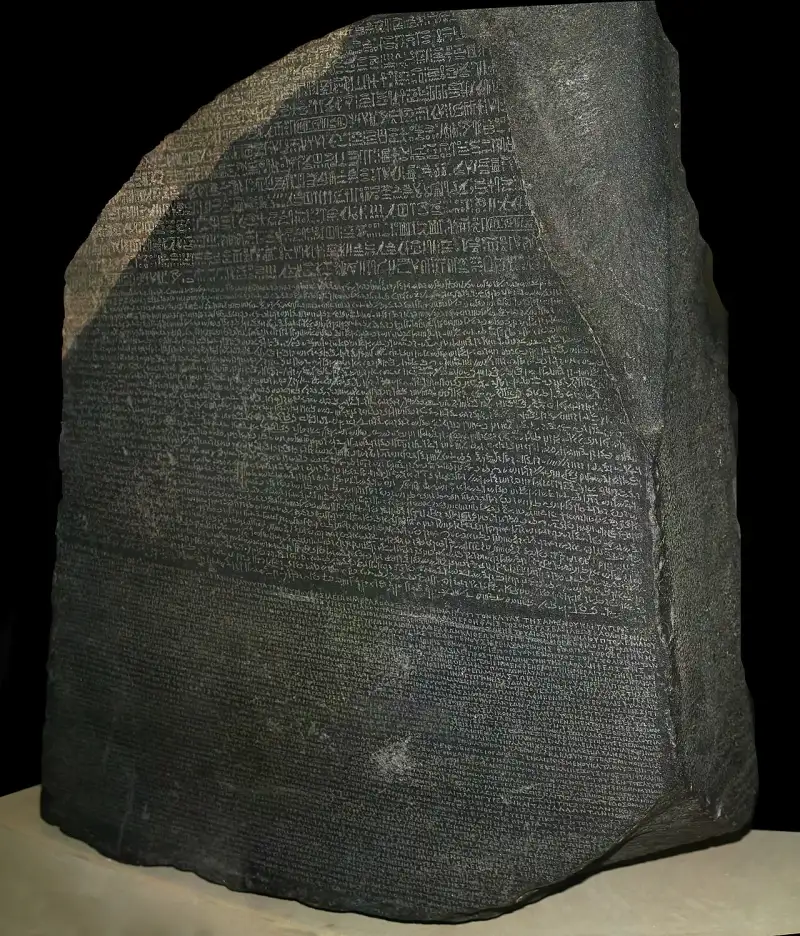
As the soldiers hacked away at an ancient wall to clear space for their cannons, their pickaxes struck something hard. It was not just another piece of masonry. Dragged from the rubble and the mud was a heavy, dark slab of stone, roughly the size of a tabletop. It measured 44 inches tall, 30 inches wide, and weighed an astonishing 1,680 pounds.
Bouchard immediately recognized that this was no ordinary building block. The face of the stone was polished and covered in dense inscriptions. What made his heart race, however, was the structural layout of the text. The stone was divided into three distinct registers, each featuring a different script:
- The Top Register: Fourteen lines of ancient Egyptian hieroglyphs, mostly missing or damaged.
- The Middle Register: Thirty-two lines of a cursive, unknown script (which would later be identified as Demotic, the everyday administrative language of ancient Egypt).
- The Bottom Register: Fifty-four lines of Ancient Greek.
Bouchard, though an engineer and not a linguist, possessed the educated foresight to grasp the artifact’s potential significance. The Greek text, which could be readily translated by scholars of the era, declared that the decree contained within was to be inscribed “in sacred, and native, and Greek characters.” This was the crucial clue. If the three texts were identical in meaning, then the Greek section could serve as a direct, one-to-one translation guide for the mysterious hieroglyphs above it.
The silence was finally about to break. The Rosetta Stone had been found. #ArchaeologicalDiscovery #Napoleon
A Sidelong Glance at Antiquity: What the Stone Actually Said
Before diving into the fierce intellectual war that followed its discovery, it is deeply ironic to examine what the Rosetta Stone actually says. Given its monumental role in the history of human knowledge, one might expect it to contain a profound philosophical treatise, an epic poem of gods and monsters, or a dramatic historical chronicle of sweeping conquests.
Instead, the Rosetta Stone is essentially a piece of bureaucratic propaganda.
The text is a decree passed by a council of priests in the city of Memphis in 196 BC, during the reign of the Ptolemaic King Ptolemy V Epiphanes, who was merely a young boy at the time. The Ptolemaic dynasty, being of Greek descent, often faced unrest and rebellion from the native Egyptian population. The decree is a political instrument designed to solidify the young king’s divine right to rule and to ensure the loyalty of the powerful Egyptian priesthood.
The text tediously outlines the various benefactions Ptolemy V bestowed upon the temples:
- Tax Exemptions: He reduced taxes and completely forgave debts owed by the temples to the crown.
- Gifts of Grain and Money: He provided substantial donations of silver and grain to the temple treasuries.
- Military Protection: He successfully besieged the city of Lycopolis, defeating rebels who had risen against the state, thereby protecting the priests and the people.
- Amnesty: He granted amnesty to prisoners and those who had been on the run during the years of unrest.
In return for these generous favors, the decree dictates that the priests must honor the king. They are ordered to construct new statues of Ptolemy V in every temple, to celebrate his birthday and coronation days with festivals and offerings, and, most importantly, to erect copies of this very decree in all the major temples across Egypt, written in the three scripts so that all—the gods, the native populace, and the Greek ruling class—could read of the king’s piety and benevolence.
It is a stunning irony of history that a rather dry, sycophantic tax document, mass-produced and placed in temples across the land, became the singular, most important artifact in the history of linguistics. It was the ancient equivalent of a press release, yet it held the secrets to eternity. #AncientHistory #PtolemaicEgypt
The Spoils of War: From French Hands to the British Museum
The joy of the French discovery was short-lived. The military realities of Napoleon’s Egyptian campaign soon came crashing down. In 1801, a massive British expeditionary force, led by General Sir Ralph Abercromby, landed in Egypt to oust the French once and for all. The French army, isolated, diseased, and outmaneuvered, was eventually forced to surrender at Alexandria.
A bitter dispute immediately arose over the fate of the countless antiquities the French savants had meticulously collected, cataloged, and drawn over the past three years. General Jacques-François Menou, the French commander, obstinately claimed that the artifacts, particularly the Rosetta Stone, were his personal property and should remain with the French. The British commander, Major General John Hely-Hutchinson, vehemently disagreed. Under the terms of the Capitulation of Alexandria, all antiquities collected by the French were declared the property of the British Crown as spoils of war.
The tension was palpable. The French scholars threatened to burn their priceless notes and drawings rather than hand them over to the British. Legend has it that the French even tried to smuggle the Rosetta Stone out of Alexandria on a small boat, hidden among personal baggage, but they were intercepted by British agents.
Ultimately, the British prevailed. The Rosetta Stone, a heavy, mute prisoner of war, was loaded onto the captured French frigate L’Égyptienne and sailed to England. In 1802, it arrived in Portsmouth and was subsequently transported to London. King George III ordered it to be placed in the British Museum, where it has remained almost continuously ever since.
On its side, the British painted a stark, triumphant inscription in white letters: “Captured in Egypt by the British Army in 1801.” The physical stone belonged to Britain, but the intellectual race to decipher its secrets had only just begun. It would be a battle fought not with cannons and cavalry, but with ink, paper, and the sheer power of human genius. #BritishMuseum #WarSpoils
The Race to Read: The English Polymath vs. The French Genius
The news of the Rosetta Stone’s existence swept through the academic circles of Europe like wildfire. Lithographic copies and plaster casts of the inscriptions were quickly distributed to universities and scholars across the continent. The text was a puzzle begging to be solved, a linguistic Mount Everest waiting to be conquered. The translation of the Greek text was completed relatively quickly, confirming the nature of the decree. But the hieroglyphs remained fiercely stubborn.
The quest to decipher the stone soon narrowed into an intense, decades-long rivalry between two extraordinary minds: the brilliant English polymath Thomas Young, and the obsessive, tormented French linguist Jean-François Champollion.
Thomas Young: The Man Who Knew Everything
Thomas Young was a man of staggering intellect, often described as “the last man who knew everything.” A physician, physicist (famous for the double-slit experiment establishing the wave theory of light), and linguist, Young approached the Rosetta Stone with the cold, analytical precision of a mathematician.
In 1814, Young began his rigorous analysis of the stone. He focused heavily on the middle section, the Demotic script, realizing it was a simplified, cursive form of the hieroglyphs rather than a completely separate language. Young made significant breakthroughs. He was the first to realize that the hieroglyphic system was not entirely ideographic (picture-based) as had been assumed for centuries, but that it contained phonetic elements (representing sounds), at least when spelling foreign names.
Young correctly identified that the oval enclosures, known as cartouches, contained the names of royalty. By comparing the Greek name “Ptolemaios” (Ptolemy) with the hieroglyphs inside a specific cartouche on the stone, Young successfully assigned phonetic values to several hieroglyphic signs. He proved that a square represented a ‘p’, a semicircle a ‘t’, a lion a ‘l’, and so on.
It was a monumental leap forward. Young published his findings anonymously in the Encyclopædia Britannica in 1819. However, Young’s progress eventually stalled. He remained deeply convinced that the phonetic spelling was an exception, a tool used only by the ancient Egyptians to write foreign, Greek names, and that the vast majority of the hieroglyphs were still mystical, symbolic pictures. His scientific mind, constrained by established dogma, could not make the final, imaginative leap.
Jean-François Champollion: The Tormented Visionary
Across the English Channel, Jean-François Champollion was attacking the problem with a fervor that bordered on madness. Unlike the diverse Young, Champollion was singularly obsessed with Egypt from a very young age. Born in 1790 in the midst of the French Revolution, he was a linguistic prodigy. By his teenage years, he had mastered Latin, Greek, Hebrew, Amharic, Sanskrit, Avestan, Pahlavi, Chaldean, Syriac, Ethiopic, and, most crucially, Coptic.
Coptic was the final phase of the ancient Egyptian language, written using the Greek alphabet with a few additional characters. It survived primarily as the liturgical language of the Egyptian Christian Church. Champollion firmly believed that Coptic was the direct linguistic descendant of the language of the pharaohs. This conviction would prove to be his greatest weapon.
Champollion lived a life of poverty, political persecution, and fragile health, but his mind burned with the fire of decipherment. He studied every copy of Egyptian inscriptions he could get his hands on, comparing them endlessly. He built upon Young’s work with the cartouches, acknowledging the Englishman’s discovery of the phonetic alphabet for foreign names, though the two men would later engage in a bitter priority dispute.
Champollion expanded the phonetic alphabet by studying cartouches from other monuments, successfully translating the names of other Greek and Roman rulers of Egypt, such as Cleopatra, Alexander, and Tiberius. But the ultimate question remained: did this phonetic system apply to the older, purely Egyptian pharaohs, or just the foreign conquerors?
”Je tiens l’affaire!” - The Breakthrough of 1822
The climax of this decades-long intellectual thriller arrived in September 1822. Champollion received copies of newly discovered inscriptions from the temple of Abu Simbel, built long before the Greeks or Romans arrived. These inscriptions contained cartouches of ancient, native Egyptian kings.
Champollion stared at a particular cartouche. It contained three symbols: a circle with a dot in the center, a mysterious symbol with three loops, and two folded cloths (which he already knew from his work on Ptolemy represented the sound ‘s’).
Drawing upon his vast knowledge of Coptic, Champollion had a sudden, electrifying realization. The circle with a dot was the sun, and the Coptic word for sun was Ra. He hypothesized that the looped symbol was the word for “birth” or “to give birth,” which in Coptic was mise.
He put the sounds together: Ra + mise + s + s.
Ramesses.
He had just read the name of Ramses the Great, one of the most powerful pharaohs in Egyptian history.
Trembling, he moved to another cartouche. This one contained the image of an ibis bird, the symbol of the god Thoth. Using the same logic, he translated it as Thoth + mise + s.
Thutmose.
The realization hit him with the force of a physical blow. The hieroglyphic system was not just picture writing. It was a complex, beautiful, and fully functional combination of phonetic signs (representing sounds) and ideographic signs (representing ideas). The Egyptians had been writing their own names, their own verbs, their own history phonetically all along. The code was cracked. The language was alive.
According to historical lore, Champollion gathered his papers, sprinted down the street in Paris to the Institute of France where his brother worked, burst into the office, threw the papers on the desk, and shouted, “Je tiens l’affaire!” (“I’ve got it!”).
The sheer emotional and mental exhaustion of the revelation was too much for his fragile constitution. Champollion immediately collapsed to the floor and fell into a coma-like state that lasted for five days. When he awoke, he began drafting his famous Lettre à M. Dacier, published on September 27, 1822, in which he officially announced his discovery to the world. The silence of fifteen centuries had been broken by the fevered brilliance of a single, obsessed scholar. #Decipherment #Linguistics #Genius
The Resurrection of a Civilization
The impact of Champollion’s decipherment cannot be overstated. It was not merely an academic triumph; it was the resurrection of an entire civilization. Before 1822, ancient Egypt was a land of myth and mute stones. After 1822, it was a land of history, poetry, religion, and humanity.
Equipped with Champollion’s grammar and dictionary (published posthumously, as he died young at the age of 41, his body broken by his obsessive work and travels in Egypt), scholars could finally read the walls.
The blank, imposing faces of the pharaohs suddenly gained names, lineages, and personalities. The battles they fought, such as Ramses II’s clash with the Hittites at Kadesh, were read in vivid, propagandistic detail. The profound religious beliefs of the Egyptians, enshrined in the Book of the Dead and the Pyramid Texts, were finally understood, revealing a complex theology centered on Ma’at (cosmic balance), the afterlife, and the journey of the soul.
We learned about the daily lives of the common people: the complaints of workers on strike at Deir el-Medina, the passionate love poetry penned on papyrus, the medical treatises detailing surgical procedures, and the complex legal documents governing land and inheritance. The ancient Egyptians ceased to be mysterious, magical figures and became human beings—fearing death, loving their families, suing their neighbors, and striving for a good life along the fertile banks of the Nile.
The Rosetta Stone was the catalyst for an explosion of knowledge that fundamentally altered our understanding of human history. It pushed the boundaries of recorded civilization back thousands of years, proving that complex, highly organized societies with profound literary traditions existed long before the Greeks and Romans. #HistoricalRevelation #AncientCivilization
The Enduring Legacy of the Stone
Today, the Rosetta Stone sits behind thick glass in Room 4 of the British Museum. It is the most visited object in the entire institution, drawing millions of awe-struck observers every year. It is no longer just an archaeological artifact; it has become a global icon, a metaphor for solving the unsolvable.
The term “Rosetta Stone” has entered the modern lexicon to describe any essential clue to a new field of knowledge. We speak of the “Rosetta Stone of genetics” or the “Rosetta Stone of immunology.” When the European Space Agency launched a probe to study a comet and unlock the secrets of the early solar system, they aptly named it the Rosetta spacecraft, with its lander named Philae (after the island where the last hieroglyph was carved).
The Modern Controversy: A Demand for Return
Yet, the stone’s legacy is not without ongoing conflict. The Rosetta Stone remains at the center of a fierce, decades-long debate regarding cultural repatriation. Prominent Egyptian archaeologists and government officials, most notably Dr. Zahi Hawass, have repeatedly and passionately demanded the permanent return of the stone to Egypt.
They argue that the stone was stolen, taken as imperial booty during a time of colonial occupation, and that it rightfully belongs in the Grand Egyptian Museum in Giza, standing alongside the culture that created it. “The Rosetta Stone is the icon of our Egyptian identity,” Hawass has stated. “Its home should be Egypt.”
The British Museum, conversely, argues that the stone was acquired legally under the treaties of the time, and that as a “universal museum,” it is best positioned to preserve, protect, and display the artifact to a global audience in the context of world history. They fear that returning such a prominent item would set a precedent that could empty the halls of major Western museums.
This debate highlights the complex, often painful legacy of colonialism and archaeology. The stone that united humanity through the understanding of language now serves as a focal point for arguments over ownership, heritage, and the right to control one’s own history.
The Eternal Whisper of the Nile
Regardless of where it physically resides, the true power of the Rosetta Stone lies in what it accomplished. It stands as a testament to the enduring power of the written word and the relentless curiosity of the human mind.
When you look at the Rosetta Stone, you are not just looking at a hunk of volcanic rock. You are looking at a portal. You are looking at the exact moment when the impenetrable darkness of the past was pierced by the light of understanding. Because of a young boy king’s tax decree, the desperate fortifications of a French soldier, the cold logic of an English polymath, and the fiery genius of a French linguist, the ancient gods awoke from their slumber.
The temples of Karnak are no longer silent. The tombs of the Valley of the Kings whisper their secrets to those who care to read them. Through the Rosetta Stone, ancient Egypt achieved the very thing it sought so desperately: immortality. As long as we can read their words, the pharaohs will never truly die. They continue to speak, telling us tales of a golden empire born from the mud of the Nile, echoing across eternity, reminding us that no voice, no matter how deeply buried beneath the sands of time, is ever truly lost. #Immortality #Legacy #MarkDinn #HistoricalFiction
Mark Dinn is an acclaimed author of historical fiction, known for bringing the forgotten dramas of the past vividly to life. His work explores the intersection of human ambition, archaeological discovery, and the relentless march of time.
#History #Egypt