Showing Posts From
All we can save
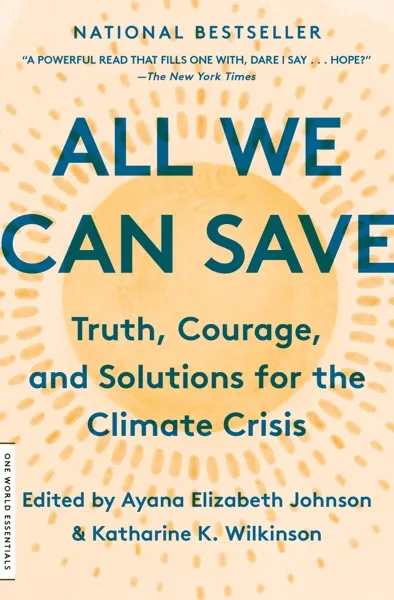

All We Can Save Author: Ayana Elizabeth JohnsonPage Count: UnknownPublication Year: 2019-GB All We Can Save: A Call to Climate Action That Strikes Deeper Than Policy Reports Ayana Elizabeth Johnson’s All We Can Save is not another dense manifesto on climate change—it’s a living, breathing conversation. Compiled as an anthology of essays, poetry, and personal reflections by women from across the globe, the book dismantles the myth that saving the planet is a task for technocrats and politicians alone. Instead, it positions climate action as a moral, creative, and deeply human endeavor. With urgency and grace, Johnson and her contributors reveal a truth that too many reports bury: real solutions emerge from empathy, lived experience, and justice—not just from carbon budgets or policy whitepapers. Johnson, a marine biologist and co-founder of the Ocean Collectiv, is no stranger to bridging science and society. But here, she transcends the role of translator. She curates a chorus of voices—Indigenous leaders, Black farmers, young activists, artists, and scientists—each offering not just a plan, but a vision. There are no monolithic heroes here. Instead, the book celebrates multiplicity: solutions rooted in Indigenous knowledge, urban farming, restorative justice, and community care. This isn’t a manual for the privileged few; it’s a kitchen-table movement in print. The book’s greatest strength lies in its refusal to separate climate action from social justice. Essays like “The Climate Crisis Isn’t Gender Neutral” by Ayana Elizabeth Johnson herself, and “Police the Police” by Rhiana Gunn-Wright, make the case that environmental degradation disproportionately harms marginalized communities—and thus, liberation must be central to any climate strategy. This intersectional lens is not an afterthought; it’s the foundation. The tone is unapologetically fierce yet tender, blending data with storytelling, statistics with poetry. In one standout piece, poet Ailish Hopper writes, “The earth is not dying. It is being murdered.” Such lines don’t just inform—they sear. Johnson’s editorial style is deft. She doesn’t impose a single narrative thread but allows contradictions and tensions to breathe. The book moves fluidly between urgency and hope, despair and defiance. There are moments of raw honesty: Katharine K. Wilkinson’s “The Time Is Always Right” reflects on the exhaustion of being a woman of color in the climate space, while Varshini Prakash’s “From the Ground Up” charts the rise of the Sunrise Movement with the grit of a grassroots organizer. The writing is neither overly academic nor simplistic—it’s accessible yet profound, like a fireside chat with the smartest people you’ve never met. One of the book’s most striking features is its inclusion of creative works—poems, personal letters, and even a short play. These aren’t decorative interludes; they’re essential. Poetry, in particular, becomes a vessel for emotions that data cannot convey. In “Dear Greta,” by Kathy Jetñil-Kijiner, the voice of a mother to her child carries the weight of climate grief and the promise of intergenerational resilience. Such pieces remind us that climate change is not just a policy problem—it’s a human story, and we need all the forms of language we can muster to tell it. Johnson’s introduction sets the stage with a quiet power. She recounts a moment of doubt while working on the anthology—feeling overwhelmed by the scale of the crisis. But then she remembers: “We are not failing the planet. We are failing each other.” That line encapsulates the book’s ethos. It’s not about saving the Earth, which will endure long after us. It’s about saving ourselves—our humanity, our communities, our capacity for care. The design of the book, with its soft earth-toned cover and thoughtful typography, mirrors its content: understated but intentional. Every essay, poem, and reflection feels chosen with care, like a handpicked bouquet of responses to a shared emergency. All We Can Save doesn’t promise easy fixes or silver bullets. Instead, it offers something more valuable: a community of thinkers and doers who refuse to wait for permission. It’s a call to action wrapped in a hug—a reminder that climate justice isn’t a distant goal, but a practice we can begin today, in our kitchens, gardens, schools, and streets. In an era where urgency often drowns out nuance, Johnson and her contributors prove that depth and speed are not mutually exclusive. They show that the future isn’t just something we inherit—it’s something we co-create, together, with all our flaws and all our love. This book doesn’t just inform. It transforms. #ClimateJustice #WomenLeadClimate #IntersectionalEnvironmentalism #ClimateHope #AllWeCanSave #EcoFeminism Related InsightsThe Body in the Bath Book Review and Summary Inventions Inspired by Oceanic Animals Book Review and Summary A Most Decadent Curse Book Review and Summary{ "@context": "https://schema.org", "@type": "FAQPage", "mainEntity": [ { "@type": "Question", "name": "What is the main focus of All We Can Save Book Review and Summary?", "acceptedAnswer": { "@type": "Answer", "text": "Everything you need to know about All We Can Save with our detailed review." } }, { "@type": "Question", "name": "Who authored the comprehensive guide on All We Can Save Book Review and Summary?", "acceptedAnswer": { "@type": "Answer", "text": "This detailed article and its insights were carefully researched and authored by Anna Kowalska." } }, { "@type": "Question", "name": "Where can I find more related content about Books?", "acceptedAnswer": { "@type": "Answer", "text": "You can explore more articles, detailed reviews, and similar insights by browsing the Related Insights section at the bottom of this article or visiting our dedicated Books category page." } } ] }