Showing Posts From
Ancientcivilizations
-
 Cemre Seyyah
 - 10 Jul, 2026 17:21
Whispers in Sandstone: Unearthing the Enduring Enigma of Petra, The Rose City
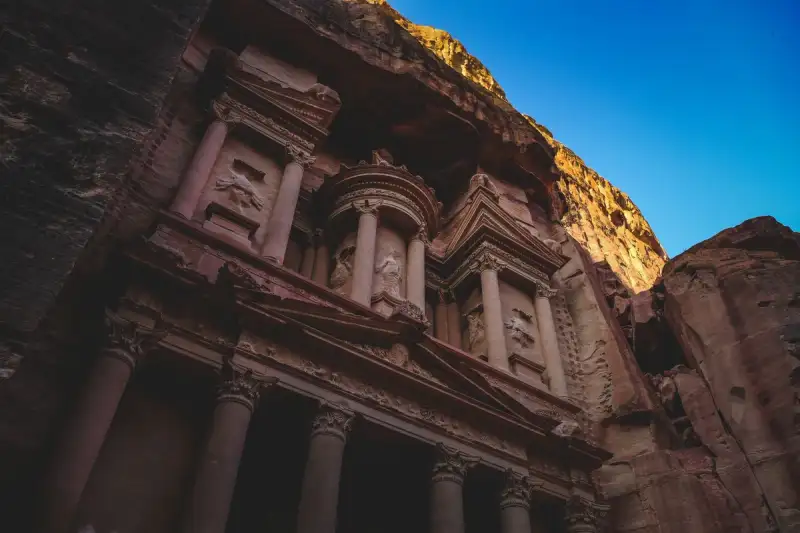
In the heart of southern Jordan, where the desert breathes tales older than memory, lies a city not merely built, but born from the very earth itself. A canvas of crimson stone, sculpted by ancient hands and the relentless artistry of time, Petra stands as a testament to human ingenuity and spiritual devotion. Known to its original inhabitants as Raqmu, meaning "The Marked" or "The Decorated," and later immortalized by the Greeks as "Petra" – simply, "Rock" – this ethereal metropolis has earned its poetic moniker, the "Rose City," from the breathtaking hue of the sandstone cliffs it calls home. A true marvel, it rightfully claims its place among the New 7 Wonders of the World and is a revered UNESCO World Heritage Site, a priceless jewel in humanity's cultural inheritance. To speak of Petra is to speak of eternity, for the story of this land stretches back into the mists of the Neolithic era. As early as 7000 BC, the nascent whispers of human settlement were heard in Beidha, a Pre-Pottery Neolithic community just north of the future city, where some of the earliest recorded farmers tilled the arid soil. Centuries later, during the Bronze Age, Petra’s strategic location began to etch itself into the annals of power, appearing in Egyptian campaign accounts and the enigmatic Amarna letters under names such as Pel, Sela, or Seir. The Edomite Echoes and the Rise of Raqēmō The Iron Age, spanning from 1200 to 600 BC, marked the era of the Edomites in the Petra region. Here, the unique configuration of the mountains became their salvation, offering a vital reservoir of water in an otherwise unforgiving landscape. This precious resource transformed the area into an essential stopping point for merchants, fostering a vibrant trade in commodities like wines, olive oil, and wood. Initially accompanied by nomadic tribes who eventually moved on, the Edomites remained, leaving an indelible mark on the land before the advent of the Nabataeans. Historical whispers, though debated by scholars, even speak of a tragic event involving 10,000 men cast from the mountain of Umm el-Biyara, where an Edomite site, dating no earlier than the seventh century BC, was later excavated. Into this ancient tapestry, a nomadic Arab people, the Nabataeans, intricately wove their destiny. One among several Bedouin tribes traversing the Arabian Desert in search of pasture and water, the Nabataeans, despite initial theories suggesting Aramean roots, are confirmed by archaeological, religious, and linguistic evidence as a distinct northern Arabian tribe. It was they who cemented the city’s identity, giving it the name Raqēmō, or Raqmu, as attested in ancient inscriptions. This name, possibly linked to the Arabic raqama meaning "to mark, to decorate," perfectly encapsulates the renowned carved rock façades that would come to define their architectural prowess. The Hebrew Bible, too, echoes this nomenclature, referring to a city called Rekem in the time of Moses, ruled by kings including one named Rekem. Josephus, the ancient historian, further confirms that Petra, known to the Greeks, was still called Rekeme by the Arabs of his era, after its royal founder. Even a funerary inscription found near the gorge entrance speaks of a Petraios born in Raqmu. The potential identification of Petra with the biblical Sela, a Hebrew word simply meaning "rock," remains a subject of scholarly discussion, but its connection to the ancient land of Edom is widely considered. Before their settled grandeur, the Nabataeans were described by Diodorus Siculus around 312 BC as a nomadic people who prioritized freedom from possessions, a philosophy that would drastically shift with time. At this early stage, the region was merely a natural fortress, a refuge, without a settled town, as indicated by accounts of Antigonus' expeditions against them. The Golden Age and the Ingenuity of Water It was in the 4th century BC that the Nabataeans settled in this strategic haven, transforming it into the capital of the Nabataean Kingdom by the 2nd century BC. Recognizing Petra's prime location on the lucrative incense trade routes, they shrewdly established it as a major regional trading hub, generating considerable wealth. Their mastery over the harsh desert environment was truly remarkable. Faced with scarcity, the Nabataeans developed sophisticated water conduit systems and efficient rainwater collecting techniques, along with advanced desert farming methods, allowing their civilization to thrive where others would falter. This ingenuity not only sustained their population but also cemented Petra's economic supremacy. Petra reached the zenith of its splendor in the 1st century AD. This was the era when the iconic Al-Khazneh, or The Treasury, was meticulously carved into the sandstone cliffs—a breathtaking structure believed to be the mausoleum of Nabataean king Aretas IV. During this golden age, the city's population swelled to an estimated 20,000 inhabitants, a bustling metropolis flourishing amidst the rugged landscape. The sheer scale and artistry of their rock-cut architecture during this period remain a source of awe and wonder.Roman Annexation and Gradual Decline The glorious independence of the Nabataean Kingdom, however, was destined to yield to the expanding might of Rome. In 106 AD, under the governorship of Aulus Cornelius Palma Frontonianus, the region of the Arabian Peninsula under Petra's influence was annexed by the Roman Empire, becoming part of the new province of Arabia Petraea. This marked the end of the native Nabataean dynasty, yet, paradoxically, the city continued to prosper for a time under Roman rule. The Petra Roman Road, a testament to Roman engineering and their commitment to infrastructure, was constructed around this period, further integrating Petra into the vast imperial network. A century later, during the reign of Severus Alexander, Petra still commanded a degree of grandeur, but signs of decline began to emerge. The issue of coinage ceased, and the construction of sumptuous tombs, a hallmark of Nabataean and early Roman Petra, came to an abrupt halt. This sudden cessation of grand projects suggests a significant catastrophe, perhaps an invasion by the formidable Sasanian Empire, though the exact cause remains debated. Concurrently, the rise of Palmyra, another influential city in the Roman East (flourishing from 130–270 AD), began to siphon away the vital pre-Islamic Arab trade routes that had long sustained Petra. As sea trade routes gained prominence, eclipsing the traditional overland caravan paths, Petra's economic importance inexorably waned. Despite this decline in commercial prowess, the city appears to have maintained a lingering significance as a religious center. Another Roman road was constructed at the site, perhaps indicating continued strategic or symbolic value. Epiphanius of Salamis, a bishop writing between c.315 and 403 AD, recounts a pagan feast held there on December 25th in honor of the virgin Khaabou and her offspring, Dushara. Dushara, along with al-Uzza, was one of Petra's principal deities, worshipped alongside a pantheon of other Nabataean gods such as Allat and Manat. Emperor Trajan further solidified Rome's presence and connectivity between 111 and 114 AD with the construction of the Via Traiana Nova. This ambitious road stretched from the Syrian border all the way to the Red Sea, passing directly through Petra. It meticulously followed the ancient routes of Nabataean caravans, and under the protective embrace of the Pax Romana, this route briefly revived trade between Arabia, Syria, and the Mediterranean harbors. The influence of emperors like Hadrian, around 125 AD, also played a role in the ongoing Roman administration and development of the region. Obscurity and Rediscovery The 4th century brought further misfortune. A devastating earthquake in 363 AD shattered many of Petra’s structures, dealing a severe blow to the city's already diminishing fortunes. Though several Christian churches were erected during the Byzantine era, indicating a shift in religious landscape, the city’s overall decline continued. By the early Islamic era, the once-thriving metropolis was largely abandoned, its intricate rock-cut dwellings and grand temples left to the desert winds, inhabited only by a handful of resilient nomads. For centuries, Petra remained a ghost city, its existence fading from Western memory, a secret held tightly by the local Bedouin tribes. It became a lost wonder, a forgotten chapter in the grand narrative of human civilization. This profound obscurity lasted until 1812, when the intrepid Swiss traveler, Johann Ludwig Burckhardt, disguised as an Arab scholar, "rediscovered" the city, unveiling its breathtaking beauty and historical significance to a captivated Western world. His accounts sparked renewed interest and laid the groundwork for future exploration and archaeological endeavors.Petra Today: A Living Legacy Today, Petra stands as more than just an archaeological site; it is a profound symbol of Jordan, the vibrant heart of its ancient soul. UNESCO, in its profound admiration, has described Petra as "one of the most precious cultural properties of man's cultural heritage," a sentiment echoed by every visitor who walks its ancient paths. It is, unequivocally, Jordan's most-visited tourist attraction, drawing close to a million tourists every year, each arriving to bear witness to its unparalleled majesty. To wander through Petra’s narrow Siq, the dramatic gorge that serves as its primary entrance, is to embark on a journey through time itself. The towering sandstone walls, painted in hues of ochre, crimson, and gold, speak of forgotten empires and whispered legends. Emerging into the open to behold the breathtaking facade of Al-Khazneh is an experience that transcends mere sightseeing, touching the very soul. Beyond its iconic Treasury, the city unfolds into a vast expanse of temples, tombs, living quarters, and intricate water channels, all carved with astonishing precision and artistry directly into the living rock. Petra is a testament to the enduring power of human spirit, adaptation, and vision. It reminds us that even in the most challenging environments, civilizations can flourish, leaving behind legacies that continue to inspire awe millennia later. It is a city of echoes, of rose-tinted dreams, where every carved facade and every silent canyon holds a fragment of an extraordinary past, inviting all who visit to listen to the whispers in the sandstone.#Petra #RoseCity #JordanTravel #AncientWonders #NabataeanLegacy