Showing Posts From
Ancientrome
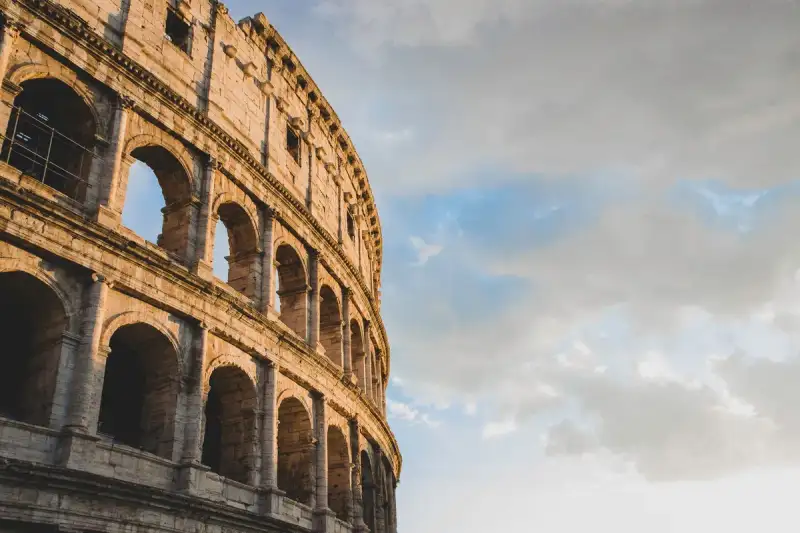

The very air in Rome hums with an ancient resonance, a symphony of forgotten glories and triumphs that still echo from every cobblestone and crumbling archway. Yet, amidst this chorus of antiquity, one monument rises, not merely as a structure of stone and mortar, but as a thrumming heart of imperial power, public spectacle, and enduring human drama: the Colosseum. It is more than a ruin; it is a sentinel of civilization, a silent narrator of an empire's zenith and the multifaceted lives it encompassed. To stand before it is to feel the weight of two millennia, to hear the roar of phantom crowds, and to understand that some stories, etched in travertine and tuff, are truly immortal. Nestled gracefully in the sprawling embrace of Italy's eternal capital, just to the east of the venerable Roman Forum, the Colosseum stands as an elliptical titan. It is not merely a testament to Roman ingenuity but an unparalleled marvel of engineering scale, holding the distinction as the largest ancient amphitheatre ever constructed and remaining the grandest standing amphitheatre in the world. Its very form, a colossal oval, speaks of inclusivity, designed to embrace tens of thousands within its imposing walls, a masterclass in communal experience, however brutal or magnificent. The Flavian Legacy: A Monument Born of Renewal The genesis of this architectural titan is deeply intertwined with the powerful Flavian dynasty, a lineage that sought to restore Rome's morale and grandeur after the tumultuous reign of Nero. Construction commenced under the formidable Emperor Vespasian in 72 AD. A pragmatist and a military man, Vespasian understood the importance of public works, of giving back to the people, and of cementing his dynasty's legitimacy. He initiated a project that would define an era, transforming a symbol of private imperial excess into a monumental arena for public entertainment. Vespasian, however, would not live to see its completion. The colossal undertaking was brought to fruition by his son and successor, Titus, who reigned from 79 to 81 AD, with the grand inauguration taking place in 80 AD. Further embellishments and modifications were carried out during the subsequent reign of Domitian (81–96 AD), completing what became the most sophisticated entertainment complex of the ancient world. It is this familial patronage – Vespasian, Titus, and Domitian – that led later classicists and archaeologists to bestow upon it the more formal, if less popularly known, appellation: the Flavian Amphitheatre, a name that honors the gens Flavia, their distinguished family name. Constructed from a formidable array of materials, the Colosseum is a testament to the Romans' mastery of construction. Its imposing skeleton of travertine limestone, sourced from nearby quarries, provided structural integrity and a dazzling white finish in its prime. Volcanic rock, known as tuff, lent its strength, while brick-faced Roman concrete – a revolutionary material for its time – allowed for complex shapes and incredible durability. This combination of natural resources and advanced engineering allowed for a structure that could accommodate an estimated 50,000 to 80,000 spectators at various junctures in its history, with an average audience capacity often cited around 65,000. Imagine the logistical feat of seating and managing such a throng, a testament to Roman organizational prowess. The Canvas of Spectacle: Life and Death in the Arena For centuries, the Colosseum served as the beating heart of Roman public life, a stage for spectacles that ranged from the awe-inspiring to the utterly barbaric. Gladiatorial contests, the most iconic and perhaps most misunderstood of its events, pitted highly trained fighters against each other in contests of skill, courage, and often, brutal fatality. These were not mere blood sports; they were complex social rituals, opportunities for emperors to display generosity, for citizens to vent frustrations, and for individuals to achieve fleeting fame or face ignominious death. Beyond the gladiators, the arena hosted a bewildering array of public shows. Animal hunts, known as venationes, saw exotic beasts from across the empire – lions, tigers, bears, rhinoceroses, and more – battling each other or specially trained hunters, a dazzling and terrifying display of imperial might and geographical reach. Executions, often theatrical and gruesome, served as stark warnings and expressions of state power. Re-enactments of famous battles brought historical and mythological narratives to life, while dramas based on Roman mythology provided a form of entertainment more akin to modern theatre, albeit with far grander staging. Perhaps most astonishingly, for a brief period, the arena was even flooded for naumachiae, or mock sea battles, transforming the Colosseum into an inland sea for naval engagements. The sheer engineering required to achieve this is almost unfathomable.The Name: A Colossus of Meaning The name "Colosseum" itself carries a fascinating etymology, a linguistic journey through time that often leads to misconception. Originally, the building's Latin name was simply amphitheatrum, signifying its function. While "Flavian Amphitheatre" is commonly used today, there is no definitive evidence that this name was widely used during classical antiquity. Some Romans may have unofficially referred to it as Amphitheatrum Caesareum, an adjective pertaining to the title Caesar, but this was likely a poetic flourish and not exclusive to Rome's great amphitheatre, as Vespasian and Titus themselves constructed another Flavian Amphitheatre in Puteoli (modern Pozzuoli). The popular name "Colosseum" is widely believed to derive from a colossal statue of Nero, a bronze giant modeled on the Colossus of Rhodes. This immense sculpture depicted Nero as a solar deity, and it was moved to a position beside the amphitheatre by Emperor Hadrian (r. 117–138 AD). The Latin adjective colosseus, meaning "gigantic" or "colossean," aptly described this statue. By the year 1000, the Latin name "Colosseum" had been coined specifically to refer to the amphitheatre, drawing its inspiration from the nearby "Colossus Solis" (Colossus of the Sun), as Nero's statue was then known. It's here that a famous historical nuance, often misconstrued, comes into play. In the 8th century, an epigram attributed to the Venerable Bede contained a prophetic verse: "Quamdiu stat Colisæus, stat et Roma; quando cadet colisæus, cadet et Roma; quando cadet Roma, cadet et mundus" – "as long as the Colossus stands, so shall Rome; when the Colossus falls, Rome shall fall; when Rome falls, so falls the world." This powerful declaration is frequently, and erroneously, translated to refer to the amphitheatre itself. However, at the time Pseudo-Bede wrote, the masculine noun coliseus specifically applied to the colossal statue of Nero, not the Flavian Amphitheatre. Even Lord Byron's poem "Childe Harold's Pilgrimage" perpetuates this common mistranslation, inadvertently cementing the error in popular imagination. The name continued its evolution through the Middle Ages. Medieval Latin saw variations like coloseum (attested from the 12th century) and coliseum (from the 14th century). In the 12th century, the structure was specifically recorded as amphitheatrum colisei, the "Amphitheatre of the Colossus." By the High Middle Ages, it was recognized in Old French as colosé in the late 13th century, and Middle French saw colisée by the early 16th century, a term that had by then broadened to apply to any amphitheatre. This lineage passed into Middle English as colisee, used by John Capgrave in his Solace of Pilgrims, where he remarked: "collise eke is a meruelous place … þe moost part of it stant at þis day." Similarly, John Bourchier, 2nd Baron Berners, in his 1533 translation of Antonio de Guevara's biography of Marcus Aurelius, referred to "this Emperour, beynge with the Senate at Collisee ...." Italian colosseo or coliseo first referred to the Roman amphitheatre before also becoming a generic term, as did Catalan coliseu, Spanish coliseo, and Portuguese coliseu. The earliest citation for the name "Colosseum" in Early Modern English comes from Philemon Holland's 1600 translation of Bartolomeo Marliani's Urbis Romae topographia, which explicitly states: "This Amphitheatre was commonly called Colosseum, of Neroes Colossus, which was set up in the porch of Neroes house." John Evelyn, in his translation of Roland Fréart de Chambray, similarly noted, "And 'tis indeed a kind of miracle to see that the Colosseum … and innumerable other Structures which seemed to have been built for Eternity, should be at present so ruinous and dilapidated." This rich linguistic history underscores how deeply the structure, and its naming, have been woven into the fabric of European culture and language. From Opulence to Public Forum: The Site's Transformation The very ground upon which the Colosseum proudly stands tells a compelling story of Roman history and transformation. The chosen site was a naturally flat area, nestled in the floor of a low valley, strategically positioned between the Caelian, Esquiline, and Palatine Hills. A canalized stream once traversed this area, alongside an artificial lake and marshland. By the 2nd century BC, this valley was a densely inhabited part of Rome, a vibrant urban landscape. This landscape was drastically altered by the Great Fire of Rome in 64 AD, a catastrophic event that devastated large portions of the city. Capitalizing on the destruction, the controversial Emperor Nero seized much of the area, annexing it to his personal imperial domain. On this prime piece of land, he embarked on the construction of the opulent Domus Aurea, his "Golden House," a sprawling palace complex designed for unparalleled luxury. In front of this grandiose residence, Nero created an artificial lake, complete with pavilions, meticulously designed gardens, and elegant porticoes, transforming a bustling urban district into his private pleasure grounds. The existing Aqua Claudia aqueduct was even extended to supply this extravagant new area with water, and, of course, the gigantic bronze Colossus of Nero was erected nearby, standing proudly at the entrance to the Domus Aurea. Vespasian's decision to construct the Colosseum on the very site of Nero's lake was a masterstroke of political symbolism. It was a powerfully populist gesture, a clear declaration of his intent to return land and resources from the emperor's private extravagance to the public good. Much of the Domus Aurea was systematically torn down, a deliberate act of dismantling a controversial predecessor's legacy. The artificial lake was filled in, and its land was meticulously prepared and reused as the foundation for the new Flavian Amphitheatre. To support the monumental operations of the arena, gladiatorial schools and various other auxiliary buildings were constructed nearby, within the former grounds of the Domus Aurea, creating an integrated complex dedicated to entertainment and spectacle. This transformation from a symbol of imperial self-indulgence to a grand public space speaks volumes about the political savvy of the Flavian emperors.Enduring Legacy: From Ruins to Global Icon The glory days of the Colosseum as an entertainment venue, however, were not eternal. With the decline of the Western Roman Empire and the rise of Christianity, the spectacles, often deemed pagan and excessively violent, gradually ceased. By the early medieval era, the building was no longer used for entertainment. Yet, its sheer structural integrity and vastness ensured its continued relevance, albeit in radically different capacities. It was creatively repurposed for various functions: as housing for citizens, workshops for artisans, quarters for a religious order, and even as a formidable fortress during periods of civil unrest. Tragically, it also served as a convenient quarry, its precious stones and materials (spolia) plundered for other building projects across Rome. Eventually, it gained sanctity as a Christian shrine, commemorating the martyrs believed to have died within its walls. Despite being substantially ruined over centuries by devastating earthquakes and the relentless depredations of stone robbers, the Colosseum has steadfastly remained an internationally renowned symbol of Imperial Rome. Its very silhouette against the Roman sky evokes an empire's might and artistic ambition. Its profound historical and cultural significance led to its inclusion as one of the New 7 Wonders of the World, a testament to its enduring power to captivate and inspire. Today, the Colosseum stands as one of Rome's most popular tourist attractions, drawing millions annually who come to walk in the footsteps of emperors and gladiators, to marvel at its scale, and to contemplate the stories etched into its ancient stones. Its symbolic weight extends even to contemporary religious practices; each Good Friday, the Pope leads a poignant, torchlit Catholic "Way of the Cross" procession that begins in the sacred area surrounding the Colosseum, connecting ancient suffering with Christian remembrance. Its image is even immortalized on the Italian version of the 5 euro cent coin, a constant reminder of its pervasive influence on Italian identity and heritage. The Colosseum, in its present state, is a powerful paradox: a magnificent ruin, a testament to both human grandeur and the relentless march of time. It embodies the ebb and flow of history, from a bustling valley to Nero's private lake, to a public amphitheater, then a quarry, and finally, a revered global monument. Its stones, scarred by earthquakes and human hands, continue to whisper tales of power, passion, and the indomitable spirit of an empire that, through this very structure, still commands our awe. To truly understand Rome, one must not merely see the Colosseum, but feel its pulse, listen to its echoes, and recognize its immutable grandeur as a permanent fixture in the human story.#Travel #AncientRome #Colosseum #ItalianHistory #ArchitecturalWonders Related InsightsDive Into a Hidden World: The Most Breathtaking Underwater Museums and Sculpture Parks Im Bann der Gezeiten: Wenn Stein und Meer den Mont Saint-Michel umarmen Beyond the Supermarket Aisle: A Gastronomic Odyssey Through Earth’s Most Exotic Fruits{ "@context": "https://schema.org", "@type": "FAQPage", "mainEntity": [ { "@type": "Question", "name": "What is the main focus of Echoes of Eternity: Unearthing the Colosseum's Immutable Grandeur?", "acceptedAnswer": { "@type": "Answer", "text": "Journey into the heart of ancient Rome with John Explorer as we unveil the Colosseum, an architectural marvel steeped in tales of emperors, gladiators, and an enduring legacy that shapes our world." } }, { "@type": "Question", "name": "Who authored the comprehensive guide on Echoes of Eternity: Unearthing the Colosseum's Immutable Grandeur?", "acceptedAnswer": { "@type": "Answer", "text": "This detailed article and its insights were carefully researched and authored by John Explorer." } }, { "@type": "Question", "name": "Where can I find more related content about Travel?", "acceptedAnswer": { "@type": "Answer", "text": "You can explore more articles, detailed reviews, and similar insights by browsing the Related Insights section at the bottom of this article or visiting our dedicated Travel category page." } } ] }