Showing Posts From
Bibliophile

-
 Aylin Okur
 - 05 Jul, 2026 16:17
The Whispering Canvas: Unveiling the Hidden Worlds of Fore-Edge Painting
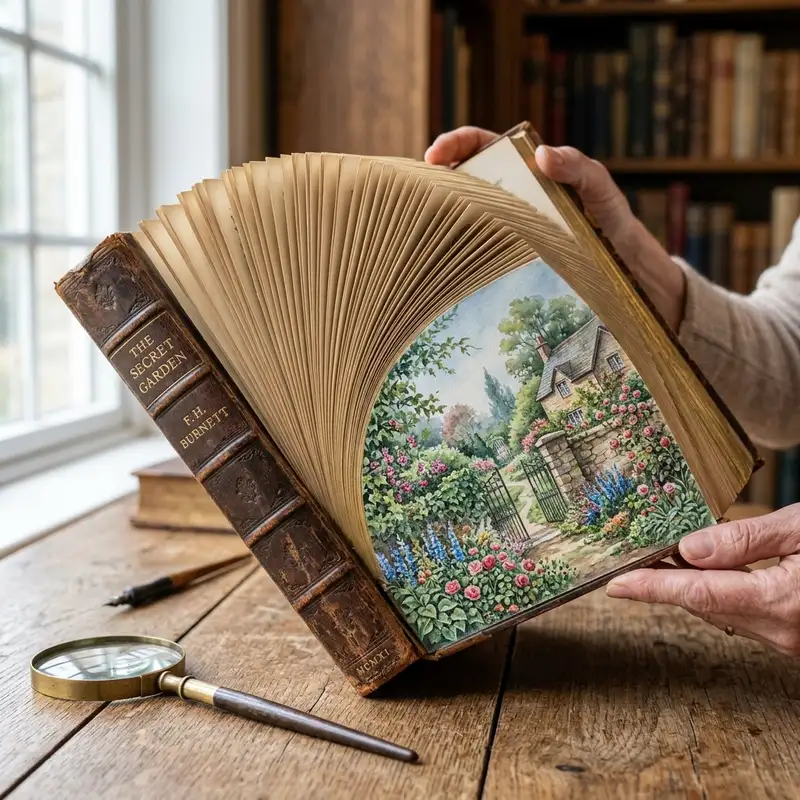
Imagine holding a book, its leather cover worn smooth by time, its pages gilded with a faint shimmer. It appears, at first glance, to be a distinguished but otherwise ordinary volume from a bygone era. You turn it over in your hands, perhaps admiring the craftsmanship, before a gentle curiosity prompts you to fan its pages. And then, it happens. As the tightly bound leaves unfurl, a world of vibrant color, intricate detail, and breathtaking artistry springs into view, a miniature landscape, a portrait, a narrative scene that was utterly invisible moments before. This is not a magic trick, nor a fleeting illusion. This is the sublime, almost clandestine art of fore-edge painting, a testament to human ingenuity and the enduring desire to embed beauty in the most unexpected places. For centuries, the edges of books have served primarily as practical surfaces – a place for titles, perhaps, or simple decorative gilding. But for a select few artisans and their discerning patrons, the fore-edge represented a canvas, a secret portal to a world of hidden imagery. It is an art form shrouded in layers, quite literally, designed to remain unseen until deliberately revealed, offering a profound sense of discovery that few other mediums can replicate. In an age dominated by instant gratification and overt displays, the subtlety and surprise inherent in fore-edge painting offer a meditative counterpoint, inviting us to slow down, to look closer, and to marvel at the depths of human creativity that lurk just beneath the surface. A Glimpse into History: Origins and Evolution The precise origins of fore-edge painting are, much like the paintings themselves, somewhat elusive, debated among bibliophiles and art historians. While rudimentary forms of decoration on book edges, such as geometric patterns or heraldic motifs, can be traced back to the 10th century, the technique of painting a hidden scene that appears only when the pages are fanned is generally believed to have emerged much later. Early examples from the 17th century point to Italy and England as potential birthplaces, though it was in 18th and 19th century England that the art truly flourished and gained widespread popularity. During the Georgian and Victorian eras, fore-edge painting became a sophisticated embellishment for fine bindings, particularly for sentimental texts, religious works, or collections of poetry. Booksellers and binders, recognizing the allure of this hidden artistry, would commission skilled miniaturist painters to adorn their most prized volumes. Initially, these paintings often depicted religious scenes, portraits of the book's owner, or allegorical figures. As the art evolved, landscapes, architectural views, naval battles, and pastoral scenes became increasingly prevalent, reflecting the romantic and picturesque tastes of the period. Artists often chose scenes relevant to the book's content or the region where it was bound, adding another layer of narrative richness to the already complex object. One of the earliest documented examples of a truly hidden fore-edge painting is found on a book from 1641, bound for Charles I. However, it was the Edwards of Halifax bindery in England, established by James Edwards in the late 18th century, that is often credited with perfecting and popularizing the art form. Their signature technique involved applying paint directly to the fanned edges, often over a base of gilt, creating a seamless integration of protection and art. The craftsmanship of these early masters set a high standard, with their works now considered highly sought-after treasures in the world of rare books.The Art of Concealment: Techniques and Materials Creating a fore-edge painting is an extraordinarily delicate and precise process, demanding not only artistic skill but also an intimate understanding of the book's physical structure. The magic lies in the illusion: the painting must disappear completely when the book is closed, leaving only the gleaming gilt or plain edge visible, and then reappear in full glory when the pages are fanned. The process typically begins with the book's edges being gilded, a protective and decorative layer of gold leaf applied to the block of pages. This gilding serves multiple purposes: it protects the paper from moisture and dust, adds a luxurious finish, and crucially, provides a pristine, uniform surface over which the painting can be concealed when the book is closed. Once the gilding is complete, the book is clamped in a special press, allowing the pages to be fanned out at a shallow, precise angle, exposing a minute sliver of each page's edge. It is on these almost microscopic surfaces that the artist begins their painstaking work. Using very fine brushes and specialized watercolors or gouache, the scene is meticulously painted, stroke by stroke, across the collective edges of hundreds of pages. Each individual stroke must be perfectly aligned across multiple pages to form a continuous image when fanned, yet simultaneously disappear into the gilt when the book is closed. This means the paint must be applied thinly and precisely, adhering only to the fanned edge without bleeding onto the face of the page. The choice of medium is critical. Watercolors and gouache are preferred for their quick drying time and ability to be applied thinly without causing the pages to stick together or warp. Oil paints would be too thick and could damage the paper or prevent the book from closing properly. After the painting is complete and thoroughly dry, a very thin, flexible sizing or varnish is often applied to protect the artwork. This final step is crucial to ensure the longevity of the delicate painting and prevent it from flaking or rubbing off with handling. The book is then released from the clamp, and as the pages settle back into their original position, the painted scene vanishes, hidden once more beneath the gilt, awaiting its next reveal.Masters and Their Brushstrokes: Notable Artists and Collections While many early fore-edge painters remain anonymous, their works are preserved in rare book collections around the world, testament to their skill. The Edwards of Halifax workshop, as mentioned, stands out as pioneers, and their influence is undeniable. Known for their neoclassical designs and pastoral scenes, their books are highly prized by collectors. Beyond specific names, the lineage of fore-edge painting can be traced through the distinct styles and recurring motifs found across centuries. In the 20th century, the tradition was revived and championed by artists like Miss C.B. Currie and Vera W. Lute. Miss Currie, active in the early to mid-20th century, created hundreds of exquisite fore-edge paintings, often signed with her initials. Her work is characterized by vibrant colors and detailed landscapes, often featuring famous landmarks or scenes from British history. Vera W. Lute, another prolific artist, continued the tradition with her delicate brushwork and imaginative compositions, ensuring the art form's survival through difficult times for traditional book arts. Today, contemporary artists continue to explore and expand the boundaries of fore-edge painting, bringing modern sensibilities to this ancient craft. While still a niche art, dedicated practitioners like Martin Frost and others are creating new works, often combining traditional techniques with contemporary themes, ensuring that this hidden art form continues to evolve and captivate new audiences. Their works can be found in private collections, specialist antiquarian bookshops, and occasionally in exhibitions dedicated to the art of the book. Major institutions like the British Library, the Library of Congress, and numerous university rare book libraries house significant collections of books adorned with fore-edge paintings, preserving these miniature masterpieces for future generations to discover. Unveiling the Narrative: Themes and Symbolism The themes chosen for fore-edge paintings are as diverse as the books they adorn, yet they often share a common thread of resonance with the primary text or the owner's interests. Landscapes were, and remain, immensely popular – tranquil rivers, rolling hills, charming village scenes, or bustling cityscapes like London and Paris. These often depicted places that held sentimental value for the book's owner or locations central to the book's narrative. Imagine a copy of Wordsworth's poetry revealing a Lakeland scene, or a history of England unveiling a panorama of Windsor Castle. Beyond landscapes, historical events, naval battles, and architectural marvels were also frequently depicted, especially in books pertaining to history or travel. Portraits, particularly of famous figures or the book's original owner, also made occasional appearances, adding a personal touch to the volume. Allegorical scenes, depicting virtues, mythological figures, or symbolic representations, offered a more intellectual layer of appreciation, requiring careful contemplation to decode their hidden meanings. The symbolism inherent in fore-edge painting is multifaceted. Firstly, there is the obvious symbolism of the hidden itself – the idea that beauty, wisdom, or truth often lies beneath the surface, waiting to be revealed by those who seek it out. It transforms the book into a metaphorical treasure chest, with a secret reward for the curious. Secondly, the choice of specific imagery often served as a personal emblem or a narrative extension. A painting of a ship on a book about voyages not only delighted the owner but also reinforced the book's theme in a unique, intimate way. In an era before mass-produced visual media, a fore-edge painting was a highly personalized and bespoke form of artistic expression, a silent conversation between the artisan, the owner, and the book's content. Beyond the Edge: The Book as a Multisensory Object Fore-edge painting compels us to reconsider the book not merely as a vessel for text, but as a holistic, multisensory object of art and craftsmanship. In an increasingly digital world, where books are often consumed as ephemeral data streams on glowing screens, the physical book’s materiality becomes ever more precious. A fore-edge painting elevates this materiality, emphasizing the tactile experience of turning pages, the visual surprise, and the intellectual delight of discovery. The weight of the cover, the scent of aged paper, the texture of the binding, and the glint of gilt edges all contribute to a rich sensory engagement. When a fore-edge painting is revealed, it adds another dimension, transforming the reading experience into a private exhibition. It reminds us that books are not just about what they contain between their covers, but also about how they are presented, preserved, and interacted with. They are objects that can carry stories not just through words, but through the very art embedded within their physical form. This fusion of literary and visual art makes fore-edge painted books particularly captivating, challenging the notion that a book's value lies solely in its textual content. Preservation and Modern Revival Like all delicate works of art, fore-edge paintings require careful preservation. Exposure to direct sunlight, fluctuations in humidity, and improper handling can cause the colors to fade, the paint to crack, or the pages to stick together. Rare book librarians and conservators employ specialized techniques to protect these treasures, often storing them in climate-controlled environments and ensuring minimal handling. The original varnish applied by the artists, though protective, can also become brittle over time, requiring sensitive conservation efforts. Despite the challenges of preservation and the labor-intensive nature of its creation, fore-edge painting is experiencing a quiet revival. A small but dedicated community of contemporary artists, binders, and collectors are actively working to keep this intricate craft alive. Workshops are offered, techniques are shared, and new commissions are undertaken. Modern interpretations often push the boundaries of traditional themes, incorporating contemporary imagery, abstract designs, or even pop culture references, ensuring the art form remains relevant and continues to surprise. This modern resurgence highlights a growing appreciation for bespoke craftsmanship and the unique charm of handmade objects in a mass-produced world. The Allure of the Unseen: Why it Still Captivates What is it about fore-edge painting that continues to hold such sway over our imagination? Perhaps it is the inherent sense of magic, the secret world that appears from nowhere. In an age of relentless transparency, there is something deeply appealing about an art that demands patience and curiosity to be fully appreciated. It offers a moment of personal revelation, a private wonder shared only with the book and its beholder. Furthermore, fore-edge painting represents the pinnacle of craftsmanship, a testament to an artist's skill, dedication, and meticulous attention to detail. It is a slow art in a fast world, a quiet rebellion against the superficial, inviting us to delve deeper, to truly observe. Each revelation of a fore-edge painting is a brief, enchanting journey into a hidden realm, a reminder that the greatest treasures often lie concealed, waiting patiently for the moment of their exquisite unveiling. It transforms the act of opening a book from a simple mechanical gesture into an act of discovery, imbued with history, artistry, and an enduring sense of wonder.#ForeEdgePainting #RareBooks #HiddenArt #BibliophileTreasures #BookHistory Related InsightsEveryday Angel Book Review and Summary Love on the Brain Book Review and Summary Gravity’s Rainbow Book Review and Summary{ "@context": "https://schema.org", "@type": "FAQPage", "mainEntity": [ { "@type": "Question", "name": "What is the main focus of The Whispering Canvas: Unveiling the Hidden Worlds of Fore-Edge Painting?", "acceptedAnswer": { "@type": "Answer", "text": "Beyond the covers lies a secret realm of art. Discover fore-edge painting, the astonishing technique that transforms book edges into breathtaking, hidden canvases." } }, { "@type": "Question", "name": "Who authored the comprehensive guide on The Whispering Canvas: Unveiling the Hidden Worlds of Fore-Edge Painting?", "acceptedAnswer": { "@type": "Answer", "text": "This detailed article and its insights were carefully researched and authored by Aylin Okur." } }, { "@type": "Question", "name": "Where can I find more related content about Books?", "acceptedAnswer": { "@type": "Answer", "text": "You can explore more articles, detailed reviews, and similar insights by browsing the Related Insights section at the bottom of this article or visiting our dedicated Books category page." } } ] }
-
 Emily Page
 - 29 Jun, 2026 13:16
The Whispers Within Pages: Unearthing the Secret Art of Fore-Edge Painting
Imagine a book, unassuming in its leather binding, perhaps a classic text or a volume of poetry. Its edges gleam with the subtle luster of gold, a testament to its age and craftsmanship. You pick it up, admiring its weighty presence, its elegant design. But then, you perform a simple, almost instinctive gesture: you fan the pages. And in that precise moment, a secret world unfurls before your eyes. A vibrant landscape, a historical scene, a delicate portrait, or an intricate allegorical tableau materializes as if by magic, shimmering into existence along the very edge that minutes ago seemed merely gilded. This, my dear reader, is the captivating, often clandestine, art of fore-edge painting. In an age saturated with digital content and fleeting trends, there remains an enduring fascination with the tangible, the handcrafted, and the hidden. Fore-edge painting, a craft whose origins whisper through centuries of bibliophilic devotion, stands as a profound testament to this allure. It is not merely a decorative technique but a profound act of concealment and revelation, transforming a humble book into a vessel for both literary narratives and secret visual artistry. This deep dive into its #history, its meticulous execution, and its enduring charm promises to unlock a forgotten chamber in the grand library of human ingenuity. The Genesis of a Gilded Secret The #journey of fore-edge painting begins not with elaborate scenes, but with humble decorative intentions. Early forms of edge decoration date back to the 10th century, primarily involving simple patterns or heraldic devices painted directly onto the closed, squared-off edges of books. These were often protected by layers of gesso and varnish, serving as identifiers of ownership or simply as embellishments. However, the true innovation – the art of painting a scene onto the fanned pages – is generally credited to the 17th century. It was in England, during the reign of Charles I, that the first examples of paintings appearing on the splayed edges of books began to emerge. These early works, though often less refined than their later counterparts, laid the groundwork for the exquisite art form we recognize today. The technique involves clamping the book slightly askew, allowing the pages to fan out subtly, creating a continuous, albeit textured, surface for the artist to work on. Once the painting is complete and dry, the pages are returned to their normal, closed position, and the edges are then gilded with gold leaf, effectively concealing the artwork. This gilding serves not only as a protective layer but also as a magical curtain, ensuring the artwork remains hidden until the book is fanned again. The initial subjects were often crests, mottoes, or floral patterns, reflecting the artistic tastes and heraldic traditions of the period. However, as the technique evolved, so did the ambition of the artists, paving the way for the intricate landscapes, portraits, and genre scenes that would define its golden age. The Golden Age: Edwards of Halifax and Beyond The 18th century witnessed the zenith of fore-edge painting, largely propelled by the innovation and entrepreneurial spirit of James Edwards (1757-1816) and his family firm in Halifax, England. The Edwards family are synonymous with the perfection and popularization of this art form. They developed a distinctive style of bookbinding, characterized by elegant, often vellum bindings, and their signature practice of commissioning exquisite fore-edge paintings. Edwards of Halifax didn't just paint edges; they created entire aesthetic experiences. Their books were coveted by the elite, becoming symbols of wealth, refinement, and a discerning taste for the unique. The subjects chosen for these hidden masterpieces often complemented the book's content. A volume of Shakespeare might reveal a scene from one of his plays; a travelogue might hide a vista from a distant land; a book on natural history might contain a vibrant botanical illustration. The connection between the internal text and the external, hidden art added another layer of intellectual and aesthetic pleasure for the owner.The skill of the artists employed by Edwards was paramount. Using delicate watercolors, they would meticulously apply paint to the minute ridges of the fanned pages, ensuring that the image seamlessly reappeared each time the book was opened correctly. The challenge was immense: each stroke had to be precise, anticipating the distortion caused by the page breaks, yet contributing to a coherent whole. The drying time between layers was critical to prevent colors from bleeding or pages from sticking. Once the painting was complete and perfectly dry, the edges would be burnished and gilded, often with elaborate tooling, rendering the hidden artwork completely invisible. While Edwards of Halifax remains the most prominent name, other binders and artists in England, #France, and later, America, adopted and adapted the technique, each adding their own stylistic nuances. The demand for these secret treasures grew, driven by a fascination with novelty, the beauty of the craft, and the intrinsic value of possessing something so uniquely personal and hidden. The Craft: An Invisible Canvas The creation of a fore-edge painting is a delicate dance between art and precision engineering. It demands not only artistic talent but also an intimate understanding of book structure and materials. The process typically begins with a tightly bound book. The binder or artist first secures the book in a press, fanning the leaves slightly to expose the working surface – the collection of minute steps formed by the individual pages. This fan must be absolutely consistent, providing an even 'canvas'. Any unevenness would result in a distorted or broken image. Using watercolors, which are ideal for their quick drying time and translucent qualities, the artist meticulously paints the chosen scene onto this textured surface. The challenge is multi-faceted:Perspective: The artist must mentally adjust for the concave curve of the fanned pages, ensuring the painting appears flat and cohesive when viewed. Continuity: Each stroke must align perfectly across the miniscule gaps between pages. Precision: The paints must be applied sparingly to avoid soaking through the pages or causing them to swell and stick together. Composition: The chosen scene must be adaptable to the narrow, elongated format provided by the fanned edge. Landscapes, cityscapes, and portraits are common, but allegorical and genre scenes also feature prominently.After the painting is completely dry – a crucial step that can take several days – the book is released from the press, and the pages return to their natural, closed position. The magic happens here: the artwork vanishes. The final step is the application of gold leaf to the closed edges. This gilding is not merely decorative; it acts as a protective shield for the delicate watercolor beneath and, most importantly, as the perfect disguise, maintaining the book's outwardly conventional appearance. Some books even feature a double fore-edge painting, where a different scene appears depending on which way the pages are fanned! Such works are incredibly rare and highly prized.Symbolism and Secrecy: Why Conceal Art? Beyond the sheer aesthetic pleasure and technical mastery, fore-edge painting embodies a profound symbolism of secrecy and personal delight. In an era where books were often ostentatious displays of wealth and knowledge, a hidden artwork added an exclusive layer of intimacy. It was art not for public display, but for the knowing few, for the discerning owner who understood the book's dual #nature. This clandestine quality often lent the books an air of mystery. Was the hidden scene a private joke, a coded message, a beloved memory, or a moral instruction intended only for the owner's contemplation? For a collector, discovering such a painting on an otherwise ordinary-looking volume is akin to finding a hidden treasure map, unlocking a secret passage in history. The choice of subjects often reflects the personal interests of the patron or the prevailing cultural sensibilities. Landscapes served as reminders of grand tours or cherished estates; portraits immortalized loved ones; classical scenes echoed a classical education; and allegories offered subtle moral or philosophical commentary. The very act of concealing these images speaks to a desire for privacy in art consumption, a private communion between the owner, the book, and the hidden image. It transforms the book from a mere object into a personal confidante, holding its secrets close. Decline, Revival, and Enduring Allure The golden age of fore-edge painting waned in the late 19th and early 20th centuries. The advent of industrial printing, mass production of books, and changing aesthetic preferences led to a decline in demand for such labor-intensive and expensive artisanal book decorations. Publishers focused on affordability and broader distribution, making elaborate hand-painted additions an uneconomical luxury. However, true artistry rarely vanishes completely. The latter half of the 20th century and the early 21st century have seen a small but dedicated revival of fore-edge painting. Contemporary artists, often members of bookbinding guilds or societies, continue to practice and innovate within this #ancient tradition. They experiment with modern subjects, vibrant color palettes, and even more intricate designs, ensuring that the legacy of this unique art form endures. These modern practitioners often seek to preserve the historical techniques while infusing the work with contemporary relevance, bridging centuries of craftsmanship. For bibliophiles and collectors today, discovering an original fore-edge painted book is a moment of profound joy. These books are not just historical artifacts; they are windows into a past where beauty was often deliberately understated, where art was meant to be discovered, not just observed. Each book with a hidden painting tells a dual story: the narrative within its pages and the secret visual tale along its edge. The allure of fore-edge painting lies in its capacity for surprise, its tangible connection to a lost art, and its embodiment of meticulous craftsmanship. It reminds us that books are more than just text; they are objects of art, craft, and history, capable of holding profound secrets within their very structure. Next time you encounter an antique book with gilded edges, take a moment. Fan its pages. You might just uncover a whisper from the past, a masterpiece patiently awaiting its moment of revelation, a testament to the enduring magic found within the unassuming realm of books.#HiddenBookArt #ForeEdgePainting #AntiqueBooks #BookCraftsmanship #SecretArt