Showing Posts From
Borana culture
-
 John Explorer
 - 18 Jun, 2026 23:45
The Echoes of Thirst: Unearthing the Ancient Hymns of Kenya's Singing Wells
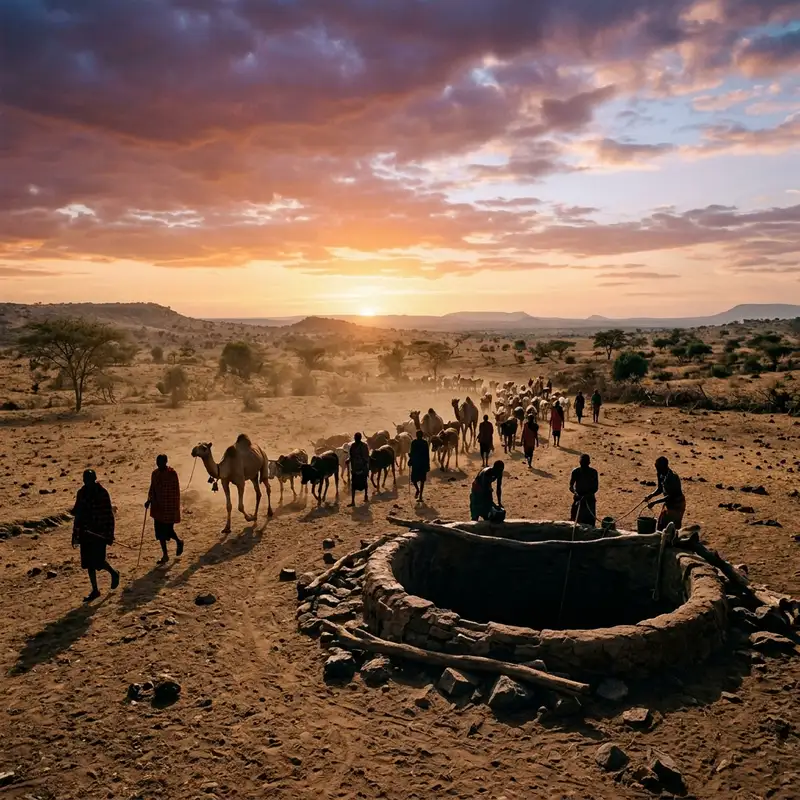
"The Echoes of Thirst: Unearthing the #ancient Hymns of Kenya's Singing Wells" It wasn't the silence that first struck me, nor the searing, omnipresent heat of the Chalbi Desert. No, it was the sound. A rhythmic, resonant hum that pulsed through the arid air, an ancient, almost primordial chorus rising from the very earth itself. It was the sound of life, painstakingly drawn, and sung into being. This was my introduction to the Singing Wells of Kenya – a place not found on any conventional tourist map, a practice woven into the fabric of a people, a testament to resilience, community, and an enduring bond with the land. My quest to find these legendary wells began not with a guidebook, but with a whisper, a footnote in an obscure anthropological text detailing a semi-nomadic community in northern Kenya. The Borana, it read, had for centuries employed an extraordinary method of extracting water from deep subterranean aquifers, a method so laborious and unique it involved intricate human chains and, most strikingly, a synchronized, melodic chant. Intrigued by the sheer poetry of the concept – water given voice – I packed my bags, determined to peel back the layers of dust and time to uncover this living cultural phenomenon. The Dust-Laden Path to a Living Legend Getting to the heart of Boranaland, in northern Kenya, is an odyssey in itself. The tarmacked roads soon give way to corrugated dirt tracks, then to mere suggestions of paths winding through a landscape that seems to stretch to infinity under an unforgiving sun. Hours turned into days, traversing a terrain dotted with acacia trees, thorny shrubs, and the occasional solitary giraffe silhouetted against a vast, cerulean sky. My Land Cruiser, groaning under the strain, kicked up plumes of ochre dust, coating everything in a fine, powdery film. This wasn't a #journey for the faint of heart, nor for those seeking creature comforts. It was a pilgrimage into the wild heart of East Africa, a testament to the isolation that has, paradoxically, helped preserve the very traditions I sought. My guide, a soft-spoken Borana man named Guyo, navigated with an innate sense of direction, his eyes scanning the horizon for signs of life, for the barely perceptible tracks of livestock. He spoke of the wells with reverence, explaining that they are not mere water sources, but sacred spaces, focal points for the community, and repositories of ancestral knowledge. The deeper we ventured, the more I understood the profound relationship between the Borana and their environment – an environment that demands ingenuity, cooperation, and an unwavering spirit to yield its most precious resource. A Symphony of Survival: Witnessing the Ritual Unfold Finally, after days of #travel, a subtle shift in the air, a faint reverberation, signaled our approach. We left the vehicle and proceeded on foot, the sound growing steadily louder, more distinct. It wasn't a song in the Western sense, not a melody with verses and choruses, but a percussive, rhythmic vocalization, a call and response that seemed to emanate from the very earth. As we rounded a cluster of thorny bushes, the scene before me arrested my breath. It was a deep, wide well, a gaping maw in the earth, perhaps 30 feet across and descending to an unknown depth. Around its perimeter stood dozens of Borana men, their lean, muscled bodies gleaming with sweat. They were arranged in a human chain, some standing on ledges carved into the well walls, others at the bottom, hip-deep in water. Each man held a leather bucket, passing it up, hand-to-hand, from the depths to the surface. And with every movement, every hoist, every transfer, came the song. A guttural, rhythmic chanting, a continuous, undulating sound that provided a vital cadence to their back-breaking labor. The song isn't arbitrary. It's a complex system of cues, a living communication network. The pitch, the rhythm, the specific chants, all convey vital information: when to hoist, when to pass, when a bucket is full, when it's empty. It's a precisely orchestrated ballet of physical exertion and vocal coordination, honed over centuries. The deeper the well, the more men are needed, the more intricate the chain, and the more complex the accompanying 'song'. It was a visceral, powerful demonstration of collective effort, a profound example of how a community can thrive in extremis. The Unspoken Language of Water and Kinship I sat for hours, mesmerized, watching the endless cycle of buckets ascending, tipping their precious cargo into troughs carved from logs, where herds of cattle, goats, and camels jostled for a drink. The animals, too, seemed to understand the rhythm, patiently waiting their turn, guided by the Borana herdsmen who maintained order with practiced ease. The air was thick with the dust of hooves, the lowing of cattle, and the insistent, hypnotic human song. It was a tableau that felt ancient, timeless, a scene that could have unfolded a thousand years ago or yesterday. My conversation with Guyo, often conducted in hushed tones so as not to disturb the ritual, helped me unravel the deeper significance. These wells, he explained, are not just about survival; they are about identity. The Borana identify strongly with their animals – their wealth, their sustenance, their very reason for being. Providing water for them is not just a chore; it is a sacred duty. The wells are clan property, passed down through generations. Each well has a specific name, a #history, a lineage. The rights to draw water are strictly governed by unwritten rules and ancient customs, ensuring equitable access and preventing conflict in a land where water means life and scarcity can mean war. He told me stories of his ancestors, of the generations of men who had dug these wells by hand, chipping away at rock, pulling out soil bucket by bucket, inch by painstaking inch. These wells are legacies, monuments to perseverance. The songs, Guyo elaborated, serve multiple purposes. They provide the rhythmic coordination essential for lifting heavy buckets over extended periods, alleviating fatigue and preventing injury. But beyond the practical, they are also prayers, blessings for the water, for the animals, for the community. They are a way of communicating not just with each other, but with the spirits of the land, acknowledging their dependence on #nature's bounty.A Shared Labour, A Shared Soul I asked Guyo if I could approach closer, perhaps even try to help. He smiled, a gesture of quiet acceptance. As I stepped towards the well's edge, the heat intensified, radiating from the earth itself. The scent of damp earth, animal, and human sweat filled my nostrils. I watched closely as one of the men at the surface deftly tipped a full leather bucket into the wooden trough, then swung the empty bucket back down, catching the next one ascending from the tier below. It was a seamless, fluid motion, born of decades of practice. Joining the human chain was an experience both humbling and physically demanding. Even just for a few rotations at the surface, catching and passing the surprisingly heavy, water-filled leather buckets, the sheer effort was palpable. My untrained hands fumbled at first, but the men around me, with gentle nudges and encouraging murmurs, guided my movements. The rhythm of the song permeated my very being, transforming the arduous task into something almost meditative. I felt a connection, not just to the men beside me, but to the generations who had performed this same ritual, their voices echoing through time. It was an honour, a fleeting immersion in a tradition so profound, so vital. Echoes of History and the Face of Modernity The Singing Wells are estimated to be several hundred years old, perhaps even more, their origins lost in the mists of time. They represent an ingenious adaptation to an extremely challenging environment. In a region prone to severe droughts, these deep wells have been the lifeline for the Borana and their livestock, providing a reliable water source when seasonal rivers dry up and shallow ponds evaporate. However, these ancient wells, and the traditional way of life they support, face modern challenges. Climate change exacerbates drought conditions, placing even greater strain on water resources. The advent of modern boreholes, while providing easier access to water, also poses a threat to the traditional social structures and communal responsibility fostered by the Singing Wells. There's a delicate balance to be struck between progress and preservation. Guyo expressed hope that the younger generation would continue to value and maintain these wells, recognizing their cultural and historical significance beyond their mere utility. He spoke of the 'gadaa' system, the traditional Borana socio-political system that governs everything from land use to generational leadership. The wells are intrinsically linked to this system, representing a collective resource managed for the common good. To abandon the wells would be to sever a vital artery of their #culture, a piece of their very soul. The Lingering Hum of Humanity As the sun began its slow, fiery descent, painting the sky in hues of orange and purple, the activity at the well gradually wound down. The herds, satiated, began their slow journey back to their temporary enclosures. The singing softened, became more reflective, a lullaby to the setting sun. I felt a profound sense of privilege, having witnessed something so raw, so authentic, so deeply human. The Singing Wells are more than just a method of drawing water. They are a living testament to human ingenuity, community spirit, and an unbreakable bond with nature. They are a school of cooperation, a library of ancestral knowledge, and a symphony of survival. In a world increasingly fragmented and reliant on technology, the Borana's Singing Wells stand as a powerful reminder of what can be achieved when people work together, in harmony with their environment, sustained by tradition and the echoes of their own voices. Leaving Boranaland, the rhythmic chant of the wells lingered in my ears, a haunting melody that transcended language. It wasn't just the sound of water being drawn, but the sound of history, of resilience, of a culture singing its way through the centuries. It was a song that promised life, echoing across the vast, silent expanse of the desert, a profound and unforgettable symphony of survival. #Kenya #SingingWells #BoranaCulture #HiddenGems #AfricanTraditions Related InsightsGobeklitepe: The First Temple The Magic of Mont Saint-Michel: Normandy's Floating Abbey Beyond the Silk Road: Unveiling China's Epic Tea Horse Road – Your Definitive Guide to a Lost World{ "@context": "https://schema.org", "@type": "FAQPage", "mainEntity": [ { "@type": "Question", "name": "What is the main focus of The Echoes of Thirst: Unearthing the Ancient Hymns of Kenya's Singing Wells?", "acceptedAnswer": { "@type": "Answer", "text": "Journey deep into Northern Kenya to discover the Borana people's ancient Singing Wells, a profound testament to community, survival, and the enduring power of tradition." } }, { "@type": "Question", "name": "Who authored the comprehensive guide on The Echoes of Thirst: Unearthing the Ancient Hymns of Kenya's Singing Wells?", "acceptedAnswer": { "@type": "Answer", "text": "This detailed article and its insights were carefully researched and authored by John Explorer." } }, { "@type": "Question", "name": "Where can I find more related content about Travel?", "acceptedAnswer": { "@type": "Answer", "text": "You can explore more articles, detailed reviews, and similar insights by browsing the Related Insights section at the bottom of this article or visiting our dedicated Travel category page." } } ] }