Showing Posts From
Bulgaria
-
 John Explorer
 - 13 Jun, 2026 08:45
The Silent Architects of Stone: Unearthing the Last Weavers of Kladenets in Bulgaria's Mystical Rhodopes
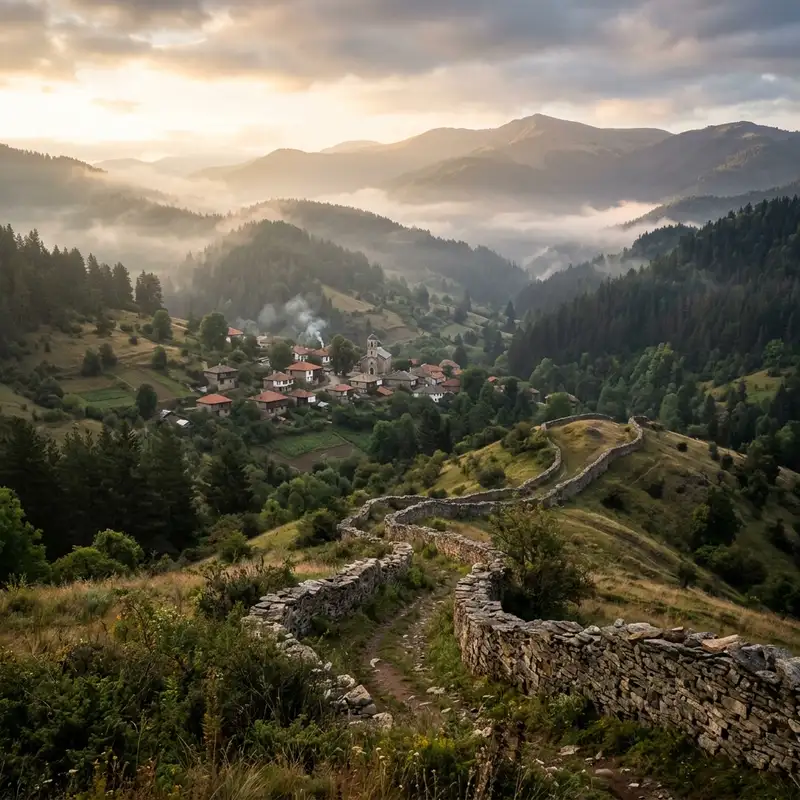
The first time I saw it, it was a ghost. A whisper on the horizon, a silhouette against the bruised purple of a Balkan sunset. It wasn't a castle, nor a natural rock formation, but something in between – an impossible geometry of stone, rising from the rugged spine of the Rhodope Mountains in Bulgaria. It looked like a wave frozen mid-crest, or perhaps a giant's ribcage, intricate and defiant. It shouldn't have been there, not like that. Not without mortar, without modern tools, without a hint of its origins in any map or guide I possessed. That fleeting glimpse ignited an obsession, a relentless pursuit of a truth that felt #ancient, almost mythical. My usual travels lead me off the beaten path, but this felt different. This wasn't merely 'off the path'; it was off the map, off the radar, a fragment of #history clinging to life in the shadow of a forgotten mountain range. For months, that image haunted my periphery, a stone riddle I couldn't solve. I scoured academic papers, obscure archaeological forums, regional folklore collections. My search led me down rabbit holes of Thracian megaliths, Roman fortifications, Ottoman bridges – but nothing resonated with the organic, almost sentient quality of that structure. It felt crafted by hands that understood stone not as inert matter, but as a living canvas. Then, a tiny, almost throwaway line in a decades-old ethnographical journal caught my eye: a brief mention of a unique dry-stone masonry technique, referred to colloquially as 'stone weaving,' practiced by a handful of families in the deep, isolated valleys of the Western Rhodopes. The village name was a barely legible scribble: Kladenets. A place so small, it seemed to exist solely in the fading memory of a bygone era. And that, I knew, was where my #journey had to begin. The Unseen Path to Kladenets The Rhodopes are a formidable beast. Unlike the jagged, dramatic peaks of the Alps or the Dolomites, these mountains possess a more ancient, brooding grandeur. Their slopes are rounded by millennia, cloaked in dense pine forests that whisper secrets in the wind. Deep gorges cut through the landscape, rivers roar through narrow defiles, and isolated hamlets cling to impossible ledges, each a world unto itself. Getting to Kladenets was less a journey and more an expedition into a forgotten time. Paved roads quickly gave way to gravel, then to rutted dirt tracks, passable only by a sturdy 4x4. My phone signal vanished hours before I even glimpsed the first signs of human habitation. Days blurred into a montage of winding mountain roads, the scent of wild herbs and damp earth, the occasional sighting of a lone shepherd or a family of wild boar. The few locals I encountered spoke a dialect thick with ancient inflections, their eyes holding the quiet wisdom of generations who have lived in harmony with – and at the mercy of – these mountains. When I asked about Kladenets, their responses were cautious, a mix of curiosity and a deep-seated protectiveness. "A long way," some would say, or "Only the old ones stay there now." Their words only deepened my resolve. Finally, after what felt like an eternity of hairpin bends and breathtaking vistas, the track opened onto a high plateau. Below, nestled in a bowl-shaped valley, lay Kladenets. It wasn't picturesque in the conventional sense. There were no brightly painted houses or manicured gardens. Instead, buildings of rough-hewn stone, their roofs adorned with heavy slate tiles, seemed to melt into the landscape, almost indistinguishable from the rock faces around them. Smoke curled lazily from a few chimneys, a testament to the village's enduring life. The silence was profound, broken only by the chirping of crickets and the distant murmur of a mountain stream. The Language of Stones: An Introduction to 'Stone Weaving' My arrival was met with quiet observation rather than fanfare. Children peeked from behind heavy wooden doors, their elders regarded me with an unhurried, assessing gaze. It was only after a bowl of steaming lentil soup and a glass of fiery rakia, offered by an elderly woman named Elena, that the ice truly began to break. Her eyes, the colour of deep forest moss, held a gentle curiosity. When I showed her a crude sketch of the structure I had seen – the ghost on the horizon – a flicker of recognition passed over her face. "Ah," she murmured, her voice like rustling leaves, "The Sentinel's Cairn. Yordan built it. His family, before him." Elena explained that 'stone weaving' wasn't just a building technique; it was a philosophy, a spiritual practice passed down through their lineage. It involved selecting stones not just for their size or shape, but for their inherent 'character.' Each stone, they believed, possessed a spirit, a memory, a story. The weaver's task was to listen to these stories, to understand how each stone wanted to lie, where it wanted to rest, how it wanted to interlock with its neighbours. There was no mortar, no binding agent other than gravity, friction, and an almost preternatural understanding of balance and stress distribution. "The mountain gives us the stones," Elena explained, gesturing towards the rugged slopes that embraced the village. "We do not fight the stone; we dance with it. We find its partner. We make it sing." This wasn't engineering; it was poetry in three dimensions, a silent dialogue between human hands and ancient earth. It became clear that the extraordinary structures I had glimpsed were not anomalies, but the pinnacle of a widespread, albeit deeply localized, tradition. Yordan: The Last Maestro Yordan was a man carved from the very mountains he served. His face was a roadmap of wrinkles, each one telling a story of sun, wind, and countless hours spent wrestling with stone. His hands, gnarled and powerful, moved with a surprising delicacy as he demonstrated the rudiments of his craft. He didn't use chisels often, preferring to 'read' the natural fractures and cleavage planes of the rock, splitting it with wedges and hammers only when absolutely necessary. His primary tools were his eyes, his intuition, and a small, heavy mallet. He showed me how to 'dress' a stone, not by carving it into submission, but by gently coaxing it, removing only the minimum necessary to allow it to fit perfectly within the growing wall. The secret, he revealed, was in creating a labyrinth of internal connections – each stone not just resting on another, but locking into it, embracing it, forming an unbreakable chain. "The stronger the embrace," Yordan rasped, his voice rough as granite, "the longer the song endures." He spoke of creating internal 'lungs' within the wall, allowing it to breathe with the mountain, to expand and contract with the seasons, to resist the mighty forces of wind and frost.I spent days watching Yordan work, mesmerized. He moved with a slow, deliberate grace, often pausing, head tilted, as if in silent communion with the stones scattered around him. He spoke of the ancestors who had perfected this art, of structures that had stood for centuries, testament to their profound understanding. He spoke of how the 'weavers' were once the most respected figures in the community, responsible for everything from field enclosures to defensive walls, from bridges to sacred markers. Now, he was one of the last. The Sentinel's Cairn: A Masterpiece of Endurance Finally, the day came when Yordan led me to the Sentinel's Cairn. It was even more magnificent up close. Tucked into a high saddle between two peaks, it was a colossal dry-stone structure, a series of interlocking, undulating walls that seemed to grow organically from the earth itself. It was not a single, monolithic object, but a collection of interconnected segments, each flowing into the next, forming a formidable, yet elegant, barrier against the elements. Its exact purpose was lost to time, but the lore held that it served multiple functions. It was a windbreak, protecting ancient animal trails and travellers. It was a territorial marker, defining the sacred boundaries of the Kladenets community. And most fascinatingly, it was believed to have an astronomical function. Yordan pointed out specific alignments where, on certain solstices and equinoxes, the rising sun would cast shadows through perfectly formed apertures, illuminating specific internal chambers or marking distant peaks. It was a giant, silent calendar, a timeless observatory built by hands that understood the cosmos as intimately as they understood the earth. The scale was astounding. It would have taken generations to build, each generation adding their 'voice' to the stone symphony. Standing beside it, I felt a profound sense of humility, a realization of the ephemeral #nature of human life contrasted with the enduring power of creation born from deep connection to the land. It wasn't just a wall; it was a monument to resilience, to ingenuity, to a way of life that honored the material world as sacred. The Echoes of a Dying Art But this magnificent legacy was also a poignant reminder of its fragility. Yordan's children had left Kladenets years ago, drawn by the promise of education and opportunities in the cities. The young people who remained saw stone weaving as back-breaking labour, a relic of the past with no place in the modern world. Why spend weeks carefully fitting stones when concrete and steel offered faster, easier solutions? The spiritual connection, the profound understanding of material, was being lost to convenience and expediency. "The stones still sing," Yordan mused, his gaze fixed on the ancient Cairn, "but fewer and fewer listen." His words carried the weight of a vanishing world. The knowledge embedded in his weathered hands, the intuitive wisdom passed down through centuries, was on the precipice of extinction. It was a slow, quiet cultural erosion, far from the dramatic clashes of civilizations, but no less tragic. My time in Kladenets was a profound lesson in the value of the 'unseen.' In a world saturated with information, where every landmark is cataloged and every experience curated, places like Kladenets, and practices like stone weaving, offer a vital counter-narrative. They remind us that true richness often lies not in what is loudly advertised, but in what whispers from the edges, in the quiet enduring traditions that defy commercialization and mass appeal. Leaving Kladenets, I carried not just memories, but a deep sense of responsibility. Not to 'save' it, for such interventions often do more harm than good, but to bear witness. To share the story of Yordan and the silent architects, to acknowledge the profound beauty and wisdom embedded in their unassuming craft. To perhaps inspire someone, somewhere, to seek out their own 'ghost on the horizon,' to listen to the silent songs of forgotten places, and to appreciate the profound value of traditions that teach us how to dance with the earth, rather than merely conquer it. The Rhodopes will continue to guard their secrets, but for a brief, precious moment, I was allowed a glimpse behind the veil. The Sentinel's Cairn still stands, a testament to enduring human spirit and the unbreakable bond between man and stone. And somewhere, deep in those ancient mountains, I know Yordan continues his quiet work, weaving the earth's memory into enduring song, one stone at a time. #RhodopeMountains #StoneWeaving #HiddenBulgaria #AncientCrafts #CulturalPreservation #Bulgaria #RhodopeMountains #AncientCrafts #HiddenGems #CulturalPreservation Related InsightsAngkor Wat: Il Cuore Cosmico di Pietra, Tra Devozione e Mistero nel Regno Khmer Australien: Wo die Ewigkeit des Outbacks auf den Puls der Moderne trifft The Ruins of Troy{ "@context": "https://schema.org", "@type": "FAQPage", "mainEntity": [ { "@type": "Question", "name": "What is the main focus of The Silent Architects of Stone: Unearthing the Last Weavers of Kladenets in Bulgaria's Mystical Rhodopes?", "acceptedAnswer": { "@type": "Answer", "text": "Deep in Bulgaria's forgotten Rhodope Mountains, an ancient, almost mystical tradition of 'stone weaving' endures, guarded by its last silent architects. Join me on an investigative journey to uncover a craft that defies time and engineering." } }, { "@type": "Question", "name": "Who authored the comprehensive guide on The Silent Architects of Stone: Unearthing the Last Weavers of Kladenets in Bulgaria's Mystical Rhodopes?", "acceptedAnswer": { "@type": "Answer", "text": "This detailed article and its insights were carefully researched and authored by John Explorer." } }, { "@type": "Question", "name": "Where can I find more related content about Travel?", "acceptedAnswer": { "@type": "Answer", "text": "You can explore more articles, detailed reviews, and similar insights by browsing the Related Insights section at the bottom of this article or visiting our dedicated Travel category page." } } ] }