Showing Posts From
Carpathianmountains
-
 John Explorer
 - 04 Jun, 2026 22:15
The Whispers of the White Gold: Tracing the Carpathian Salt Scribes of Maramureș
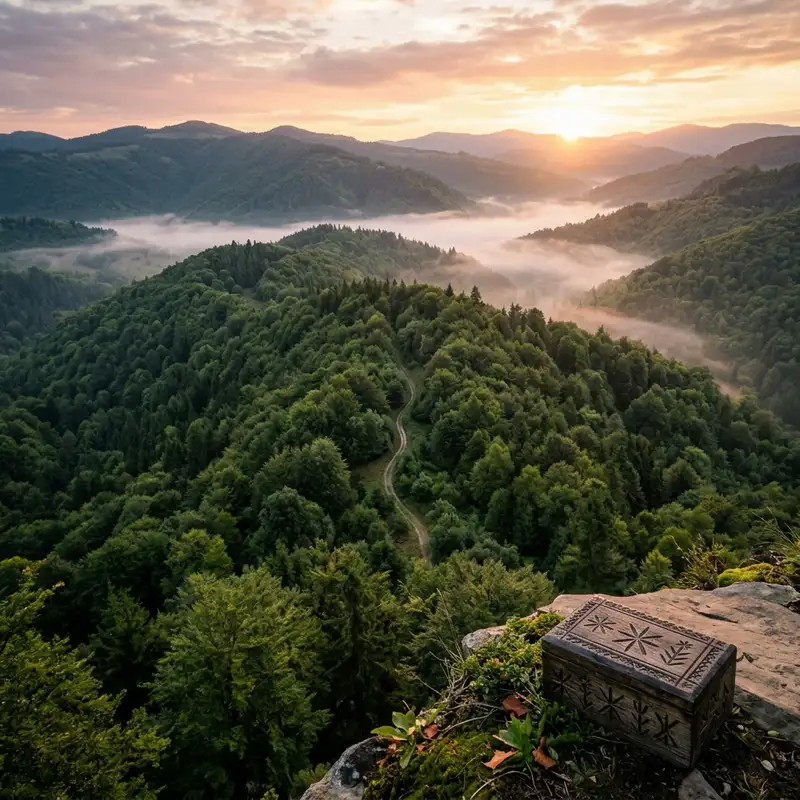
The small, unassuming wooden box lay nestled amongst tarnished silver and forgotten porcelain in a dimly lit antique stall in Vienna. Its dark, aged timber felt smooth under my fingertips, its surface incised with patterns that seemed more rune than decoration. Inside, not jewels, but an array of oddly shaped salt crystals, each one distinct, like miniature sculptures carved by the wind and the sea, yet clearly bearing the mark of a human hand. Beneath them, a scrap of brittle parchment, its faded ink outlining a single, repeated phrase in a language I vaguely recognized as an #ancient dialect of Romanian: "Sarea Vorbește. Scribes of the White Gold." The Salt Speaks. This wasn't a casual find; it was a siren call, a fractured whisper from a past deeply intertwined with one of humanity's most primal treasures. Salt. More than just a condiment, it was once currency, preservative, spiritual cleanser, and the very foundation of empires. But "Scribes of the White Gold"? The term ignited a spark of intense curiosity that quickly consumed my travel-worn soul. My life as John Explorer has led me down countless forgotten paths, but this phrase, this box, pointed towards an enigma far more profound than mere trade routes or abandoned mines. It hinted at a secret society, a lineage of keepers whose purpose was to listen to the Earth's crystalline heart. My compass, metaphorically speaking, swiveled wildly, pointing not to a known landmark, but to a vast, green emptiness on the map: the rugged, heavily forested folds of the Carpathian Mountains, specifically the remote Maramureș region, straddling the modern-day border of Romania and Ukraine. This was where the salt spoke, and where, I was determined, I would learn its language. The Unseen Map: From Cryptic Inscription to Carpathian Foothills My initial delve into #history books and online archives proved frustratingly sparse. "Salt Scribes" yielded no immediate results. The vast libraries offered ample information on the historical importance of salt in Eastern Europe, the Roman and Daco-Roman salt mines, the infamous "salt roads" that crisscrossed the continent, and the economic power wielded by those who controlled its flow. But the specific cultural lineage, the mystical connotation of "scribes" dedicated to it, remained elusive. It felt like searching for a specific constellation when only the milky way was visible. It was only through a deep dive into obscure ethnographical journals from the early 20th century, dusty academic papers published by forgotten Romanian folklorists, and ultimately, a hand-drawn map tucked into a digitized collection of Carpathian regional studies, that the contours of my quest began to sharpen. The map, depicting a section of the Northern Carpathians, showed not just towns and rivers, but faint, dotted lines labeled "Drumul Sarii Vechi" – the Old Salt Road – alongside curious symbols that resembled the carvings on my wooden box. One particular section, snaking through an especially isolated valley near the Ukrainian border, was marked with a symbol that looked uncannily like a stylized salt crystal, accompanied by the archaic phrase: "Locul Undes Sarea Povestește" – The Place Where the Salt Tells Stories. The Maramureș region is already a land steeped in legend, famed for its towering wooden churches, elaborately carved gates, and a way of life that feels profoundly untouched by modernity. But my quest wasn't for its well-trodden cultural gems. It was for something deeper, something interwoven into the very bedrock of its existence, beneath the soil, within the veins of "white gold" that had shaped its destiny for millennia. I packed my worn hiking boots, a sturdy camera, and a notebook already filled with more questions than answers, the weight of the salt box in my backpack a constant, resonant reminder of my purpose. Beyond the Wooden Churches: A Descent into Maramureș's Crystalline Heart The #journey into Maramureș is a passage into another temporal dimension. The paved roads eventually give way to gravel, then to ancient tracks barely wide enough for my rented 4x4. The air shifts, growing crisp with the scent of pine and damp earth. Wooden houses, dark with age and adorned with intricate carvings, dot the landscape, their smoke curling lazily into the vast sky. Farmers in traditional garb still work fields with horses, and the rhythm of life slows to a pulse dictated by the sun and seasons. My first few days were spent in the larger (relatively speaking) villages, trying to subtly inquire about "salt stories" or "scribes." I met with suspicion, polite bewilderment, and sometimes, a hint of superstitious discomfort. The phrase "Sarea Vorbește" was occasionally recognized, but usually dismissed as an old wives' tale, a metaphor for the preciousness of salt. It became clear that if the Salt Scribes existed, their legacy was either long forgotten or guarded with an intensity that bordered on secrecy. Then, by pure chance, in a remote hamlet named Bârsana, known for its stunning monastery, I stumbled upon a small, ramshackle museum dedicated to local crafts. Among faded textiles and rudimentary farming tools, I saw it: a similar wooden box, albeit larger and more ornate, with identical carved symbols. An elderly woman, the museum's curator and likely its only regular visitor, sat knitting in a corner. Her name was Doamna Elena. I showed her my box, and her eyes, initially clouded with age, sharpened with a glimmer of recognition. She didn't speak English, and my Romanian, while functional, was strained by the dialect. But with a blend of gestures and broken phrases, a story began to unfold. Doamna Elena explained that the symbols were indeed "semne de sare" – salt signs. She spoke of her grandmother, who had told tales of "oameni ai sării" – people of the salt – who didn't just mine it, but "understood" it. They were said to possess a unique connection to the earth, able to discern the "mood" of the salt veins, predict collapses, and even read prophecies in the patterns of crystalline formations. They were guardians, healers, and, yes, scribes – not of paper, but of wood, stone, and the very salt itself. She called them Sararii, a term that felt ancient and sacred. These weren't miners in the modern sense; they were custodians of a profound, almost spiritual heritage. The Deep Vein: Salt's Ancient Grip on the Carpathians The history of salt in the Carpathian Basin is a saga of power, survival, and deep cultural reverence. For millennia, before currency was standardized, blocks of salt were literally "white gold," traded across vast distances. The Romans exploited the rich salt deposits of Dacia, their legions securing the mines not just for sustenance but as a strategic resource. Later, medieval Hungarian and later Austro-Hungarian empires fiercely controlled the Maramureș salt mines, understanding their immense economic and military value. Whole towns sprang up around salt operations, and specific routes, like the "Drumul Sarii," were meticulously maintained, guarded, and taxed. But beyond the economic and political, there was always a spiritual dimension. Salt was a powerful protector against evil, used in blessings, funeral rites, and agricultural fertility rituals. It symbolized purity and permanence. It was said to draw out illness, ward off curses, and bind agreements. Doamna Elena, through her halting stories and the translation of a helpful young student, spoke of "blesteme de sare" – salt curses. These weren't malevolent spells, but rather ancient vows or warnings etched into salt crystals and hidden within the mines, meant to protect the veins from greed and over-extraction. Only the Sararii, with their understanding of the salt's language, could interpret and, if necessary, appease them. The Sararii, she explained, were a closed community, a guild whose knowledge was passed down through generations. They weren't just skilled craftsmen; they were observers of the land, interpreters of natural signs, and creators of a unique symbolic language expressed through carved wood, stone, and solidified salt. Their "writing" wasn't alphabetic, but glyphic, abstract representations of natural forces, cosmic events, and the internal structure of the salt itself. They were responsible for maintaining the balance between human need and the earth's bounty, ensuring the "salt spirit" was respected. With the advent of industrial mining in the 19th and 20th centuries, their role diminished, their secrets pushed into the shadows, deemed superstitious relics by the march of progress. The Fading Trail: In Search of the "Salt Sanctuary" Doamna Elena pointed me towards a deeply isolated valley, higher in the mountains, almost at the border, where she believed the last vestiges of the Sararii might still cling to existence. "There are old paths," she said, tapping the faded map I carried, "paths only they know. And a place, deep in the earth, where the salt still sings." Armed with her cryptic directions and the ancient map, I embarked on the final, most challenging leg of my journey. The "Drumul Sarii Vechi" here was no more than a deer trail, overgrown and barely discernible. It wound through ancient beech forests, across rushing mountain streams, and along precipitous slopes. The silence was profound, broken only by the rustling leaves, the distant cry of a hawk, and the rhythmic crunch of my boots. I found faint markers on old trees, sometimes a curious notch, other times a small, weathered wooden carving that echoed the symbols on my box. These were the Sararii's wayfinders, invisible to the uninitiated. After several days of arduous trekking, guided by these subtle cues and the magnetic pull of the unknown, I reached a narrow gorge. The air grew cooler, carrying a distinct mineral tang. A small, almost invisible path veered off into a cleft in the rock face, leading downwards into the earth. This wasn't a mine entrance, but something more natural, a deep fissure widened by ancient water flow and, perhaps, human hands. The darkness inside was absolute, broken only by the beam of my headlamp. The walls were wet, glistening with crystalline deposits, and the air was thick with the scent of raw earth and salt. It was here, in the heart of the mountain, that I found it. Not a grand #temple, but a series of interconnected chambers, their walls smoothed and shaped not by explosion or pickaxe, but by careful, patient carving. And everywhere, the salt. Not uniform white, but streaked with ochre, grey, and subtle pinks, glowing faintly in my light. The very rock seemed to breathe. On a particularly smooth section of a wall, I saw them: the glyphs. Etched directly into the salt and stone, these weren't simple marks, but intricate, almost fluid patterns. Spirals, interlocking geometric shapes, stylized representations of sun, moon, and water, all intertwined with variations of the salt crystal symbol I knew so well. This was The Place Where the Salt Tells Stories. This was a Salt Sanctuary.The silence in the sanctuary was unlike any I had ever experienced. It wasn't just an absence of sound, but a profound stillness that seemed to absorb all external noise, leaving only the faint, internal hum of the earth itself. It was a space designed for contemplation, for deep listening. The glyphs weren't static images; they felt alive, imbued with centuries of intent and reverence. I spent hours there, tracing their forms with my fingers, feeling the cool, rough texture of the salt, trying to decipher their silent language. They spoke of the cycle of seasons, the flow of underground rivers, the unseen energies that governed the world. They were prayers, historical records, and warnings, all encapsulated in crystalline form. As I was about to leave, my light caught a small, almost hidden alcove. Inside, arranged meticulously, were several carved wooden implements, small chisels, brushes made of animal hair, and a shallow stone basin filled with salt crystals of various sizes and hues. And nestled amongst them, a small, worn leather-bound book. Its pages were filled not with text, but with precise drawings of the glyphs, accompanied by detailed, hand-written annotations in archaic Romanian, painstakingly explaining their meanings and uses. It was a Sararii’s ledger, a codex of "white gold." It confirmed everything: the Sararii were real, and this was their legacy. The Living Echo: A Glimpse of the Last Keeper Emerging from the sanctuary, blinking in the late afternoon sun, I felt a deep sense of accomplishment, yet also a bittersweet melancholy. Had I merely documented a ghost, a lost art preserved only in stone and parchment? The answer came, quietly, unexpectedly, at a small, isolated cabin I passed on my descent. Smoke curled from its chimney, and the faint sound of rhythmic tapping emanated from within. Hesitantly, I approached. An old man, his face a roadmap of mountain winds and sun, sat hunched over a workbench, meticulously carving a piece of wood. Next to him, a block of rock salt, and several tools identical to those I had found in the sanctuary. He wore a simple, homespun tunic, and his hands, though gnarled with age, moved with a surprising dexterity and precision. He looked up as I approached, his eyes, the colour of deep mountain lakes, holding a knowing calm. His name was Ion. He was, he explained slowly, in a resonant, gravelly voice, a descendant of the Sararii. The last one, he believed. His family had tended the sanctuary for generations, keeping the traditions alive, though in ever-diminishing ways. He spoke of the salt not as a commodity, but as a living entity, a conduit to the earth's memory. He showed me how he crafted the wooden boxes, each one designed to hold specific salt crystals imbued with different properties – for healing, for protection, for foresight. He demonstrated the art of "reading" the internal structures of salt crystals, pointing out minute fissures and colorations that, to him, told stories of geological epochs and unseen energies. He even etched a small, delicate glyph onto a piece of polished salt for me, a symbol of journey and discovery, a silent blessing for my path. His craft wasn't just about carving; it was about connecting. He spoke of listening to the mountains, feeling the subtle shifts in the earth, and understanding the rhythm of the salt veins. His voice carried the weight of generations, a quiet strength that transcended language barriers. The Sararii, he clarified, were not just scribes of salt, but scribes to salt, dedicated to translating its ancient wisdom for humanity, to ensure balance was maintained. Their decline was not just the loss of a craft, but the silencing of a vital dialogue between humanity and the earth. The Legacy of the White Gold Leaving Ion and the quiet majesty of the Maramureș mountains, I carried more than just my photographs and notes. I carried a profound sense of privilege, a connection to a deeply hidden stratum of human #culture. The Sararii of Maramureș are more than a historical footnote; they represent a philosophy, a way of understanding our relationship with the natural world that has largely been forgotten in our rush towards modernity. They are a testament to the fact that true wealth often lies not in what we extract, but in what we understand and respect. Their story is a potent reminder of the myriad unseen layers that underpin seemingly familiar landscapes. Beneath the iconic wooden churches and vibrant folk traditions of Maramureș lies this crystalline heart, beating with the echoes of ancient scribes who listened to the earth and carved its whispers into white gold. The journey was arduous, the discoveries profound, and the encounter with Ion, the last Sararii, a humbling testament to the enduring power of human tradition. As John Explorer, my mission has always been to uncover the stories that the world often overlooks. And in the forgotten valleys of the Carpathians, I found one of the most resonant. The salt, indeed, still speaks, if only we learn how to listen. #CarpathianHiddenGems #MaramuresTraditions #SaltScribesHistory #LostCultureRomania #AncientSaltTrails