Showing Posts From
Cheshire crossing
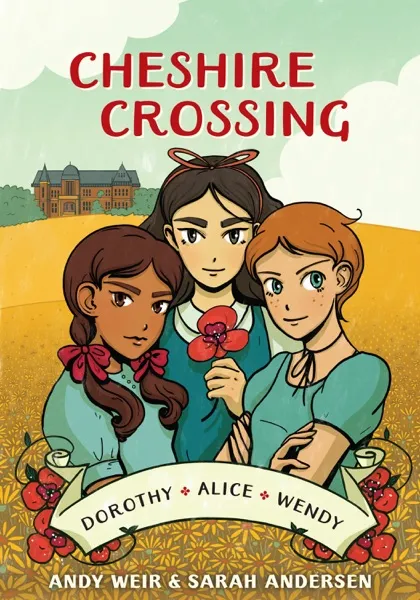
Cheshire Crossing Author: Andy WeirPage Count: UnknownPublication Year: 2019-GB Cheshire Crossing is Andy Weir’s delightful, genre-defying romp through the worlds of classic children’s literature, where imagination collides with science and the impossible becomes the inevitable. At its core, this graphic novel—yes, Weir’s first graphic novel—explores the collision of childhood wonder and adult cynicism, the blurred line between fantasy and reality, and the quiet, enduring power of belief. It’s a story about not outgrowing wonder, but rather learning how to wield it responsibly. The plot follows Beth, a young girl who has been institutionalized multiple times after claiming to have visited the worlds of Alice in Wonderland and Peter Pan. Doctors label her delusional; her mother, desperate but skeptical, seeks a cure. Enter Dr. Robert Wilson, a pioneering neuroscientist who believes Beth’s claims might be rooted in something real—perhaps undiscovered dimensions or glimpses into parallel realities. As he probes her mind with cutting-edge (and ethically questionable) technology, Beth’s adventures in Wonderland and Neverland begin to bleed into the real world, threatening to unravel the fabric of both. Weir, best known for The Martian and Project Hail Mary, once again demonstrates his knack for blending hard science with gripping storytelling. But here, he strips away the physics and the orbital mechanics, replacing them with something far more whimsical: the science of the subconscious. Dr. Wilson’s experiments aren’t about calculating trajectories or survival ratios—they’re about mapping the imagination, quantifying the intangible, and daring to ask: What if the mind isn’t just a receiver of reality, but a gatekeeper to other worlds? This shift in focus allows Weir to indulge in the kind of playful, literary alchemy that made classic children’s stories so enduring. Cheshire Crossing isn’t just a crossover—it’s a convergence. Alice’s riddles, Peter’s eternal youth, and Beth’s own fractured psyche weave together into a narrative that feels both nostalgic and fresh. Weir respects the source material without being bound by it, reimagining Wonderland not as a dream but as a dimension with its own rules, its own dangers, and its own dark truths. One of the book’s most compelling themes is the cost of growing up. All three protagonists—Beth, Alice, and Wendy—are on the cusp of adolescence, caught between the boundless creativity of childhood and the rigid expectations of adulthood. Alice, now a teenager, is tired of being a child and longs for control. Wendy, older and more world-weary, sees Neverland as a retreat from responsibility. Beth, meanwhile, refuses to let go of the magic entirely. Weir frames their journeys not as escapes, but as necessary evolutions—each must confront the limitations of their own imaginations before they can find a place in the real world. Weir’s writing style in Cheshire Crossing is deft and understated, trading the technical jargon of The Martian for sharp, concise dialogue and vivid, often surreal imagery. The graphic novel format allows him to lean into visual storytelling, and the artwork—by Sarah Andersen of Sarah’s Scribbles fame—captures the whimsy and unease of crossing between worlds. The contrasts are striking: the sterile white of the asylum against the vibrant chaos of Wonderland; Beth’s wide, hopeful eyes framed by Dr. Wilson’s calculating stare. It’s a visual language that underscores the central tension—reason versus wonder, control versus chaos. What makes Cheshire Crossing so resonant is its empathy. Weir never mocks his characters for their beliefs, even when their beliefs defy logic. Instead, he suggests that there’s a kernel of truth in every delusion—if only we’re brave enough to look for it. The story asks us to consider: Is wonder a flaw to be corrected, or a gift to be cultivated? And in a world that often prizes skepticism over awe, that question feels both urgent and deeply human. At its heart, Cheshire Crossing is a love letter to those who refuse to let go of magic, even when the world insists it’s time to grow up. It’s a reminder that sometimes, the most scientific minds are the ones who dare to believe in the impossible—and that the most profound discoveries begin with a single, stubborn question: What if? For readers who grew up on these stories, it’s a thrilling revisit. For those encountering them for the first time, it’s an invitation to never stop asking questions. And for all of us, it’s a gentle nudge to hold onto wonder, even as the world tries to teach us otherwise. #CheshireCrossing #AndyWeir #AliceInWonderland #PeterPan #GraphicNovel #FantasyMeetsScience Related InsightsWizard's First Rule Book Review and Summary American Hagwon Book Review and Summary Circe Book Review and Summary{ "@context": "https://schema.org", "@type": "FAQPage", "mainEntity": [ { "@type": "Question", "name": "What is the main focus of Cheshire Crossing Book Review and Summary?", "acceptedAnswer": { "@type": "Answer", "text": "Everything you need to know about Cheshire Crossing with our detailed review." } }, { "@type": "Question", "name": "Who authored the comprehensive guide on Cheshire Crossing Book Review and Summary?", "acceptedAnswer": { "@type": "Answer", "text": "This detailed article and its insights were carefully researched and authored by Natalia Sokolova." } }, { "@type": "Question", "name": "Where can I find more related content about Books?", "acceptedAnswer": { "@type": "Answer", "text": "You can explore more articles, detailed reviews, and similar insights by browsing the Related Insights section at the bottom of this article or visiting our dedicated Books category page." } } ] }