Showing Posts From
Democracy in a hotte
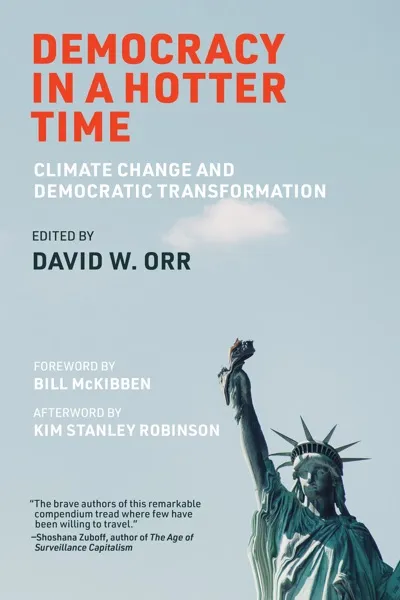

Democracy in a Hotter Time Author: David W. OrrPage Count: UnknownPublication Year: 2023-GB David W. Orr’s Democracy in a Hotter Time arrives at a moment when the word “democracy” feels both overused and underdelivered—a hollowed-out ideal murmuring from election posters while the planet roasts outside the polling booth. Published in 2023, this sweeping critique doesn’t just lament the crisis of governance in an age of climate collapse; it reimagines democracy itself as an organism that must evolve or die. Orr, a veteran environmental thinker and former Oberlin College professor, wields a prose style that is at once lyrical and urgent, blending philosophy with policy, poetry with prognostication. The result is less a manual than a manifesto—one that challenges readers not just to vote, but to rethink what it means to belong to a living democracy in a world burning hotter by the season. At the core of Orr’s argument lies a provocative inversion: democracy, he insists, is not a political system but a biological condition. It thrives only when citizens recognize their entanglement with the ecosystems that sustain them. “We are not separate from the Earth,” Orr writes, “we are Earth itself, momentarily self-aware.” From this premise, he dismantles the modern myth of progress—especially the idea that technological innovation alone can outpace ecological breakdown. Democracy in a Hotter Time is not anti-technology, but it is deeply anti-hubris. Orr critiques the Enlightenment assumption that reason alone can master nature, and instead champions a “re-enchanted” politics—one that restores reverence for the more-than-human world. This is not new age sentimentality; it’s a survival strategy. Orr’s style is deceptively gentle. He avoids the apocalyptic screaming common in climate discourse, opting instead for a measured, almost pastoral cadence that feels paradoxically comforting in its clarity. He writes of “the long now” of ecological time—centuries, not election cycles—and urges readers to cultivate what he calls “slow democracy,” a politics built on patience, place, and participation. This is not the democracy of cable news and Twitter storms, but of town meetings, soil stewardship, and intergenerational memory. His prose often resembles that of a wise elder narrating a cautionary tale over a crackling fire: measured, wise, and quietly devastating in its implications. Yet beneath the calm surface, Orr’s critique is radical. He questions the very foundations of liberal democracy—its individualism, its extractive economics, its addiction to growth. He asks whether representative democracy, as currently constituted, can ever respond adequately to a crisis that demands collective restraint, sacrifice, and long-term thinking. His answer is a resounding no—unless we redefine both governance and the governed. Orr champions “ecological constitutionalism,” where environmental limits are legally embedded in governance, not treated as externalities. He envisions a society where civic virtue includes ecological literacy, where voting is secondary to participation in local land trusts, community energy projects, and regenerative agriculture. The book’s most striking chapter, “The Politics of Grief,” is also its most quietly revolutionary. Orr doesn’t shy from acknowledging the emotional toll of climate collapse—the rage, the despair, the guilt. But he frames grief not as a paralyzing force, but as a catalyst for deeper democracy. “To mourn is to remember what we love,” he writes. “And to remember is to act.” This section alone could reframe climate activism from a moral duty into a spiritual practice—a way of honoring life in the face of its undoing. Orr’s influence is evident in his prose. He draws on Thoreau, Wendell Berry, and Joanna Macy without ever feeling derivative. His sentences are often compact, almost aphoristic—“Democracy is oxygen for the soul, but only if the soul is alive to the air.” Yet his arguments are expansive, weaving together climate science, political theory, and indigenous wisdom. He cites the Māori concept of kaitiakitanga (guardianship) and the African philosophical tradition of ubuntu (“I am because we are”) not as exotic flourishes, but as living models of relational governance. What makes Democracy in a Hotter Time so compelling is its refusal to offer easy solutions. Orr doesn’t propose a new political party or a climate policy checklist. Instead, he invites readers into a deeper conversation: What does it mean to be a citizen when the Earth itself is under siege? How do we cultivate democracy not as a mechanism, but as a practice of care? These are not questions with answers, but with commitments. And in a time when cynicism and despair are often the default responses to ecological collapse, Orr’s book is a rare and necessary antidote. It is, in the end, a love letter to democracy—not the one we inherited, but the one we might still become. It is tender, tough, and unflinching. And if the planet is to cool, our politics must first catch fire with meaning. #DemocracyInAHotterTime #ClimateDemocracy #EcologicalConstitutionalism #ClimateJusticeNow #ReEnchantedPolitics #LongNowDemocracy Related InsightsIt's a Prince Thing (the Princess Rules) Book Review and Summary Clarity Book Review and Summary Bad Honeymoon Book Review and Summary{ "@context": "https://schema.org", "@type": "FAQPage", "mainEntity": [ { "@type": "Question", "name": "What is the main focus of Democracy in a Hotter Time Book Review and Summary?", "acceptedAnswer": { "@type": "Answer", "text": "Everything you need to know about Democracy in a Hotter Time with our detailed review." } }, { "@type": "Question", "name": "Who authored the comprehensive guide on Democracy in a Hotter Time Book Review and Summary?", "acceptedAnswer": { "@type": "Answer", "text": "This detailed article and its insights were carefully researched and authored by Anna Kowalska." } }, { "@type": "Question", "name": "Where can I find more related content about Books?", "acceptedAnswer": { "@type": "Answer", "text": "You can explore more articles, detailed reviews, and similar insights by browsing the Related Insights section at the bottom of this article or visiting our dedicated Books category page." } } ] }