Showing Posts From
Eyes of the void
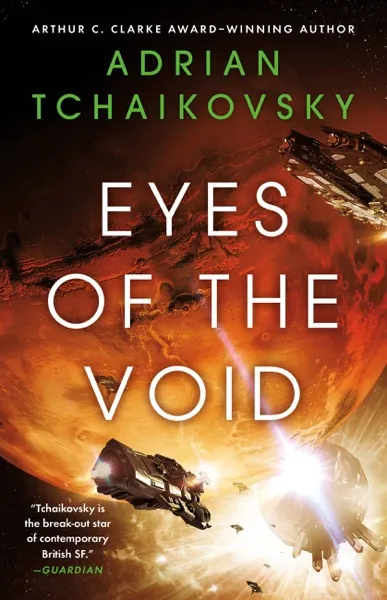

Eyes of the Void Author: Adrian TchaikovskyPage Count: UnknownPublication Year: 2022-GB Eyes of the Void is the second instalment in Adrian Tchaikovsky’s sprawling space opera series The Final Architecture, and it confirms what his fans already know: Tchaikovsky is a master of high-concept science fiction who can make the cosmic feel intimate and the alien deeply human. Where the first book, Children of Time, dazzled with its multi-millennial narrative and evolutionary storytelling, Eyes of the Void sharpens the focus, zooming in on the psychological and moral consequences of contact between species that are not just different, but fundamentally incomprehensible. This is not a story about first contact; it’s a story about the terror and wonder of failed contact—of staring into the abyss and wondering if the abyss is staring back. Central to the book is the theme of perception. Tchaikovsky forces us to question what it means to witness, to understand, and to communicate when the very frameworks of reality differ. The novel follows multiple strands: human colonists on a doomed world, an ancient machine intelligence awakening to a universe it no longer recognizes, and the enigmatic Architects—beings of such alien geometry that their very presence warps space and time. The human characters, particularly Dr. Avrana Kern (the AI fragment of a long-dead scientist) and her reluctant host, the void-touched Captain Holsten Mason, grapple with the idea that they may not be the observers they think they are. Are they studying the Architects, or is the Architects’ gaze the one that matters? Tchaikovsky flips the script on the classic "humans vs. the universe" trope, suggesting that humanity’s greatest threat isn’t exploitation or conquest, but irrelevance—a chilling thought in an era where our species is obsessed with leaving a mark on the cosmos. The author’s style is deceptively simple, yet layered with complexity. Tchaikovsky’s prose is clean and unadorned, but that’s a deliberate choice to mirror the clinical detachment of his characters—scientists, engineers, and explorers who treat the impossible as routine. His real strength lies in his ability to weave vast, philosophical ideas into the fabric of his narrative without ever losing sight of the human (or post-human) heart of the story. There’s a moment early in the book where a character reflects on the "terror of symmetry"—the idea that some truths might only be accessible to minds that operate on principles we can’t comprehend. It’s a brilliant distillation of the novel’s core tension: the void isn’t just empty space; it’s a mirror that reflects our own limitations. Tchaikovsky’s worldbuilding is another standout feature. The Final Architecture series is set in a universe where civilizations rise and fall not through war or plague, but through the slow, inevitable decay of meaning. The Architects, for instance, are not villains in the traditional sense; they are custodians of a dying cosmic order, and their actions—however incomprehensible—may be driven by a sense of duty as much as by malice. This ambiguity is what makes Eyes of the Void so compelling. The book doesn’t just ask what we would do if we encountered the unknowable; it asks whether we’d even recognize it when we saw it. Would we mistake their silence for hostility? Their indifference for aggression? The answers are left tantalizingly unresolved. One of the most striking aspects of Tchaikovsky’s approach is his use of time. Eyes of the Void spans centuries, yet it never feels sprawling or indulgent. Instead, the passage of time is a tool to explore how different species—and even different iterations of the same consciousness—adapt (or fail to adapt) to change. The human colonists, for example, are forced into hibernation for generations, only to wake into a world that has moved on without them. It’s a poignant metaphor for the human condition itself: we’re always playing catch-up, always trying to make sense of a reality that has already reshaped itself around us. Tchaikovsky also excels at creating a sense of creeping dread. The void isn’t just a setting; it’s a character—a silent, watchful presence that looms over every page. The book’s title is a clue to its central metaphor: eyes imply vision, but the void suggests absence. What are we seeing when we look into the void? Ourselves? Nothing at all? The tension between these possibilities is what drives the story forward. And yet, despite the existential weight of its themes, Eyes of the Void never loses its emotional core. The relationships between characters—whether human, AI, or something in between—are deeply felt, and their struggles to connect in a universe that seems designed to keep them apart are heartbreakingly relatable. In many ways, Eyes of the Void is a meditation on the hubris of intelligence. It asks whether understanding is even possible when the universe’s architecture is built on principles we can’t grasp. Tchaikovsky doesn’t offer easy answers, but he does offer something rarer: a story that leaves you staring into the dark, wondering what you might have missed—and whether that missing piece was ever meant for you to see. #EyesOfTheVoid #AdrianTchaikovsky #SciFi #SpaceOpera #FinalArchitecture #CosmicHorror Related InsightsAmerican Heroes Book Review and Summary The Magical Cheese Emporium (Spellshop, #4) Book Review and Summary Rule of Wolves/King of Scars Book Review and Summary{ "@context": "https://schema.org", "@type": "FAQPage", "mainEntity": [ { "@type": "Question", "name": "What is the main focus of Eyes of the Void Book Review and Summary?", "acceptedAnswer": { "@type": "Answer", "text": "Everything you need to know about Eyes of the Void with our detailed review." } }, { "@type": "Question", "name": "Who authored the comprehensive guide on Eyes of the Void Book Review and Summary?", "acceptedAnswer": { "@type": "Answer", "text": "This detailed article and its insights were carefully researched and authored by Michael Brown." } }, { "@type": "Question", "name": "Where can I find more related content about Books?", "acceptedAnswer": { "@type": "Answer", "text": "You can explore more articles, detailed reviews, and similar insights by browsing the Related Insights section at the bottom of this article or visiting our dedicated Books category page." } } ] }