Showing Posts From
Ladakh
-
 John Explorer
 - 24 Jun, 2026 14:45
The Aetherial Threads: Unearthing Ladakh's Forgotten Sky Roads of the Monastics
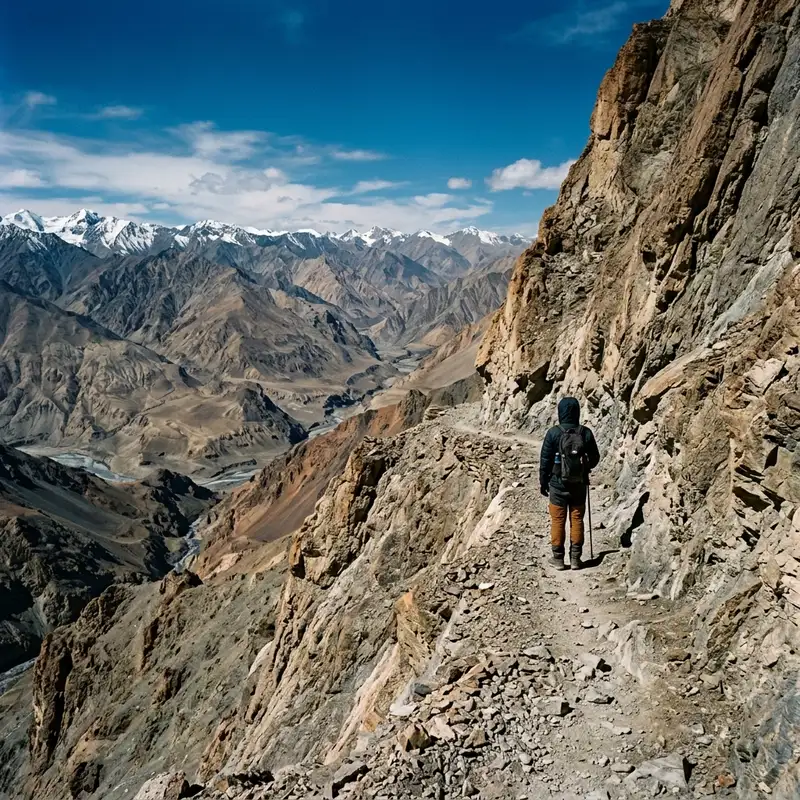
The air, thin and sharp like a perfectly honed blade, sliced through my lungs with each desperate gasp. My vision blurred at the periphery, a dizzying dance of sapphire sky and ochre rock. There was no path here, not in the conventional sense. Only an instinct, a faint whisper from a centuries-old story, guiding my frostbitten boots across scree slopes that seemed to dissolve underfoot. This wasn’t a hike; it was an act of faith, a pursuit of ghosts along routes whispered about only by the oldest Lamas, an investigative #journey into the very soul of the Himalayas. I was searching for Ladakh’s invisible Sky Roads, #ancient monastic trails that exist more in legend than on any map. A Whisper from the High Peaks: The Genesis of a Quest My fascination began innocently enough, buried within the brittle pages of an obscure 19th-century British survey report. Amidst detailed topographic measurements and colonial observations of local customs, a single, intriguing footnote caught my eye. It alluded to "aerial paths"—high-altitude routes supposedly used by early Buddhist monks to connect isolated meditation caves and nascent gompas (monasteries) long before established villages or trade routes even existed. These were not the well-trodden pilgrim paths of today, nor even the challenging passes known to modern trekkers. These were something else entirely: routes predicated on absolute solitude, spiritual endurance, and an intimate knowledge of a landscape that actively sought to repel human presence. The report dismissed them as local myth, perhaps exaggerations of strenuous journeys. But for me, that dismissal was the spark. The idea clung to me like the mountain mist, morphing from a mere academic curiosity into an obsession. I spent years after that initial encounter poring over ancient Tibetan texts, consulting with revered Lamas in more accessible monasteries, and cross-referencing fragmented oral histories. What emerged was a mosaic of clues: references to "the paths of the sky-wanderers," "the threads of the dakinis," and tales of monks who would disappear for months, only to reappear, transformed, from directions where no man could possibly have traveled. These were not just physical trails; they were spiritual arteries, conduits for enlightenment, carved by generations of ascetics pushing the boundaries of human endurance and faith. They represented a form of pilgrimage so profound, so utterly detached from worldly concerns, that they had faded from collective memory, leaving only spectral echoes in the thin air. Into the Labyrinth of Stone and Spirit: Initial Preparations and First Steps The logistics of tracing routes that practically don't exist were, to put it mildly, daunting. Forget GPS; these paths predated written language in many instances, marked perhaps by nothing more than a carefully placed cairn long since toppled, or an unusually shaped rock noted only by a monastic mind honed by years of meditation. My preparation involved not just physical conditioning for extreme altitudes and treacherous terrain, but also a deep dive into the local dialects of Ladakhi and archaic Tibetan, hoping to unearth forgotten place names or subtle directional cues hidden within old chants. I traveled with minimal gear, a skilled local guide named Tenzin whose family had lived in these valleys for generations and possessed an intuitive understanding of the land, and a deep-seated humility. The mountains here permit no arrogance. Our journey began in a village so remote it scarcely warranted a dot on any map, a place where the nearest motorable road was a three-day walk away. From there, we ascended. The first few days were a blur of rising altitude, the landscape morphing from arid scrubland to vast, desolate plateaus, then into a realm of jagged, snow-capped peaks. The oxygen thinned relentlessly, each step a conscious effort. We followed faint animal tracks, crossed glacial streams that numbed the feet to the bone, and navigated sheer rock faces where handholds were precarious and footholds scarce. Tenzin, usually stoic, often paused, his gaze sweeping the vast expanse, searching for a sign that only he could interpret – a particular shade of lichen, a subtle change in the rock's stratification, a feeling in the wind. These were not roads for the casual adventurer; they were pathways for the truly dedicated, or the utterly desperate. The Footprints of Saints: Decoding the Ancient Paths The physical manifestation of a "Sky Road" was never a uniform trail. Sometimes it was a narrow ledge clinging precariously to a cliff face, barely wide enough for one foot. Other times, it was a series of small, strategic cairns (ovoos in Tibetan) built millennia ago, now half-buried by erosion. Most often, it was simply an imagined line across a vast, unmarked expanse of boulders and ice, visible only to an eye trained by generations of ancestral knowledge, or perhaps, a spiritual intuition. We found ancient rock carvings, faint and weathered, depicting symbols that hinted at directional markers or protective deities. A single, stylized stupa etched into a granite slab would signify a particularly dangerous passage, or a point of profound spiritual significance. One evening, huddled in a makeshift shelter against a raging snowstorm, Tenzin recounted a tale passed down through his family: of a legendary Lama who, seeking ultimate enlightenment, walked for seven years across these sky roads, never once descending below 5,000 meters. He ate only what he found, meditated in glacial caves, and communicated with the spirits of the mountains. His path, Tenzin explained, was not just about reaching a destination but about the journey itself becoming the meditation, each arduous step an offering, each breath a prayer. These Sky Roads, therefore, were less about navigation and more about transformation. They were tests, purifications, designed to strip away all worldly attachments and force an encounter with the raw, untamed self and the divine. Sanctuaries in the Sky: Unveiling the Hidden Gompas After what felt like an eternity of climbing, pushing, and doubting, we stumbled upon the first concrete evidence of our quest's validity. High above a valley that had seemed utterly devoid of human life, nestled into a natural rock overhang, was a small, perfectly preserved cave monastery. Its entrance was so artfully concealed by natural rock formations that one could pass within meters of it without ever knowing of its existence. This was not a gompa built on an accessible hill; it was an extension of the mountain itself, a part of its silent, ancient heart. Inside, the air was still and cold, yet imbued with an unmistakable warmth, a spiritual resonance that felt tangible. Ancient murals, vibrant despite the passage of centuries, adorned the rock walls, depicting scenes from the life of Buddha and tantric deities. A small, meticulously carved wooden altar held a handful of offerings – dried juniper branches, a few grains of rice, items left by a devotee perhaps decades, even centuries, ago. A single, dust-covered thangka, its colours faded but its message clear, depicted a contemplative Bodhisattva. It was clear this place had not seen regular human traffic for an age. The silence here was profound, a living entity that hummed with the echoes of countless meditations.The most striking discovery, however, was in a tiny, almost hidden alcove: a collection of manuscripts, meticulously handwritten on brittle birch bark and parchment. These were not canonical texts, but personal journals and spiritual commentaries by the monks who had lived and meditated here. They detailed not only their profound spiritual insights but also the challenges of their existence: the scarcity of food, the brutal winters, the deep solitude, and the constant awareness of their proximity to the divine. One passage, translated painstakingly by Tenzin, spoke of the Sky Roads as "the pathways to the inner self, where each stone is a lesson and each gust of wind a mantra." It confirmed everything I had suspected: these were more than just trails; they were active instruments of spiritual practice. Life at the Edge of the Breathable World: Encounters and Reflections Our journey continued, leading us to several more such hidden sanctuaries, each one a testament to an unimaginable devotion. In one, nestled so high that the clouds often swirled below us, we found a lone hermit. He was ancient, his face a roadmap of wrinkles carved by sun and wind, his eyes clear and serene as the glacial lakes. He spoke little, but his presence was a lesson in itself. He had lived there, he told us through Tenzin, for over forty years, sustained by a tiny patch of hardy greens, what he gathered from the mountains, and the spiritual nourishment of his practice. He was, in essence, a living embodiment of the Sky Roads' purpose. His daily routine was an unbroken cycle of meditation, prayer, and the meticulous maintenance of his tiny, self-sufficient world. He spoke of the mountains as his teachers, the wind as his companion, and the stars as his eternal guides. He knew the Sky Roads not as mere lines on a landscape, but as extensions of his own spiritual journey, paths that connected him not just to other hidden gompas, but to the very essence of existence. Our encounter was brief, yet deeply transformative. It solidified my understanding that these routes were not merely historical relics; they were living traditions, kept alive by the few, the truly dedicated, who chose a life beyond the veil of the mundane. The profound solitude of these altitudes forces an introspection unlike any other. Stripped of all distractions, with the vastness of the cosmos above and the monumental silence of the mountains around, one is left with only oneself. The physical discomfort, the fear of the unknown, the exhaustion – all melt away, replaced by a clarity of thought, a heightened awareness. I began to understand the draw of these Sky Roads for the ancient monks: they were not just escape routes, but pathways to confrontation – with oneself, with #nature, and ultimately, with the divine. The Echoes of Silence: The Deeper Meaning of the Sky Roads The cultural practice embedded within these Sky Roads is a unique form of pilgrimage. Unlike many pilgrimages that lead to specific, revered sites, these routes themselves were the primary spiritual undertaking. The journey was the devotion. Each arduous climb, each perilous traverse, each moment spent battling the elements, was a meditation, a ritual of purification. The goal was not merely to arrive at a sacred destination, but to undergo a transformation en route. This practice speaks volumes about the early forms of Tibetan Buddhism in Ladakh – a raw, untamed spirituality that sought truth not in grand temples, but in the elemental forces of nature, in the profound silence of the high peaks, and in the relentless testing of the physical and spiritual self. The monks who forged and traversed these paths were not just ascetics; they were pioneers of the spirit, mapping out an inner landscape as vast and challenging as the mountains they inhabited. Their practices, though extreme, highlight a universal human yearning for meaning, for transcendence, and for a deeper connection to something beyond the everyday. Preserving the Invisible: A Call for Mindful Exploration Returning from the Sky Roads was like waking from a profound dream. The vibrant colours of the modern world seemed almost garish after the muted, sublime palette of the high Himalayas. The cacophony of human activity felt jarring after weeks of absolute silence. My physical journey had ended, but the internal one had just begun. These Sky Roads, truly invisible gems of human endeavor and spiritual dedication, are fragile. They are not tourist attractions; they are sacred arteries. While the urge to explore and understand such profound historical and cultural practices is strong, their very existence depends on their continued obscurity, or at least, on extremely mindful engagement. There's a delicate balance between shedding light on these forgotten wonders and inadvertently paving the way for their degradation. My hope in sharing this account is not to create a new trekking fad, but to foster an appreciation for a form of spiritual pursuit that pushed the absolute limits of human experience. Perhaps some things are meant to remain partially hidden, to exist as whispers on the wind, accessible only to those who seek them with the purest of intentions. The true value of the Sky Roads lies not in their discovery by the masses, but in the profound philosophical lessons they offer about human resilience, faith, and the enduring quest for meaning in the most desolate yet breathtaking corners of our world. The Descent and the Lingering Resonance As Tenzin and I descended, the oxygen gradually thickening, the vastness of the valleys unfolding beneath us, I felt a sense of profound gratitude and a quiet awe. The mountains had revealed a secret, not just of physical routes, but of a way of life, a spiritual tradition that continues to defy the modern world. The Sky Roads are not just lines on a map that never was; they are lines etched into the collective spiritual consciousness of a people, faint but indelible. They reminded me that the greatest journeys are often not to the most famous landmarks, but to the unseen, unheard places where the human spirit truly soars, even at the edge of the breathable world. The thin air, the biting cold, the relentless climb – these were merely the physical manifestations of a deeper ascent. An ascent into #history, into spirituality, and into the very heart of what it means to be truly alive and connected to something ancient and profound. The Sky Roads of Ladakh, for me, will forever be the most silent, yet the most eloquent, testament to the enduring human spirit. #LadakhHiddenGems #HimalayanSpirituality #AncientMonasticTrails #ForgottenPilgrimage #HighAltitudeCulture Related InsightsSardinian Nuraghe Trails: Mapping the Bronze Age Megalithic Landscapes The Arctic's Whispering Skies: Your Ultimate Guide to Unlocking Scandinavia's Northern Lights Mystique 紫禁城:明清两代的皇家心脏{ "@context": "https://schema.org", "@type": "FAQPage", "mainEntity": [ { "@type": "Question", "name": "What is the main focus of The Aetherial Threads: Unearthing Ladakh's Forgotten Sky Roads of the Monastics?", "acceptedAnswer": { "@type": "Answer", "text": "Beyond the known passes of Ladakh lie the 'Sky Roads'—invisible ancient trails connecting forgotten high-altitude monasteries, a spiritual quest woven into the very fabric of the Himalayas." } }, { "@type": "Question", "name": "Who authored the comprehensive guide on The Aetherial Threads: Unearthing Ladakh's Forgotten Sky Roads of the Monastics?", "acceptedAnswer": { "@type": "Answer", "text": "This detailed article and its insights were carefully researched and authored by John Explorer." } }, { "@type": "Question", "name": "Where can I find more related content about Travel?", "acceptedAnswer": { "@type": "Answer", "text": "You can explore more articles, detailed reviews, and similar insights by browsing the Related Insights section at the bottom of this article or visiting our dedicated Travel category page." } } ] }