Showing Posts From
London1666
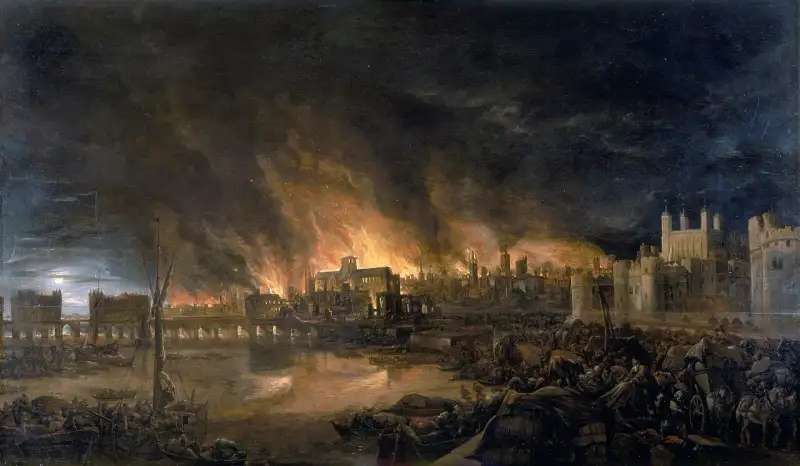

The Great Fire of London (1666): An Empire Reborn from Ashes The night of September 2, 1666, was unseasonably warm, the air thick with the dust of a long, dry summer. London, a sprawling medieval labyrinth of timber and pitch, slept under a starless sky. It was a city teetering on the precipice of ruin, though its denizens, nestled in their tightly packed beds, knew nothing of the impending doom. They were merchants and beggars, lords and cutpurses, all breathing the same stale air of a metropolis that had outgrown its ancient skin. This is the story of #London1666, a tale not just of destruction, but of the dramatic rebirth of an empire. As a historical author, I, Mark Dinn, have often wandered the modern streets of London, tracing the invisible scars left by that momentous event. To understand the Great Fire is to understand the very soul of the city—a soul forged in the crucible of a disaster so complete, it beggars belief. Let us travel back to that fateful night, stepping over the open sewers and winding our way down the narrow, claustrophobic alleys toward a modest bakery on Pudding Lane. #HistoricalFiction #MarkDinn #LondonHistory The Spark: A Baker's Oversight It began with a spark. Or perhaps an ember, overlooked in the weary exhaustion that follows a hard day's labor. Thomas Farriner, the King's baker on Pudding Lane, had drawn his ovens for the night. He was a man of some standing, providing hardtack and biscuits for the Royal Navy, a vital cog in the machinery of the burgeoning British Empire. Farriner claimed, to his dying day, that the ovens were properly extinguished. Yet, history tells a different, far more devastating tale. Sometime shortly after midnight, the latent heat found a stray bit of fuel. A piece of wood, a discarded rag, a pile of dry faggots stacked too close to the hearth. The first flames were tentative, licking at the dry timber of the bakery floor, tasting the ancient oak that formed the bones of Farriner's home. In the dead of night, the fire grew bold. It consumed the bakery with a ravenous hunger, the flames roaring up the wooden staircase, trapping Farriner, his daughter, and a maidservant on the upper floors. They escaped by clambering out of a high window, a desperate leap over the alleyway to a neighbor's roof. The maidservant, paralyzed by terror, refused to make the jump. She became the fire's first victim, a tragic footnote in the grand, terrifying ledger of the Great Fire. #PuddingLane #17thCentury The Tinderbox City To comprehend how a single bakery fire could consume a metropolis, we must understand the London of 1666. It was not the city of stone and concrete we know today. It was a medieval relic, a chaotic jumble of half-timbered houses, many of them jettisoned—meaning their upper stories leaned out over the streets, nearly touching the houses on the opposite side. Timber and Pitch: The primary building materials were oak and pitch, highly flammable substances that turned every home into a potential torch. A Drought of Biblical Proportions: The summer of 1666 had been exceptionally long and hot. A severe drought had baked the city bone-dry. The wooden frames of the houses were brittle, desperate for moisture. The Gale from the East: On the night of September 2, a strong, unyielding wind blew in from the east. It acted as a bellows, driving the flames forward with ferocious speed. Combustible Warehouses: The fire quickly reached Thames Street, a bustling thoroughfare lined with warehouses packed with the highly combustible lifeblood of the empire: tallow, oil, pitch, tar, hemp, and spirits.London was a tinderbox, waiting for a spark. And Thomas Farriner had unwittingly provided it. #AncientHistory #UrbanHistory The Inferno Awakens By Sunday morning, the fire had broken the bounds of Pudding Lane and was advancing toward the River Thames. The inhabitants of the area, accustomed to minor fires in the crowded city, initially viewed the blaze with mild concern. But as the sun rose, painting the sky a sickly, unnatural orange, the true scale of the disaster began to dawn on them. The flames hit the warehouses on Thames Street, and the fire transformed from a localized tragedy into an apocalyptic beast. Barrels of tar exploded like cannons. Rivers of burning oil flowed into the Thames, turning the water itself into a sheet of fire. The noise was deafening—a continuous, roaring bellow punctuated by the sharp crack of exploding timber and the terrified screams of the fleeing populace. I can imagine the scene: the frantic scrambling to salvage worldly possessions. Carts piled high with furniture, tapestries, and gold coins, rumbling over the cobblestones. The wealthy hired boats to carry their goods across the river to safety, driving the price of a short ferry ride to extortionate heights. The poor, with nothing but the clothes on their backs, fled on foot, a tide of desperate humanity pouring out of the city gates. #GreatFireOfLondon #HistoryNerd The Mayor's Folly In the face of such a crisis, leadership is paramount. Unfortunately for London, the Lord Mayor in 1666 was Sir Thomas Bloodworth, a man whose historical reputation is defined by a single, catastrophic failure of nerve. When Bloodworth was first roused from his bed and brought to view the fire early on Sunday morning, he was profoundly unimpressed. History has recorded his immortal, deeply regrettable words: "Pish! A woman might piss it out!" This breathtaking underestimation of the danger delayed the crucial early response. The traditional method of fighting fires in 1666 was to pull down houses in the path of the flames to create a firebreak. This required the Mayor's authority, but Bloodworth, fearing the cost of compensating the homeowners, hesitated. He wrung his hands while the city burned, his indecision costing London dearly. By the time he finally gave the order to pull down houses, it was too late. The fire had grown too large, too fast, easily leaping across the pathetic gaps created by the desperate citizens. #LeadershipFail #HistoricalFigures The King and the Duke: Royalty in the Ashes As Sunday bled into Monday, the fire became an uncontrollable monster, consuming everything in its path. The news reached Whitehall Palace, where King Charles II held court. Charles, the "Merry Monarch," was known for his hedonistic lifestyle, but in this moment of supreme crisis, he and his brother, James, Duke of York, stepped into the void left by Bloodworth's incompetence. King Charles realized that the city was in mortal peril. He bypassed the paralyzing bureaucracy of the city's government and put James in charge of the firefighting efforts. The Duke of York was a military man, and he approached the fire as he would a besieging army. He established command posts around the perimeter of the fire, drafting local men and soldiers into bucket chains and demolition crews. James rode up and down the lines, covered in soot, handing out gold coins to encourage the exhausted firefighters. The image of the royal princes, their faces blackened with ash, fighting side-by-side with common laborers, is one of the most enduring and dramatic tableaus of the Great Fire. #KingCharlesII #BritishMonarchy #RoyalHistory Desperation and Destruction: The Black Powder Solution Despite the heroic efforts of the Duke of York and his men, the fire continued its relentless march westward, driven by the howling eastern gale. It consumed the Royal Exchange, the financial heart of the empire. It swallowed the Guildhall, the center of civic governance. The heat was so intense that the lead roofs of the churches melted, pouring down the gargoyles and running through the streets in silvery, lethal streams. The conventional methods of pulling down houses with fire hooks were agonizingly slow and dangerously ineffective against the sheer ferocity of the blaze. Desperate times called for desperate measures. The King gave the order: bring in the gunpowder. The Navy was summoned, bringing barrels of black powder from the Tower of London. They began systematically blowing up houses in the path of the fire, creating massive, devastating firebreaks. The explosions shook the earth, adding to the apocalyptic atmosphere, but it was the only way to starve the beast of its fuel. The cost was immense, the destruction of property staggering, but the strategy slowly began to turn the tide. #NavalHistory #FirefightingHistory The Diarists: Pepys and Evelyn No account of the Great Fire would be complete without invoking the names of the two men who gave us our most vivid, visceral, and horrifyingly detailed accounts of the disaster: Samuel Pepys and John Evelyn. These two gentlemen, prominent figures in 17th-century London, recorded the unfolding apocalypse in their private diaries, providing future generations with an unparalleled window into the chaos. Samuel Pepys, a naval administrator and a man of insatiable curiosity, lived near the Tower of London. He was awoken early on Sunday morning by his maid, Jane, who told him of a fire in the city. Pepys initially dismissed it, but later that day, he took a boat on the Thames and witnessed the terrifying reality. His diary entries are masterpieces of journalistic observation. He noted the "pigeons... hovering about the windows and balconies till they some of them burned their wings, and fell down." He recorded the desperate panic of the citizens, the sky that looked "like the top of a burning oven," and the "most horrid, malicious, bloody flame." Pepys was instrumental in convincing the King of the severity of the situation, bypassing the useless Mayor Bloodworth and pleading for the use of soldiers and gunpowder. John Evelyn, a wealthy intellectual and horticulturist, viewed the fire with a more philosophical, though equally horrified, eye. He described the destruction as a divine judgment on a sinful city. Evelyn's account focuses on the agonizing loss of culture and architecture, particularly the burning of St. Paul's Cathedral. He wrote of the "dismal desert" the fire left behind, a post-apocalyptic landscape of smoking ruins where he could barely recognize the streets he had walked all his life. Through the eyes of Pepys and Evelyn, we don't just read about the fire; we smell the smoke, feel the blistering heat, and experience the profound psychological trauma of a city consuming itself. #SamuelPepys #JohnEvelyn #PrimarySources #HistoricalDocuments The Shadow of the Plague To fully grasp the psychological state of Londoners in 1666, one must remember the nightmare they had endured just the year before. In 1665, London was ravaged by the Great Plague, a devastating outbreak of the bubonic plague that killed an estimated 100,000 people—nearly a quarter of the city's population. The city was already a place of mourning, traumatized by the sight of death carts rumbling through the streets and the haunting cry of "Bring out your dead!" The air was thick with grief and the lingering fear of the pestilence. When the fire struck, many believed it was the final, apocalyptic stroke of a wrathful God, determined to wipe London from the face of the earth. However, historical hindsight offers a grim, fascinating irony. While the fire was a tragedy of property and displacement, it inadvertently acted as a brutal, necessary cleansing agent. The medieval slums, the rat-infested alleys, and the squalid, overcrowded tenements where the plague thrived were completely incinerated. The fire eradicated the breeding grounds of the disease. While outbreaks of plague occurred in England in subsequent years, London never again experienced a major epidemic on the scale of 1665. The Great Fire, in its merciless destruction, effectively sterilized the heart of the city, paving the way for a healthier, more sanitary metropolis. It is a chilling example of history's dark sense of balance, where salvation comes wrapped in the flames of devastation. #GreatPlague #MedicalHistory #UrbanSanitation The Treasure of the Thames: Spices, Silks, and Wine When the fire hit the warehouses along the Thames, it wasn't just burning timber and pitch; it was incinerating the wealth of the British Empire. London was a global trading hub, and the wharves were packed with exotic goods imported from the far corners of the globe. Imagine the sensory overload, the bizarre and tragic olfactory experience of the fire. As the warehouses burned, the air was filled not just with acrid smoke, but with the overpowering scent of burning spices—cinnamon, cloves, nutmeg, and pepper from the East Indies, violently roasted in the inferno. Bales of fine silk from Persia and India went up in vibrant, unnatural colored flames. Vast cellars filled with French wines and Spanish sherries boiled and exploded, the sweet alcohol feeding the fire and creating rivers of burning liquor that poured into the Thames, adding to the terrifying spectacle of a river on fire. The wealth of nations, the literal fruits of global exploration and exploitation, was reduced to fragrant, expensive ash in a matter of hours. The economic impact was staggering, bankrupting wealthy merchants overnight and crippling the city's trade for years to come. #GlobalTrade #EconomicHistory #SensoryHistory The Fall of St. Paul's Cathedral Of all the tragedies that unfolded during those infernal days, the destruction of St. Paul's Cathedral was perhaps the most culturally devastating. The old St. Paul's was a magnificent Gothic structure, the largest cathedral in England, dominating the London skyline. For centuries, it had stood as a symbol of faith and endurance. As the fire raged, the citizens of London believed the cathedral to be a safe haven. Its walls were thick, its plaza wide. Thousands of people brought their most valuable possessions—books, tapestries, gold—and stored them in the crypts of St. Paul's, trusting in the sanctity of the church to protect them. The booksellers of Paternoster Row, the center of London's publishing trade, moved their entire inventory into the cathedral's vaults. It was a fatal miscalculation. On Tuesday, September 4, the fire reached the cathedral. The wooden scaffolding erected for ongoing repairs caught alight. The flames climbed the tower, and soon, the immense lead roof began to melt. The molten lead poured down in a terrifying rain, destroying the pavement below. The fire penetrated the crypts, and the immense store of books and manuscripts became the ultimate fuel. The destruction was absolute. The ancient cathedral, the repository of centuries of knowledge and faith, burned with a ferocity that stunned the onlookers. Eyewitnesses reported that the stones of the cathedral exploded like grenades from the intense heat, and the ashes of the burned books were carried by the wind as far away as Eton and Windsor. The loss of St. Paul's was a psychological blow that struck at the very heart of the nation. #StPaulsCathedral #Architecture #GothicHistory The Aftermath: Refugees and Scapegoats By Wednesday, September 5, the eastern wind finally died down. The firebreaks created by the gunpowder explosions held. The Great Fire of London was, at last, defeated. But the victory was pyrrhic. The scale of the devastation was incomprehensible. Over 13,000 houses, 87 parish churches, the Royal Exchange, the Guildhall, and St. Paul's Cathedral were gone. An estimated 100,000 people—one-sixth of the city's population—were suddenly homeless, camped out in the fields of Moorfields and Islington, shivering in the autumn chill, their lives reduced to the ashes blowing in the wind. Remarkably, the official death toll recorded was incredibly low—traditionally stated as only six people. However, modern historians deeply suspect this number. The intense heat of the fire, reaching temperatures upwards of 1200 degrees Celsius, would have cremated many victims, leaving no remains to be recovered. Furthermore, the deaths of the poor and the marginalized were often unrecorded in the chaos of the time. The true human cost of the Great Fire remains a haunting mystery. #MysteryOfThePast #UntoldHistory The Search for a Villain In the bitter aftermath, a traumatized populace demanded answers. The people could not accept that such an apocalyptic event was the result of a simple baker's negligence. They needed a villain, a scapegoat to bear the weight of their profound loss. Suspicion immediately fell upon foreigners and Catholics. England was at war with France and the Netherlands, and anti-Catholic paranoia was a potent force in 17th-century London. Rumors spread like wildfire that the blaze was a deliberate act of arson, a Papist plot to destroy the Protestant capital. Mobs roamed the ruins, attacking anyone with a foreign accent. A tragic victim of this hysterical witch-hunt was Robert Hubert, a French watchmaker who was severely mentally impaired. Hubert confessed to starting the fire, claiming he had thrown a firebomb through the window of Farriner's bakery on behalf of the Pope. His confession was riddled with contradictions and impossibilities. It was later proven that Hubert had not even arrived in London until two days after the fire began. Yet, the authorities, desperate to appease the mob, accepted his false confession. Robert Hubert was hanged at Tyburn, a pathetic and innocent sacrifice to the city's grief and paranoia. His execution remains a dark stain on the history of the Great Fire, a stark reminder of the dangers of mob justice and the human need to find a culprit in the face of inexplicable tragedy. #JusticeDenied #HistoricalInjustice The Fire Court: Justice in the Ashes In the immediate aftermath of the fire, a massive legal crisis loomed. With thousands of properties destroyed, the complex web of leases, sub-leases, and freeholds threatened to stall the rebuilding effort indefinitely. Landlords demanded rent for houses that no longer existed; tenants, bankrupted by the disaster, refused to pay. The potential for endless litigation could have left London a ruined wasteland for decades. Recognizing this threat, Parliament established the "Fire Court" (officially the Court of Fire Judicature) in 1667. This was an extraordinary legal innovation. The court was composed of twenty-two senior judges who were granted unprecedented powers to hear cases, cut through legal red tape, and make binding, final decisions without the possibility of appeal. The Fire Court operated with remarkable efficiency and fairness. The judges sat in the ruins of Clifford's Inn, often working late into the night. They had the authority to cancel leases, extend terms, apportion costs between landlords and tenants, and order the rebuilding of properties. Their primary directive was to ensure that rebuilding happened as quickly as possible, overriding strict legal rights in favor of practical compromise and the public good. The records of the Fire Court remain a fascinating study in rapid crisis management and legal pragmatism. Without this remarkable institution, Wren's new city of stone might never have been built, trapped forever in the purgatory of 17th-century contract law. #LegalHistory #FireCourt #CrisisManagement Rebuilding an Empire: Wren's Vision The ashes of London were barely cool when the immense task of rebuilding began. King Charles II recognized the danger of a displaced, furious populace and acted swiftly to secure food and shelter for the refugees. He also saw an unprecedented opportunity. The fire had cleared the slate; it had wiped away the medieval squalor and presented the chance to build a modern, magnificent city worthy of the center of an expanding empire. The most famous architect of the age, Sir Christopher Wren, presented the King with a radical, visionary plan for a new London. Wren envisioned a city of wide, straight avenues, grand piazzas, and a sweeping embankment along the Thames, inspired by the classical grandeur of Paris and Rome. However, Wren's utopian vision clashed with the messy reality of property rights. The citizens of London, desperate to rebuild their homes and businesses, fiercely defended the original layout of their plots. Surveying the tangled web of ownership in the rubble proved impossible, and Wren's grand plan was eventually abandoned. Yet, the city that rose from the ashes was fundamentally transformed. #ChristopherWren #CityPlanning #Renaissance A New London of Stone The Rebuilding Act of 1667 laid down strict new regulations to ensure that a disaster of this magnitude could never happen again. The use of timber for the exteriors of buildings was banned. The new London was to be built of brick and stone. Streets were widened, overhanging jetties were outlawed, and access to the river was improved to allow for better firefighting in the future. The crowning achievement of the rebuilding effort was, of course, the new St. Paul's Cathedral. Designed by Christopher Wren, the new cathedral was a masterpiece of English Baroque architecture. Its magnificent dome, soaring above the city, became a symbol of London's resilience and rebirth. For over 300 years, Wren's St. Paul's dominated the skyline, surviving even the Blitz of the Second World War, a testament to the enduring spirit of the city. The fire also catalyzed significant social and economic changes. The loss of property led to the birth of the modern property insurance industry. In 1681, Nicholas Barbon established the first fire insurance company, the "Fire Office," and instituted the first organized fire brigades, complete with liveried firemen and rudimentary fire engines. The disaster had forced the city to modernize, dragging it out of the medieval era and into the modern age. #ArchitectureLover #LondonArchitecture #Baroque The Monument: Remembering the Inferno To commemorate the Great Fire and the subsequent rebuilding, a massive Doric column was erected near the site of Farriner's bakery on Pudding Lane. Designed by Christopher Wren and Robert Hooke, "The Monument" stands 202 feet tall—the exact distance from its base to the spot where the fire started. For centuries, the inscription on the Monument reflected the prejudices of the time, explicitly blaming "the treachery and malice of the Popish faction" for the fire. It wasn't until 1830, following the Catholic Emancipation Act, that these deeply offensive and historically inaccurate words were finally chiseled away. Today, you can climb the 311 spiral steps to the top of the Monument. From the viewing platform, you can look out over the modern city of London—a city of glass skyscrapers and concrete towers, a global financial hub that stands on the ashes of the old wooden city. It is a breathtaking view, a physical connection to a moment in history that forever altered the trajectory of the British Empire. #TheMonument #LondonViews #TravelHistory Modern Echoes: The Legacy of 1666 The Great Fire of London is not just a dusty historical anecdote; its echoes resonate powerfully in the modern world. It is a story about the fragility of urban life, the devastating consequences of negligence and poor leadership, and the remarkable capacity for human resilience and innovation in the wake of disaster. When we examine the Great Fire, we see the prototypes of modern emergency management. We see the birth of the insurance industry, the implementation of building codes, and the professionalization of firefighting. The disaster forced society to adapt and evolve, to create systems that protect us from the chaotic forces of nature. Furthermore, the Great Fire serves as a powerful reminder of the danger of scapegoating and misinformation during times of crisis. The tragic fate of Robert Hubert is a cautionary tale that remains fiercely relevant in our modern age of rapid information and digital mobs. When disaster strikes, the impulse to find an enemy, to blame the "other," is a deeply ingrained and dangerous human flaw. #LessonsFromHistory #ModernRelevance #SocietalChange The Enduring Spirit of London As a writer, I am endlessly fascinated by the dichotomy of destruction and creation. The Great Fire of London was a catastrophe of unimaginable proportions, a tragedy that destroyed lives, livelihoods, and centuries of history. Yet, from that infernal crucible emerged a cleaner, safer, and ultimately more magnificent city. The story of 1666 is the story of an empire reborn from ashes. It is a testament to the indomitable spirit of Londoners, a people who, faced with the complete annihilation of their world, simply picked up the pieces, cleared the rubble, and began to build anew. The next time you walk the streets of the City of London, past the gleaming towers of finance and the historic stone facades, pause for a moment. Remember the heat, the smoke, and the terror of that fateful September. Remember Thomas Farriner's bakery, the cowardice of Mayor Bloodworth, the heroism of the Duke of York, and the tragic scapegoat Robert Hubert. And marvel at the city that refused to die, the city that rose, phoenix-like, from the ashes of its own destruction to shape the course of history. The fire may have burned the wood and melted the lead, but it could not extinguish the soul of London. It merely forged it into something stronger, something enduring, something magnificent. This has been Mark Dinn. Until our next journey into the shadows of history, keep the embers of the past alive in your minds, for they light the path to our future. #HistoricalWriter #Storytelling #LondonLife #HistoryIsAlive Related InsightsEchoes from the Ash: The Rise, Fall, and Resurrection of Pompeii The Enigma of Stonehenge: Druids and Giant Stones in Ancient Britain The Edge of Empire: A Journey Along Hadrian's Wall{ "@context": "https://schema.org", "@type": "FAQPage", "mainEntity": [ { "@type": "Question", "name": "What is the main focus of The Great Fire of London (1666): An Empire Reborn from Ashes?", "acceptedAnswer": { "@type": "Answer", "text": "A dramatic deep dive into The Great Fire of London (1666): An Empire Reborn from Ashes. Mark Dinn explores the untold history, drama, and legacy of this fascinating subject." } }, { "@type": "Question", "name": "Who authored the comprehensive guide on The Great Fire of London (1666): An Empire Reborn from Ashes?", "acceptedAnswer": { "@type": "Answer", "text": "This detailed article and its insights were carefully researched and authored by Mark Dinn." } }, { "@type": "Question", "name": "Where can I find more related content about History?", "acceptedAnswer": { "@type": "Answer", "text": "You can explore more articles, detailed reviews, and similar insights by browsing the Related Insights section at the bottom of this article or visiting our dedicated History category page." } } ] }