Showing Posts From
Longitude
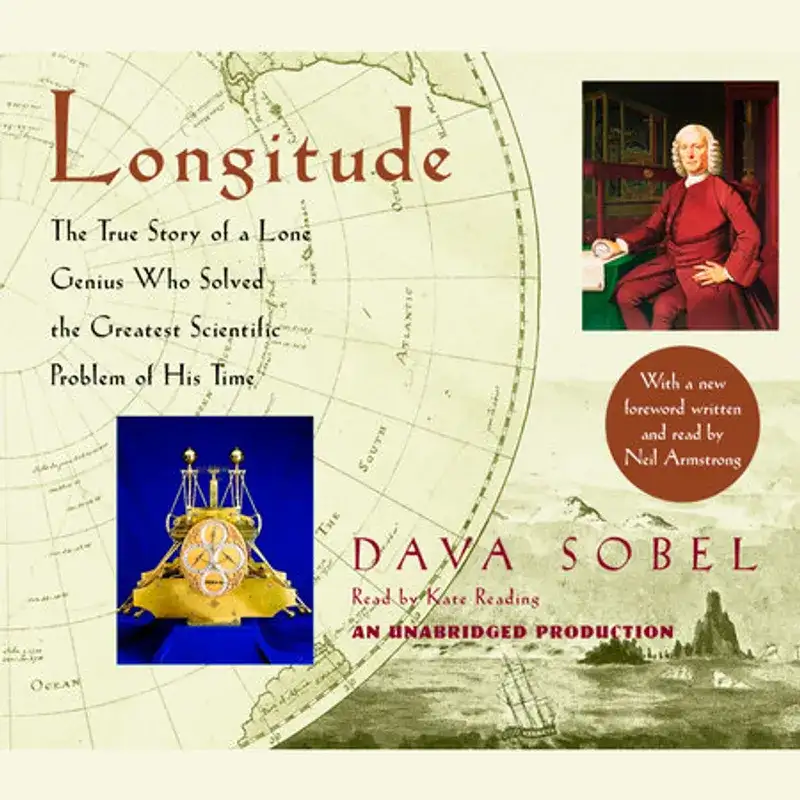

Longitude Author: Dava SobelPage Count: UnknownPublication Date: 2005-PRH Dava Sobel’s Longitude is a masterclass in narrative nonfiction—an exhilarating blend of science, history, and human drama that reads like a high-stakes thriller. First published in 1995 and later expanded in 2005, this slim yet monumental book tackles a deceptively simple question: How do you find your way when the sea has no landmarks? Sobel’s answer is not just a tale of navigation but a gripping odyssey of obsession, ingenuity, and the clash between tradition and innovation. At its core, Longitude is the story of a scientific revolution disguised as a quest for survival. For centuries, sailors could pinpoint their latitude with ease—by measuring the angle of the sun or stars—but longitude remained an unsolvable riddle. Without it, ships drifted blindly, leading to catastrophic shipwrecks, lost fortunes, and even naval defeats. The problem was so dire that in 1714, Britain’s Parliament offered the largest prize in history—a staggering £20,000 (millions today)—to anyone who could solve it. The scientific elite, from Galileo to Newton, bet on celestial solutions: tracking the movement of the moon against star charts or using Jupiter’s moons as a cosmic clock. But their methods were fragile, dependent on clear skies and flawless calculations. Enter John Harrison, a self-taught clockmaker from rural England, who dared to propose a radical alternative: a timepiece that could keep perfect time at sea, where swings in temperature, moisture, and motion would destroy ordinary clocks. Sobel’s genius lies in transforming this technical battle into a human saga. Harrison, a working-class outsider in a world dominated by aristocratic scientists, is a figure straight out of Dickens—a stubborn, meticulous genius whose life’s work becomes a decades-long fight against institutional inertia. The book crackles with tension as Harrison, already in his sixties when the contest begins, battles the scientific establishment led by the smug, dismissive Astronomer Royal, Nevil Maskelyne. Maskelyne, a man of rigid orthodoxy, represents the old guard, clinging to the heavens as the sole solution, while Harrison’s clocks—especially his H4, a pocket-watch-sized marvel—offer a practical, earthbound alternative. Sobel vividly portrays the politics of science: the backroom deals, the petty jealousies, and the outright sabotage Harrison endures. Even after his clocks prove their worth, the Board of Longitude resists paying him the full reward, forcing him into a Kafkaesque legal battle that lasts until his death. What makes Longitude so compelling is Sobel’s ability to make complex science accessible without dumbing it down. She distills the mechanics of Harrison’s clocks—with their ingenious balance wheels, temperature-compensating rods, and friction-reducing escapements—into clear, almost poetic explanations. Yet the book never feels like a textbook. Instead, it’s a detective story where every clue matters, where the ticking of a clock becomes a lifeline. Sobel’s prose is elegant and uncluttered, her pacing relentless. She moves seamlessly between the macro—the geopolitical stakes of global trade—and the micro—the sweat and frustration of a craftsman refining his inventions in a cluttered workshop. The book’s emotional core is Harrison himself, a man whose dedication borders on the pathological. Sobel doesn’t shy away from his flaws—his prickly temperament, his reluctance to share his designs—but she portrays him as a visionary whose work would save countless lives. His story is a reminder that progress is rarely neat or fair; it’s a messy, human endeavor where persistence often matters more than pedigree. The contrast between Harrison’s humble background and the elite scientists who dismiss him adds a layer of social critique, making Longitude as much about class and power as it is about science. Sobel also excels in painting the broader context. She evokes the age of exploration with all its wonder and terror—the vast, uncharted oceans, the terror of being lost, the desperation of nations vying for dominance. The book is a testament to how a single, seemingly narrow problem can ripple across history. The solution to the longitude dilemma didn’t just save ships; it enabled the British Empire’s global reach, reshaped cartography, and even influenced the Industrial Revolution by proving that precision engineering could conquer nature’s chaos. Longitude is more than a history book; it’s a celebration of curiosity and the underdog. It reminds us that the greatest breakthroughs often come from those who refuse to accept the obvious. Sobel’s storytelling turns a dry historical footnote into a page-turner, proving that science is at its most thrilling when it’s a fight against the unknown. By the final pages, you’ll never look at a clock—or the sea—the same way again. #Longitude #HistoryOfScience #JohnHarrison #MaritimeHistory #ScientificRevolution #Navigation Related InsightsThief of Night Book Review and Summary The Rust Forest: A Thriller (The Asker Series) Book Review and Summary The Princess Bride Book Review and Summary{ "@context": "https://schema.org", "@type": "FAQPage", "mainEntity": [ { "@type": "Question", "name": "What is the main focus of Longitude Book Review and Summary?", "acceptedAnswer": { "@type": "Answer", "text": "Everything you need to know about Longitude with our detailed review." } }, { "@type": "Question", "name": "Who authored the comprehensive guide on Longitude Book Review and Summary?", "acceptedAnswer": { "@type": "Answer", "text": "This detailed article and its insights were carefully researched and authored by Natalia Sokolova." } }, { "@type": "Question", "name": "Where can I find more related content about Books?", "acceptedAnswer": { "@type": "Answer", "text": "You can explore more articles, detailed reviews, and similar insights by browsing the Related Insights section at the bottom of this article or visiting our dedicated Books category page." } } ] }