Showing Posts From
Rarebooks

-
 Emily Page
 - 08 Jul, 2026 04:49
The Bound Guardians of Knowledge: Unlocking the Enduring Legacy of Chained Libraries
In an age where knowledge flows as freely as air, where the wisdom of centuries is but a click away, it is easy to forget a time when a single book was a treasure beyond measure, a beacon of light in an often-dark world. Imagine halls steeped in silence, where the very air hums with the whispers of antiquity, and each tome, rather than resting freely, is tethered – a sentinel bound to its post, guarding the precious cargo within. These are the chained libraries, an architectural and philosophical testament to a bygone era’s profound reverence for the written word, a practice that transformed custodians into guardians and scholars into pilgrims. From the twilight of the Middle Ages, stretching into the dawn of the 18th century, the chained library was not merely a curious anomaly but the standard for reference collections across Europe. This ingenious, albeit visually striking, method of safeguarding intellectual heritage speaks volumes about the value placed on books and the lengths to which societies would go to preserve them. Each chain, each secure ringlet, tells a story of scarcity, vulnerability, and an unyielding commitment to the dissemination of learning, even while acknowledging its fragility. The Genesis of Chains: Guarding Sacred Knowledge In the medieval period, the creation of a book was an arduous, meticulous, and expensive endeavor. Before the advent of the printing press, every volume was a handwritten masterpiece, often adorned with intricate illuminations, the product of countless hours of monastic or scholarly labor. Materials themselves were costly; pages were crafted from the robust durability of cowhide, or the more delicate yet prone-to-destruction papyrus, alongside wood, leaves, clay, cloth, bark, and metal. These weren't just books; they were artifacts, repositories of collective memory, theological dogma, scientific observation, and philosophical inquiry. The inherent value of these manuscripts made them prime targets. Thieves, driven by greed, and impoverished students, desperate for knowledge or a means to survive, saw books as readily convertible assets. Libraries, often housed within monasteries, cathedrals, or burgeoning universities, were therefore faced with a critical dilemma: how to make these invaluable resources accessible for study and reference while simultaneously protecting them from pilferage. The solution, born of necessity and ingenuity, was the chain. Beyond mere physical deterrents, librarians of the Middle Ages frequently invoked powerful curses, penned directly into the books themselves, a spiritual safeguard intended to deter any would-be thief with the threat of eternal damnation. These twin strategies – the tangible restraint of metal and the intangible dread of divine retribution – underscored the extraordinary measures taken to preserve these irreplaceable treasures. Anatomy of a Bound Sentinel: The Mechanics of Chaining The practice of chaining was far from arbitrary; it was a meticulously considered system designed for both security and functionality. The chain itself was never haphazardly attached. Standard practice dictated that the chain be fitted to the corner or the cover of a book, a deliberate choice with practical implications. Attaching it to the spine, though perhaps seemingly intuitive, would subject the book to excessive wear and tear from the constant stress of being moved on and off the shelf, compromising its integrity. This precise placement of the chain, typically connected via a ringlet, also dictated how the books were shelved. In a chained library, volumes are uniquely housed with their spine facing away from the reader. What visitors encounter first are the fore-edges of the pages. This arrangement was not merely aesthetic; it was profoundly functional. It allowed each book to be removed from its shelf and opened for reading without needing to be turned around, thus preventing the chain from tangling, a minor but crucial detail in the daily operation of such a library. Should a book need to be fully removed from its tether for repair, inventory, or specialized study, only the librarian, wielding a specific key, held the power to unlock its bonds. This sophisticated system of access and security highlights the preciousness of each volume and the controlled environment in which knowledge was both guarded and shared.Early Bastions of Public Intellect: Pioneering Libraries While many chained libraries were institutional, serving the clergy or scholars within specific colleges, some heralded a nascent vision of public access. The Francis Trigge Chained Library in Grantham, Lincolnshire, established in 1598, stands as England's earliest example of a library endowed for use outside a closed institution. This remarkable collection, still preserved today, can justly claim to be a precursor to the modern public library system, offering a glimpse into a future where knowledge would be accessible to a broader populace. Another pivotal example, Marsh's Library in Dublin, constructed in 1701, also transcended institutional boundaries. What makes Marsh's unique, however, is that its security measures shifted from the books to the readers. Here, it was not the precious volumes that were chained, but rather the scholars themselves were, on occasion, locked into cages. This unusual practice was a testament to the library's vast collection of rare and invaluable books, and the extreme lengths taken to prevent these cherished volumes from 'wandering' beyond its hallowed walls. These early examples underscore the evolving understanding of access, ownership, and preservation in the context of burgeoning intellectual curiosity. Echoes Through Time: Surviving European Treasures Despite the decline of the practice, a handful of chained libraries have miraculously survived, offering contemporary visitors a tangible link to medieval scholarship. Worldwide, only five such libraries retain their original furniture, chains, and books, making each a rare and invaluable window into the past. Hereford Cathedral: In Hereford, England, stands the undisputed titan among surviving chained libraries. With books dating predominantly from the 12th century, largely predating the printing press, this collection comprises handwritten manuscripts, including the seminal Hereford Gospels, written in the eighth century. It boasts an astonishing 229 chained books, making it the largest surviving chained library with its chains and books perfectly intact. For over 900 years, this magnificent library served its purpose, but like many ancient structures, it eventually faced disrepair. A decade-long, monumental restoration effort, fueled by massive monetary donations, brought it back from the brink, transforming it into a vibrant public tourist attraction and museum, also housing the famous Mappa Mundi. Its pages, crafted from various materials including unbleached animal skin, whisper stories in the languages of the people who penned them. Zutphen and Cesena: The Church of Saint Walpurga in Zutphen, Netherlands, built in 1564, houses one of these precious five. Now part of a museum, it allows visitors to step back in time, viewing original books, furniture, and, of course, the chains. Similarly, the Malatestiana Library in Cesena, Italy, a jewel of the Italian Renaissance, dating back to the 15th century, also preserves its chained collection, a testament to the era's dedication to learning and beauty. Both sites have undergone significant restoration work, ensuring their legacy endures. Wimborne Minster: Dorset, England, is home to the UK's second-largest chained library, at Wimborne Minster. Dating from 1686, though often cited as 1868, this library holds 150 titles, some wrapped in protective lambskin. Its origins are particularly illustrative of the mixed motives behind chained libraries. An initial donation of theological books from Revd William Stone was deemed primarily for clergy use and thus remained unchained. However, a subsequent gift of 90 books in 1695 from Roger Gillingham came with a stringent stipulation: the books must be chained, but crucially, the library was to be opened freely to the town's people, albeit "shopkeepers or the better class of person," reflecting lingering social hierarchies even in acts of public philanthropy. Florence's Laurentian Library: Designed by the unparalleled Michelangelo in the sixteenth century for Lorenzo de' Medici, this Florentine masterpiece represents a blend of architectural genius and the enduring practice of chaining. While its grandeur speaks of power and enlightenment, the chains subtly remind us of the immense value placed on its contents. Other notable examples dot the European landscape, including the Royal Grammar School in Guildford, Bolton School, and Wells Cathedral, which notably re-chained a number of its books, underscoring a renewed appreciation for this historical method of preservation. The list of surviving examples paints a diverse picture, from parish churches to grand cathedrals and prestigious schools, each a unique chapter in the story of books.The Decline of the Chain: A New Era of Accessibility The necessity of chaining books began to wane with one of the most transformative inventions in human history: the printing press. As printing technology advanced and proliferated, the cost of producing books plummeted dramatically. What was once a prohibitively expensive, hand-crafted rarity became more accessible, if not yet truly commonplace. This surge in availability reduced the individual value of many books, making theft less appealing and widespread loss less catastrophic. As books became less expensive, the elaborate and costly process of chaining them to shelves became economically unfeasible and, ultimately, redundant for the vast majority of new acquisitions. The shift marked a turning point from a culture of extreme scarcity and meticulous guardianship to one of increasing dissemination and, eventually, mass literacy. While the chain had served its purpose brilliantly in an age of handwritten manuscripts, its role diminished as the democratic power of print began to reshape the landscape of knowledge and information. Reviving the Past: Modern Preservation and Fascination In recent decades, there has been a significant resurgence of interest in these historical repositories, fueling extensive efforts to reconstruct and preserve chained libraries. This renewed fascination stems not only from their historical significance but also from their unique ability to transport visitors to another era. The realization that only a handful of these libraries have survived intact – with their original furniture, chains, and books – has galvanized conservationists and historians worldwide. The comprehensive restoration of Hereford Cathedral's Mappa Mundi and Chained Library museum serves as a prime example of this dedication. The painstaking work, spanning over a decade and involving substantial financial contributions, saved this 900-year-old institution from further decay, ensuring its legacy for future generations. These sites are not merely static collections; they are living museums, inviting the public to engage with history in a profoundly tangible way. They offer a rare glimpse into the practicalities of medieval scholarship, the value placed on learning, and the ingenious solutions devised to protect it. Chains in Contemporary Imagination: Pop Culture's Enduring Allure The enduring mystique of chained libraries has permeated far beyond historical archives, captivating the modern imagination and finding a firm footing in popular culture. Their evocative imagery, suggesting forbidden knowledge, ancient power, or guarded secrets, makes them a compelling backdrop for fantasy and mystery. Terry Pratchett, in his beloved Discworld series of comic fantasy novels, famously features the library of the Unseen University, where many books are chained. However, in a whimsical Pratchettian twist, these chains serve a more fantastical purpose: to prevent the more vicious magical books from escaping or, indeed, attacking unsuspecting passers-by. This playful subversion highlights the inherent intrigue of the chained book concept. The allure extends to more serious narrative forms as well. David Williams' mystery novel, Murder in Advent, specifically centers around a chained library, leveraging its historical context and confined nature for dramatic effect. In the cinematic realm, chained books make memorable appearances, immediately signaling a sense of ancient, often dangerous, knowledge. The Restricted Section of the library in Harry Potter and the Philosopher's Stone features prominently chained books, reinforcing their status as sources of powerful, potentially perilous magic. Similarly, in the season six finale of Game of Thrones, Samwell Tarly gains access to the vast Citadel Library, where many volumes are securely chained, symbolizing the deep, guarded knowledge of Westeros. Even in the Marvel Cinematic Universe, Doctor Strange depicts the library of Kamar-Taj with some forbidden ancient books on chains, meticulously watched over by the librarian, Wong, underscoring their immense power and the need for their containment. Charlie Lovett's fiction book, The Lost Book of t (presumably "The Lost Book of the Earth" or similar, from the truncated text), further attests to this ongoing fascination, showing how these historical artifacts continue to inspire new stories and fuel our collective imagination. The chained library, therefore, is more than just a relic of historical library science. It is a potent symbol: a guardian of fragile wisdom, a testament to human ingenuity, and a bridge between an arduous past and an enlightened present. These quiet halls, with their bound volumes, continue to challenge and enchant, reminding us of the profound journey of knowledge itself, secured, preserved, and eternally waiting to be unlocked.#ChainedLibraries #BookHistory #MedievalBooks #LibraryScience #HistoricSites #LiteraryHeritage Related InsightsTo the Lighthouse Book Review and Summary Life Out of Order (The Time Traveler's Wife, #2) Book Review and Summary Crash Book Review and Summary{ "@context": "https://schema.org", "@type": "FAQPage", "mainEntity": [ { "@type": "Question", "name": "What is the main focus of The Bound Guardians of Knowledge: Unlocking the Enduring Legacy of Chained Libraries?", "acceptedAnswer": { "@type": "Answer", "text": "Journey into the intriguing world of chained libraries, where ancient volumes were secured to their shelves, revealing a profound history of knowledge, preservation, and human ingenuity." } }, { "@type": "Question", "name": "Who authored the comprehensive guide on The Bound Guardians of Knowledge: Unlocking the Enduring Legacy of Chained Libraries?", "acceptedAnswer": { "@type": "Answer", "text": "This detailed article and its insights were carefully researched and authored by Emily Page." } }, { "@type": "Question", "name": "Where can I find more related content about Books?", "acceptedAnswer": { "@type": "Answer", "text": "You can explore more articles, detailed reviews, and similar insights by browsing the Related Insights section at the bottom of this article or visiting our dedicated Books category page." } } ] }
- Emily Page
- 29 Jun, 2026 13:16
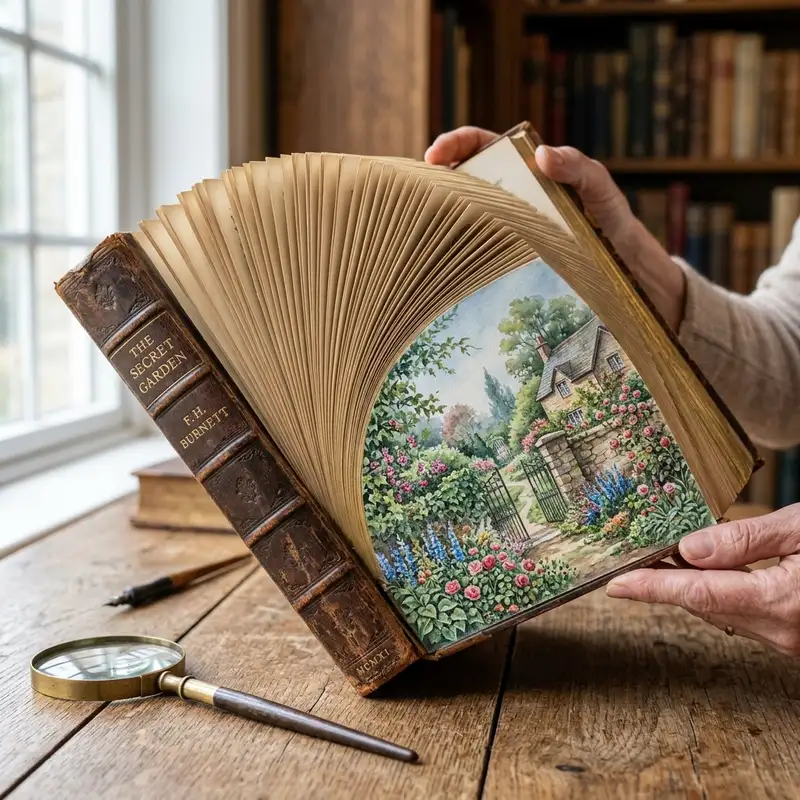
The Whispers Within Pages: Unearthing the Secret Art of Fore-Edge Painting
Imagine a book, unassuming in its leather binding, perhaps a classic text or a volume of poetry. Its edges gleam with the subtle luster of gold, a testament to its age and craftsmanship. You pick it up, admiring its weighty presence, its elegant design. But then, you perform a simple, almost instinctive gesture: you fan the pages. And in that precise moment, a secret world unfurls before your eyes. A vibrant landscape, a historical scene, a delicate portrait, or an intricate allegorical tableau materializes as if by magic, shimmering into existence along the very edge that minutes ago seemed merely gilded. This, my dear reader, is the captivating, often clandestine, art of fore-edge painting. In an age saturated with digital content and fleeting trends, there remains an enduring fascination with the tangible, the handcrafted, and the hidden. Fore-edge painting, a craft whose origins whisper through centuries of bibliophilic devotion, stands as a profound testament to this allure. It is not merely a decorative technique but a profound act of concealment and revelation, transforming a humble book into a vessel for both literary narratives and secret visual artistry. This deep dive into its #history, its meticulous execution, and its enduring charm promises to unlock a forgotten chamber in the grand library of human ingenuity. The Genesis of a Gilded Secret The #journey of fore-edge painting begins not with elaborate scenes, but with humble decorative intentions. Early forms of edge decoration date back to the 10th century, primarily involving simple patterns or heraldic devices painted directly onto the closed, squared-off edges of books. These were often protected by layers of gesso and varnish, serving as identifiers of ownership or simply as embellishments. However, the true innovation – the art of painting a scene onto the fanned pages – is generally credited to the 17th century. It was in England, during the reign of Charles I, that the first examples of paintings appearing on the splayed edges of books began to emerge. These early works, though often less refined than their later counterparts, laid the groundwork for the exquisite art form we recognize today. The technique involves clamping the book slightly askew, allowing the pages to fan out subtly, creating a continuous, albeit textured, surface for the artist to work on. Once the painting is complete and dry, the pages are returned to their normal, closed position, and the edges are then gilded with gold leaf, effectively concealing the artwork. This gilding serves not only as a protective layer but also as a magical curtain, ensuring the artwork remains hidden until the book is fanned again. The initial subjects were often crests, mottoes, or floral patterns, reflecting the artistic tastes and heraldic traditions of the period. However, as the technique evolved, so did the ambition of the artists, paving the way for the intricate landscapes, portraits, and genre scenes that would define its golden age. The Golden Age: Edwards of Halifax and Beyond The 18th century witnessed the zenith of fore-edge painting, largely propelled by the innovation and entrepreneurial spirit of James Edwards (1757-1816) and his family firm in Halifax, England. The Edwards family are synonymous with the perfection and popularization of this art form. They developed a distinctive style of bookbinding, characterized by elegant, often vellum bindings, and their signature practice of commissioning exquisite fore-edge paintings. Edwards of Halifax didn't just paint edges; they created entire aesthetic experiences. Their books were coveted by the elite, becoming symbols of wealth, refinement, and a discerning taste for the unique. The subjects chosen for these hidden masterpieces often complemented the book's content. A volume of Shakespeare might reveal a scene from one of his plays; a travelogue might hide a vista from a distant land; a book on natural history might contain a vibrant botanical illustration. The connection between the internal text and the external, hidden art added another layer of intellectual and aesthetic pleasure for the owner.The skill of the artists employed by Edwards was paramount. Using delicate watercolors, they would meticulously apply paint to the minute ridges of the fanned pages, ensuring that the image seamlessly reappeared each time the book was opened correctly. The challenge was immense: each stroke had to be precise, anticipating the distortion caused by the page breaks, yet contributing to a coherent whole. The drying time between layers was critical to prevent colors from bleeding or pages from sticking. Once the painting was complete and perfectly dry, the edges would be burnished and gilded, often with elaborate tooling, rendering the hidden artwork completely invisible. While Edwards of Halifax remains the most prominent name, other binders and artists in England, #France, and later, America, adopted and adapted the technique, each adding their own stylistic nuances. The demand for these secret treasures grew, driven by a fascination with novelty, the beauty of the craft, and the intrinsic value of possessing something so uniquely personal and hidden. The Craft: An Invisible Canvas The creation of a fore-edge painting is a delicate dance between art and precision engineering. It demands not only artistic talent but also an intimate understanding of book structure and materials. The process typically begins with a tightly bound book. The binder or artist first secures the book in a press, fanning the leaves slightly to expose the working surface – the collection of minute steps formed by the individual pages. This fan must be absolutely consistent, providing an even 'canvas'. Any unevenness would result in a distorted or broken image. Using watercolors, which are ideal for their quick drying time and translucent qualities, the artist meticulously paints the chosen scene onto this textured surface. The challenge is multi-faceted:Perspective: The artist must mentally adjust for the concave curve of the fanned pages, ensuring the painting appears flat and cohesive when viewed. Continuity: Each stroke must align perfectly across the miniscule gaps between pages. Precision: The paints must be applied sparingly to avoid soaking through the pages or causing them to swell and stick together. Composition: The chosen scene must be adaptable to the narrow, elongated format provided by the fanned edge. Landscapes, cityscapes, and portraits are common, but allegorical and genre scenes also feature prominently.After the painting is completely dry – a crucial step that can take several days – the book is released from the press, and the pages return to their natural, closed position. The magic happens here: the artwork vanishes. The final step is the application of gold leaf to the closed edges. This gilding is not merely decorative; it acts as a protective shield for the delicate watercolor beneath and, most importantly, as the perfect disguise, maintaining the book's outwardly conventional appearance. Some books even feature a double fore-edge painting, where a different scene appears depending on which way the pages are fanned! Such works are incredibly rare and highly prized.Symbolism and Secrecy: Why Conceal Art? Beyond the sheer aesthetic pleasure and technical mastery, fore-edge painting embodies a profound symbolism of secrecy and personal delight. In an era where books were often ostentatious displays of wealth and knowledge, a hidden artwork added an exclusive layer of intimacy. It was art not for public display, but for the knowing few, for the discerning owner who understood the book's dual #nature. This clandestine quality often lent the books an air of mystery. Was the hidden scene a private joke, a coded message, a beloved memory, or a moral instruction intended only for the owner's contemplation? For a collector, discovering such a painting on an otherwise ordinary-looking volume is akin to finding a hidden treasure map, unlocking a secret passage in history. The choice of subjects often reflects the personal interests of the patron or the prevailing cultural sensibilities. Landscapes served as reminders of grand tours or cherished estates; portraits immortalized loved ones; classical scenes echoed a classical education; and allegories offered subtle moral or philosophical commentary. The very act of concealing these images speaks to a desire for privacy in art consumption, a private communion between the owner, the book, and the hidden image. It transforms the book from a mere object into a personal confidante, holding its secrets close. Decline, Revival, and Enduring Allure The golden age of fore-edge painting waned in the late 19th and early 20th centuries. The advent of industrial printing, mass production of books, and changing aesthetic preferences led to a decline in demand for such labor-intensive and expensive artisanal book decorations. Publishers focused on affordability and broader distribution, making elaborate hand-painted additions an uneconomical luxury. However, true artistry rarely vanishes completely. The latter half of the 20th century and the early 21st century have seen a small but dedicated revival of fore-edge painting. Contemporary artists, often members of bookbinding guilds or societies, continue to practice and innovate within this #ancient tradition. They experiment with modern subjects, vibrant color palettes, and even more intricate designs, ensuring that the legacy of this unique art form endures. These modern practitioners often seek to preserve the historical techniques while infusing the work with contemporary relevance, bridging centuries of craftsmanship. For bibliophiles and collectors today, discovering an original fore-edge painted book is a moment of profound joy. These books are not just historical artifacts; they are windows into a past where beauty was often deliberately understated, where art was meant to be discovered, not just observed. Each book with a hidden painting tells a dual story: the narrative within its pages and the secret visual tale along its edge. The allure of fore-edge painting lies in its capacity for surprise, its tangible connection to a lost art, and its embodiment of meticulous craftsmanship. It reminds us that books are more than just text; they are objects of art, craft, and history, capable of holding profound secrets within their very structure. Next time you encounter an antique book with gilded edges, take a moment. Fan its pages. You might just uncover a whisper from the past, a masterpiece patiently awaiting its moment of revelation, a testament to the enduring magic found within the unassuming realm of books.#HiddenBookArt #ForeEdgePainting #AntiqueBooks #BookCraftsmanship #SecretArt