Showing Posts From
The character of phy
-
 Klaus Weber
 - 18 Oct, 2025 00:42
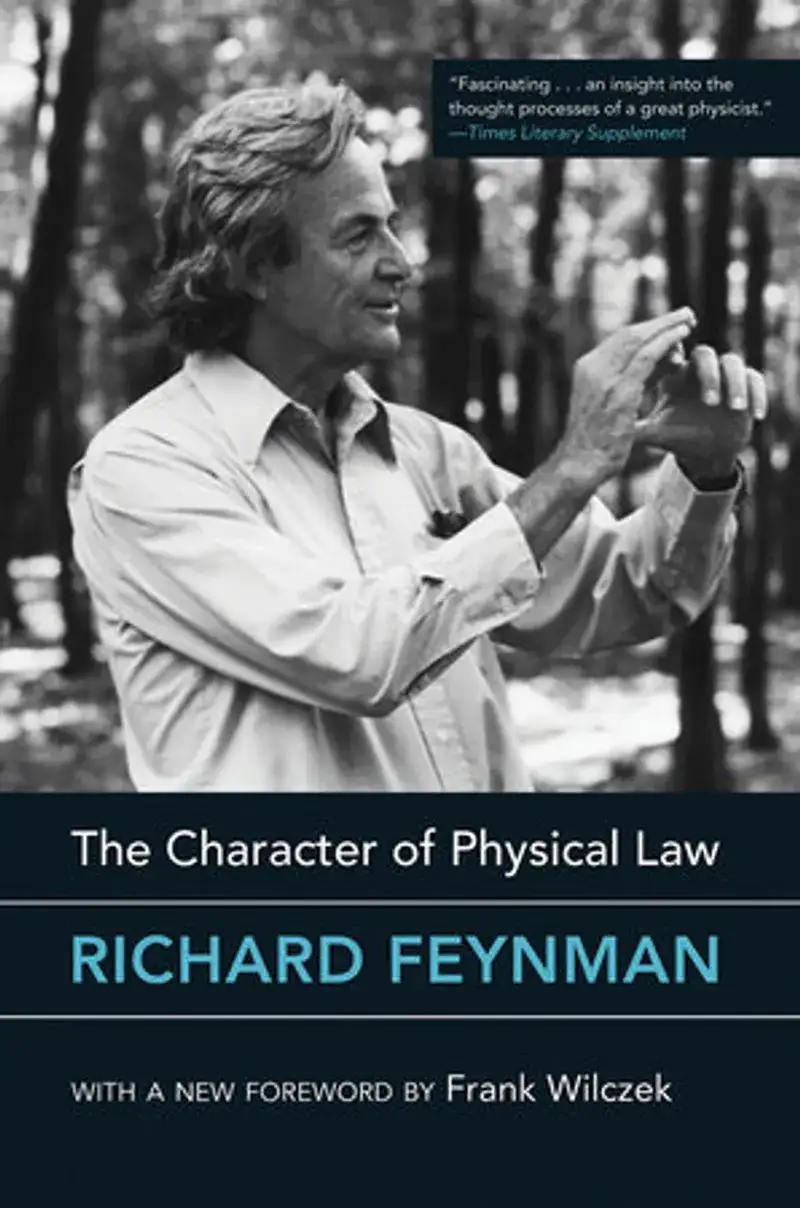
The Character of Physical Law, with new foreword Book Review and Summary
The Character of Physical Law, with new foreword Author: Richard FeynmanPage Count: UnknownPublication Date: 2017-PRH Richard Feynman wasn’t just a physicist—he was a storyteller, a showman of science, and one of the few people who could make the universe feel like a conversation over coffee rather than a lecture hall. The Character of Physical Law, drawn from his legendary 1964 Messenger Lectures at Cornell, is a masterclass in how to teach the unteachable: the fundamental rules that govern reality. In this book, Feynman doesn’t just explain physics; he invites you into the mind of a man who sees beauty in equations and wonder in the simplest of phenomena. It’s a celebration of curiosity, a manifesto for intellectual humility, and a reminder that science is as much about awe as it is about discovery. At its core, the book is about the nature of physical laws—not just what they are, but how they work, why they matter, and what they reveal about the universe’s hidden order. Feynman rejects the dry recitation of facts in favor of a more philosophical inquiry: What makes a law law-like? Why do certain principles—like conservation of energy or the symmetry of space—hold true across time and space? His answer is both profound and playful: these laws aren’t human inventions; they’re the universe’s way of keeping its secrets orderly. "The importance of a physical law," he insists, "is not how clever we are to have found it out, but how clever nature is to pay attention to it." This flips the script on traditional science writing. Instead of marveling at human ingenuity, Feynman directs our wonder toward the cosmos itself—a humbling and exhilarating perspective. Feynman’s style is the book’s greatest strength. He writes with the energy of a man who can’t wait to share his discoveries, peppering his explanations with wit, metaphors, and even a little mischief. When discussing the law of gravitation, he compares it to a "great machine" that, while not perfectly understood, works with remarkable precision—a machine we’re still learning to operate. His famous analogy of dropping a ball to explain the curvature of spacetime is so vivid it lingers like a mental image long after the book is closed. And when he tackles the puzzle of irreversibility—the fact that time seems to flow in one direction, even though the laws of physics are mostly symmetric—he does so with a mix of rigor and whimsy, using a film of a glass shattering in reverse to illustrate how entropy sneaks in to break the symmetry. What makes The Character of Physical Law timeless is how Feynman bridges the gap between the abstract and the concrete. He doesn’t just state the principle of conservation of energy; he shows how it emerges from the symmetry of time, using a thought experiment about a child on a swing to make the idea tangible. His discussion of symmetry isn’t just about mirrors or rotational patterns—it’s about the deep, almost mystical connection between mathematical elegance and physical reality. "Symmetry," he tells us, "is a hint of the underlying unity of the universe." This isn’t just a physics lesson; it’s a lesson in seeing the world differently. The book also shines in its treatment of the scientific process itself. Feynman, ever the iconoclast, warns against the dangers of dogma and the seduction of "clever" theories that don’t match reality. He champions the experimental method not because it’s infallible, but because it’s the best tool we have for testing our ideas against the universe’s stubborn facts. His skepticism of unchecked mathematical abstraction foreshadows modern debates about the role of theory in physics, making the book feel as relevant today as it did in 1967. The updated foreword by Frank Wilczek reinforces this, noting how some of Feynman’s observations—particularly about the limits of quantum mechanics—still resonate in contemporary physics. Yet for all its depth, the book never feels heavy. Feynman’s humor keeps the pages turning: his confession that he once tried to calculate how many piano tuners there are in New York City to illustrate the power of estimation; his dry remark that "if you think you understand quantum mechanics, you don’t"; his playful dig at philosophers who "have not succeeded in understanding the simplicity of nature." These asides aren’t just comic relief—they’re a reminder that science, at its best, is a human endeavor, flawed and joyful and endlessly surprising. The Character of Physical Law is ultimately a love letter to the scientific method and the people who practice it with both rigor and wonder. Feynman’s genius lies in his ability to make the reader feel like an accomplice in the discovery process. He doesn’t just want you to understand the laws of physics; he wants you to feel the thrill of uncovering them. In an era where science is often reduced to headlines or political football, Feynman’s voice is a clarion call to remember why we do this at all: because the universe is astonishing, and it’s waiting for us to pay attention. If you’ve ever looked at the night sky and wondered how it all holds together, or if you’ve ever been frustrated by a physics textbook that feels more like a manual than a story, Feynman’s book is your antidote. It’s not just a guide to the laws of nature—it’s an invitation to see the world with fresh eyes. #Feynman #PhysicsForEveryone #ScienceWriting #QuantumElectrodynamics #PopularScience #NatureOfReality Related InsightsUna ofensa mortal / A Great Reckoning Book Review and Summary Las nueve revelaciones / The Celestine Prophecy : An Adventure Book Review and Summary Malibu Rising Book Review and Summary{ "@context": "https://schema.org", "@type": "FAQPage", "mainEntity": [ { "@type": "Question", "name": "What is the main focus of The Character of Physical Law, with new foreword Book Review and Summary?", "acceptedAnswer": { "@type": "Answer", "text": "Everything you need to know about The Character of Physical Law, with new foreword with our detailed review." } }, { "@type": "Question", "name": "Who authored the comprehensive guide on The Character of Physical Law, with new foreword Book Review and Summary?", "acceptedAnswer": { "@type": "Answer", "text": "This detailed article and its insights were carefully researched and authored by Klaus Weber." } }, { "@type": "Question", "name": "Where can I find more related content about Books?", "acceptedAnswer": { "@type": "Answer", "text": "You can explore more articles, detailed reviews, and similar insights by browsing the Related Insights section at the bottom of this article or visiting our dedicated Books category page." } } ] }