Showing Posts From
The day the world en
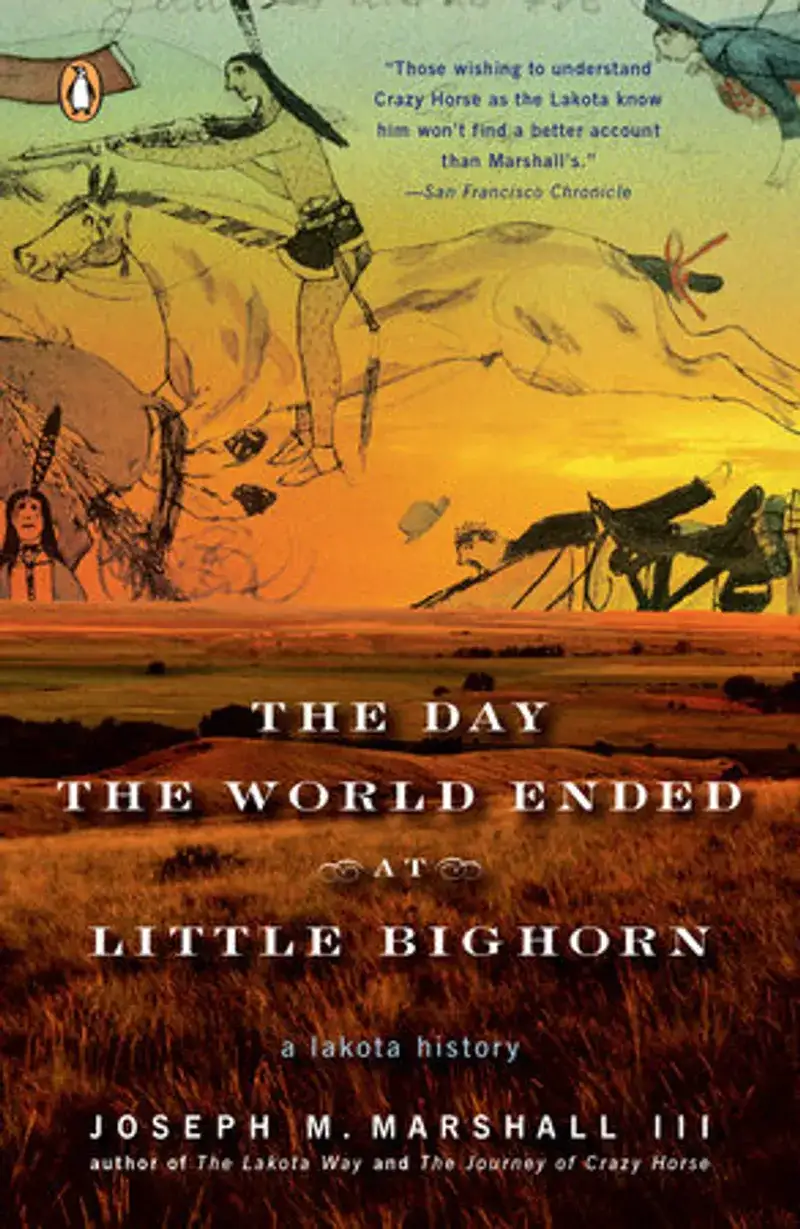
The Day the World Ended at Little Bighorn Author: Joseph M. Marshall IIIPage Count: UnknownPublication Date: 2008-PRH Joseph M. Marshall III’s The Day the World Ended at Little Bighorn is not just another retelling of the infamous Battle of the Little Bighorn—it is a deliberate act of historical reclamation, a challenge to the myths that have calcified around one of America’s most mythologized conflicts. Marshall, a Lakota historian and storyteller, strips away the romanticized veneer of Custer’s Last Stand to reveal the battle as the Lakota people experienced it: not as a tragic defeat for the U.S. Army, but as a hard-won victory against encroaching oppression, a moment of defiance in the face of genocide. In doing so, he does more than correct the record; he restores dignity to the voices long silenced by Western historiography. The book’s central theme is the reclaiming of narrative authority. Marshall argues that the Lakota oral tradition—transmitted through elders, warriors, and survivors—holds truths that written American histories have distorted or ignored. Where Custer is often depicted as a gallant if doomed hero, Marshall presents him as a reckless opportunist whose actions were fueled by arrogance and a disregard for Native sovereignty. Where the battle is framed as a senseless massacre, Marshall frames it as a justified defense of land, culture, and survival. This is not revisionism for the sake of contrarianism; it is a necessary counter-narrative, one that refuses to let the victors write the only story. Marshall’s style is as much a part of the book’s power as its content. He writes with the cadence of a storyteller, his prose flowing like the rhythm of a traditional Lakota tale. There is a lyrical quality to his descriptions of the land, the people, and the events, which makes the book read less like a dry historical account and more like an epic being passed down through generations. His use of direct Lakota terms—Tasunka Witko for Crazy Horse, Húŋkešni for Sitting Bull—is not mere decoration; it is a quiet assertion of cultural continuity, a way of grounding the reader in the worldview of the Lakota themselves. Yet Marshall does not romanticize the past. He acknowledges the complexities of the battle—the internal divisions among the Lakota and their allies, the brutal realities of warfare, the personal tragedies that followed in its wake. His account is neither triumphalist nor naive; it is a measured, respectful reconstruction of an event that reshaped Native American history. When he describes the moments leading up to the battle, he does so with a sense of inevitability, as if the clash was not just a military confrontation but a collision of two irreconcilable worldviews. One of the book’s most striking passages comes when Marshall describes the Lakota perspective on Custer’s final moments. While American accounts often depict him as fighting heroically to the end, Lakota witnesses recalled a different scene: a man who panicked, who tried to escape, who was killed as he fled. Marshall does not gloat over Custer’s death; he simply presents it as one version of events among many, refusing to deify either side. This refusal to engage in moral score-settling is what makes the book so compelling—it is not about assigning blame, but about understanding the deeper currents that led to the battle. Marshall’s approach is not without its challenges. The Lakota oral tradition is not a monolith, and memories of the battle vary even among those who witnessed it. Some critics might argue that The Day the World Ended at Little Bighorn leans too heavily on oral history, which can be subjective and fragmented. But Marshall is upfront about these limitations. He does not claim absolute historical certainty; instead, he offers a perspective that has been systematically excluded from mainstream narratives. In doing so, he invites readers to question the stories they have been told and to consider whose voices have been privileged—and whose have been erased. Ultimately, this book is a call to rethink how we remember history. Marshall does not ask us to reject all previous accounts of the Battle of the Little Bighorn; he asks us to hold them up to the light and see them for what they are—partial, often biased, and shaped by the power of the tellers. By centering the Lakota experience, he does more than correct a historical record; he models what it means to engage with the past with humility, respect, and a commitment to truth. For anyone interested in Native American history, military history, or the politics of memory, The Day the World Ended at Little Bighorn is an essential read. It is a book that challenges, enlightens, and, above all, demands that we listen. #LittleBighorn #NativeAmericanHistory #CustersLastStand #LakotaCulture #HistoricalReckoning #OralHistory Related InsightsThe Blast from the Past Book Review and Summary A Psalm for Lost Girls Book Review and Summary Clara Poole and the Long Way Round Book Review and Summary{ "@context": "https://schema.org", "@type": "FAQPage", "mainEntity": [ { "@type": "Question", "name": "What is the main focus of The Day the World Ended at Little Bighorn Book Review and Summary?", "acceptedAnswer": { "@type": "Answer", "text": "Everything you need to know about The Day the World Ended at Little Bighorn with our detailed review." } }, { "@type": "Question", "name": "Who authored the comprehensive guide on The Day the World Ended at Little Bighorn Book Review and Summary?", "acceptedAnswer": { "@type": "Answer", "text": "This detailed article and its insights were carefully researched and authored by Piotr Nowak." } }, { "@type": "Question", "name": "Where can I find more related content about Books?", "acceptedAnswer": { "@type": "Answer", "text": "You can explore more articles, detailed reviews, and similar insights by browsing the Related Insights section at the bottom of this article or visiting our dedicated Books category page." } } ] }