Showing Posts From
The deluge
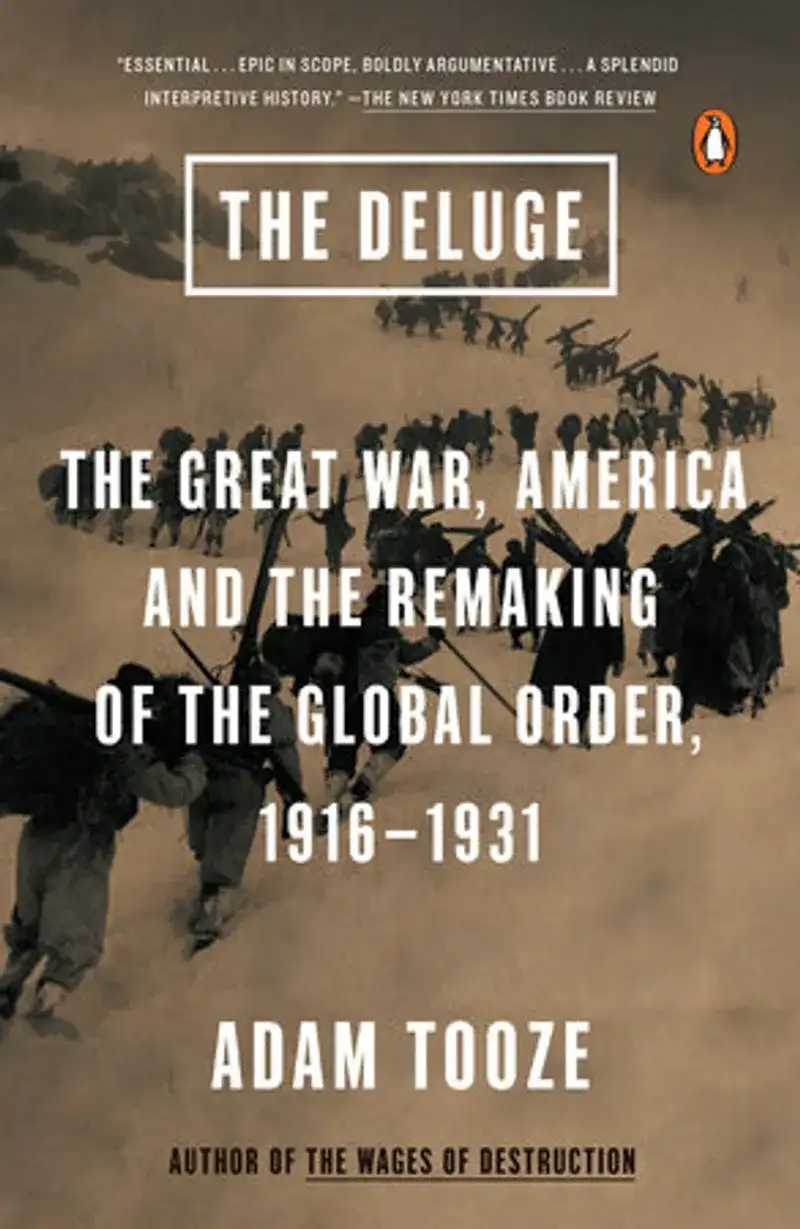

The Deluge Author: Adam ToozePage Count: UnknownPublication Date: 2015-PRH The Deluge: A Masterclass in Rewriting History Through Economics Adam Tooze’s The Deluge is not just another retelling of World War I—it is a seismic recalibration of how we understand the war’s global impact, its messy aftermath, and the unruly birth of the modern financial order. Published in 2015, this book cements Tooze’s reputation as a historian who wields economic insight like a surgeon’s scalpel, dissecting the war’s consequences with precision and fury. Where most histories dwell on trenches and treaties, The Deluge plunges into the bloodless but no less brutal machinery of money, power, and policy, revealing how the war didn’t just redraw maps—it shattered them. Tooze’s central thesis is radical: World War I wasn’t merely a European tragedy but the crucible in which American hegemony was forged. The war’s true turning point wasn’t 1917, when the U.S. entered the conflict, but the moment when Washington’s financial muscle—its banks, its loans, its industrial might—became the lifeline for a drowning world. Tooze forces us to see the war not as a static clash of empires but as a dynamic, shifting crisis where the old order (British finance, European aristocracies) crumbled under the weight of its own contradictions, and the new (American capitalism, mass mobilization) rose from the wreckage, albeit in a form no one anticipated. What makes The Deluge so electrifying is its refusal to treat economics as a side note. Tooze treats it as the engine of history. He traces how the war’s insatiable demands—shells, soldiers, ships—strained economies to the breaking point, forcing governments to abandon gold standards, print money, and beg for loans. The result? A world where the dollar replaced the pound as the dominant currency, where war debts became political dynamite, and where the very idea of national sovereignty was redefined by creditors. Tooze doesn’t just describe these shifts; he shows how they incubated the very ideologies that would later plunge the world into another war. The slide into fascism in Italy and Germany wasn’t just a political phenomenon—it was a desperate, violent response to the economic chaos that followed Versailles, a chaos too often ignored in favor of moralizing about "war guilt." Tooze’s prose is a marvel—dense with data, yet never dry; analytical, yet never detached. He has a knack for making the arcane feel urgent. When he describes the 1920s as a decade where "the world was reorganized around a single power center," he isn’t just stating a fact; he’s conjuring the ghost of British decline and American ascent. His chapter on the 1922 Genoa Conference, where European powers tried (and failed) to resuscitate the gold standard, reads like a thriller, with Tooze exposing the hypocrisy of reparations negotiations as a farce of misplaced priorities. The book’s title, The Deluge, is no metaphor: the war’s financial aftershocks were a cataclysmic flood, and Tooze ensures we feel the weight of the water crashing over every institution. The book’s greatest strength—and occasional frustration—lies in its scope. Tooze doesn’t just focus on Europe; he drags Japan, China, and even Latin America into the frame, showing how the war’s ripples stretched across the globe. This breadth is exhilarating but demands patience. Readers expecting a linear narrative may find themselves adrift in a sea of treaties, bankers’ meetings, and trade wars. Yet this is precisely the point: the war’s aftermath wasn’t a tidy peace but a global disorder, and Tooze refuses to simplify it. Perhaps the most chilling insight The Deluge offers is how the seeds of the next catastrophe were sown in the compromises of the first. The reparations imposed on Germany, the fragile debt structures that tied nations together, the rise of protectionism—all of it created a powder keg. Tooze’s book isn’t just a history lesson; it’s a warning. In an era where economic crises again ripple across borders, where American power is both indispensable and resented, The Deluge feels less like a historical account and more like a prophecy. Tooze’s work is a reminder that history isn’t made by generals or politicians alone, but by the invisible hands of financiers, bureaucrats, and the cold logic of markets. The Deluge is a masterpiece of revisionist history—not because it contradicts the past, but because it forces us to see it anew. #WorldWarI #EconomicHistory #AdamTooze #Geopolitics #FinancialCrises #HistoricalReckoning Related InsightsImagine Me Book Review and Summary Day of Ascension Book Review and Summary An Emotion of Great Delight Book Review and Summary{ "@context": "https://schema.org", "@type": "FAQPage", "mainEntity": [ { "@type": "Question", "name": "What is the main focus of The Deluge Book Review and Summary?", "acceptedAnswer": { "@type": "Answer", "text": "Everything you need to know about The Deluge with our detailed review." } }, { "@type": "Question", "name": "Who authored the comprehensive guide on The Deluge Book Review and Summary?", "acceptedAnswer": { "@type": "Answer", "text": "This detailed article and its insights were carefully researched and authored by Maximilian Fischer." } }, { "@type": "Question", "name": "Where can I find more related content about Books?", "acceptedAnswer": { "@type": "Answer", "text": "You can explore more articles, detailed reviews, and similar insights by browsing the Related Insights section at the bottom of this article or visiting our dedicated Books category page." } } ] }