Showing Posts From
The elephant tree
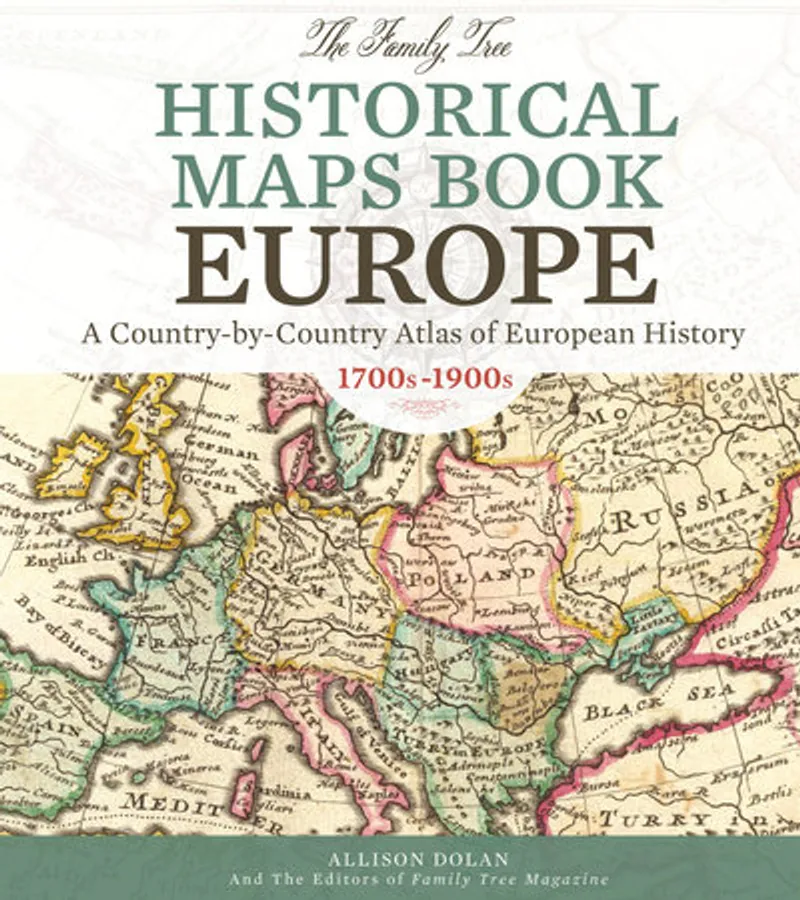
The Family Tree Historical Maps Book - Europe Author: Allison DolanPage Count: UnknownPublication Date: 2015-PRH Unlocking the Past: A Cartographer’s Time Machine to Europe’s Ancestral Lands There’s a moment in every genealogist’s journey when the dry facts of birth certificates and census records suddenly come alive—not in words, but in place. The Family Tree Historical Maps Book – Europe by Allison Dolan is that moment crystallized. More than a book, it’s a portal. A way to step into the shoes of ancestors who walked cobbled streets, tilled farmland, or sailed from ports now lost to time. With over 200 full-color historical maps spanning three centuries, Dolan doesn’t just chart borders—she traces the heartbeat of a continent through the eyes of those who called it home. At its core, this book is about context. Genealogy is often a puzzle of names and dates, but without geography, those pieces remain flat. Dolan remedies that by transforming abstract lineages into living landscapes. Imagine tracing your Irish roots only to realize the townland you seek was swallowed by a county boundary shift in 1898—or discovering that the "German" village your great-grandfather left was actually in Alsace-Lorraine, a region that swapped hands between France and Germany like a political football. These aren’t minor details; they’re the keys to unlocking records buried in archives, churches, or local government offices that still use pre-WWI administrative divisions. Dolan’s approach is methodical yet immersive. Each country—from the misty highlands of Scotland to the sun-baked hills of Greece—gets its own chapter, complete with:Evolutionary maps showing how empires rose and fell, how the Austro-Hungarian monarchy’s tentacles stretched across Central Europe, only to collapse into a mosaic of nation-states after World War I. Detailed provincial and county maps that let you pinpoint ancestral villages with surgical precision. No more squinting at vague "Southern Germany" references; here, you’ll see the exact Landkreis or guberniya your family inhabited. Timelines that anchor historical events to your research. Did your Polish ancestor flee during the 1863 uprising? The map of Russian-controlled Poland will show why records might be scattered across Warsaw’s archives. Did your Italian forebear leave before the 1861 unification? The pre-unification map of the Kingdom of the Two Sicilies could hold the clue to their original surname spelling. Administrative lists that decode the bureaucratic language of the past. Terms like Kreis, Département, or Oblast become less intimidating when you see them mapped in context.What sets this book apart is its sensorial quality. These aren’t sterile, modern cartographic diagrams but vibrant, period-accurate reproductions that feel like holding a piece of history. The 18th-century maps of Italy, with their baroque flourishes and exaggerated cityscapes, or the 19th-century German Karte with its meticulous hand-drawn borders, do more than inform—they evoke. You don’t just learn that your ancestors were from Galicia; you see the Carpathian foothills they gazed upon, the rivers they crossed, the forests they may have foraged in. Dolan’s prose is concise but never dry. She understands that genealogy is as much about feeling as it is about facts. Her introductions to each country are brief but evocative, blending historical context with practical advice. For example, her note on Ireland’s 1898 Local Government Act—where townlands were standardized—explains why so many Irish records post-1900 suddenly become easier to navigate. It’s the kind of insight that transforms a researcher’s frustration into a eureka moment. The book’s structure also makes it a joy to use. The index is a masterstroke, directing readers to digital scans of the maps (hosted by FamilySearch) for deeper exploration. This hybrid approach—physical book plus online resources—acknowledges that genealogy is increasingly a digital pursuit, while preserving the tactile pleasure of flipping through pages. Whether you’re a seasoned genealogist or a history buff dipping a toe into ancestry, the Historical Maps Book scales to your needs. Critics might argue that the book’s scope is vast, risking superficiality. But Dolan avoids this by focusing on utility. This isn’t a coffee-table ornament; it’s a toolkit. The maps are clear, the timelines are digestible, and the administrative lists are lifelines for anyone stymied by foreign bureaucratic terms. It’s the kind of book you’ll dog-ear, highlight, and return to with every new discovery. For teachers and homeschoolers, it’s a goldmine. Imagine a lesson on the Austro-Hungarian Empire where students trace the migration of Jewish communities across Galicia, or a discussion on the Irish Famine where the Atlas of Ireland maps reveal the stark divide between tenant farms and absentee landlord estates. History becomes tangible when you can see it. Ultimately, The Family Tree Historical Maps Book – Europe is a love letter to the places that shaped our ancestors—and by extension, us. It reminds us that genealogy isn’t just about who came before; it’s about where they stood, what they saw, and how the land they walked on shaped their lives. In an era where algorithms promise to "find your roots" with a click, Dolan’s book is a defiant return to the tactile, the visual, and the deeply human. It’s not just a guide to the past—it’s an invitation to walk it. #Genealogy #EuropeanHistory #FamilyHistory #AncestryResearch #HistoricalMaps #GenealogyTools Related InsightsLong Shadows Book Review and Summary How to Be Heard Book Review and Summary Daughter of Smoke & Bone Book Review and Summary{ "@context": "https://schema.org", "@type": "FAQPage", "mainEntity": [ { "@type": "Question", "name": "What is the main focus of The Elephant Tree Book Review and Summary?", "acceptedAnswer": { "@type": "Answer", "text": "Everything you need to know about The Elephant Tree with our detailed review." } }, { "@type": "Question", "name": "Who authored the comprehensive guide on The Elephant Tree Book Review and Summary?", "acceptedAnswer": { "@type": "Answer", "text": "This detailed article and its insights were carefully researched and authored by R.D. Ronald." } }, { "@type": "Question", "name": "Where can I find more related content about Books?", "acceptedAnswer": { "@type": "Answer", "text": "You can explore more articles, detailed reviews, and similar insights by browsing the Related Insights section at the bottom of this article or visiting our dedicated Books category page." } } ] }