Showing Posts From
The singularity is n
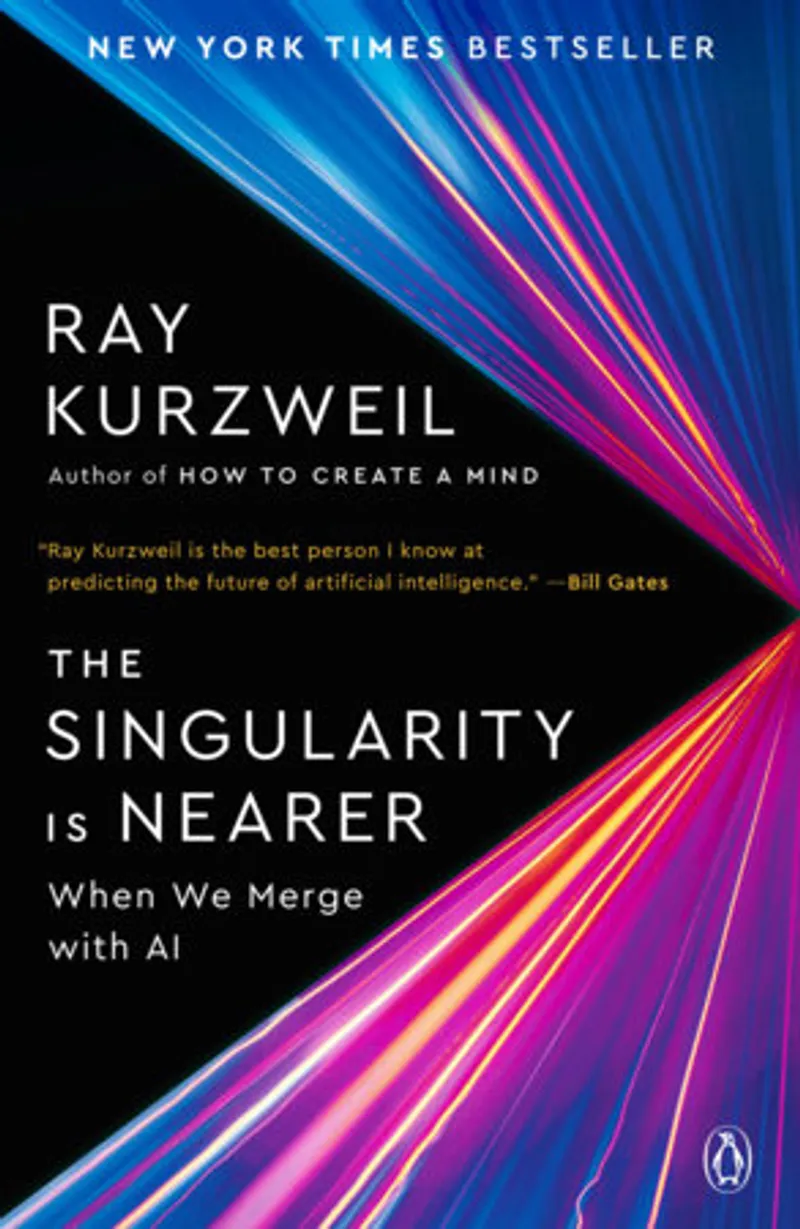

The Singularity Is Nearer Author: Ray KurzweilPage Count: UnknownPublication Date: 2026-PRH Ray Kurzweil’s The Singularity Is Nearer is not just a book—it’s a manifesto for the future, a bold declaration that the next era of human evolution is hurtling toward us at breakneck speed. Published in 2026, this follow-up to his 2005 landmark The Singularity Is Near arrives at a moment when the promises and perils of artificial intelligence, biotechnology, and nanotechnology are no longer speculative fiction but daily headlines. Kurzweil, the futurist, inventor, and Google’s director of engineering, doubles down on his most controversial claim: that by the mid-21st century, human intelligence will merge with machines, transcending biology itself. But this time, he’s not just predicting—he’s mapping the road. The central thesis of The Singularity Is Nearer is deceptively simple: the Singularity—the point at which artificial intelligence surpasses human intelligence and triggers runaway technological growth—isn’t a distant abstraction. It’s arriving sooner than even Kurzweil previously thought. Where his earlier work laid the groundwork, this book is a status report, a warning, and a call to arms. Kurzweil argues that exponential progress in computing power, genetic engineering, and brain-computer interfaces will converge within decades, not centuries. By 2045, he predicts, we’ll witness the birth of a new civilization—one where human and machine cognition blur into a hybrid intelligence capable of solving problems we can’t yet imagine. What makes this book compelling is not just its vision but its relentless optimism. Kurzweil’s style is that of a scientist who has spent a lifetime turning science fiction into reality. He writes with the clarity of a man who has spent decades explaining complex ideas to skeptics, yet his prose never dumbs down the material. Instead, he invites the reader into a world where Moore’s Law extends beyond silicon, where DNA becomes programmable code, and where consciousness itself may be uploaded. His arguments are meticulously researched, drawing from advances in neuroscience, quantum computing, and synthetic biology that have occurred since his last book. Yet, he doesn’t shy away from the ethical dilemmas—he confronts them head-on, framing them as challenges to overcome rather than insurmountable obstacles. Kurzweil’s optimism is infectious, but it’s not naive. He acknowledges the risks—job displacement, inequality, the potential for AI to act unpredictably—but he frames them as temporary hurdles on the path to abundance. His faith in human ingenuity is absolute. He points to historical precedents: when the printing press disrupted scribes, when electricity replaced manual labor, society adapted. The Singularity, he insists, will be no different. The difference this time? The pace of change will be so rapid that adaptation won’t be a choice—it will be a necessity. The book’s structure mirrors its subject: it’s a spiral of ideas, each chapter building on the last, accelerating toward a crescendo. Kurzweil begins with the science—how close we are to cracking the code of the human brain, how quantum computers are inching toward simulating consciousness. He then pivots to the societal implications: education systems that adapt in real time, healthcare that eradicates disease before symptoms appear, and economies where scarcity is a relic of the past. His tone is urgent but not alarmist. He’s not a doomsayer; he’s a guide, leading us through the fog of the future with data, not dogma. One of the book’s most striking sections is its exploration of mind uploading—the idea that human consciousness could be transferred to a digital substrate. Kurzweil doesn’t just describe the technology; he envisions what it means to be human in a world where identity is no longer tied to flesh. He grapples with questions of continuity: If your mind is copied, is the original "you" still you? If your memories are edited, are you still the same person? These aren’t abstract philosophical musings; they’re questions that will define the next generation. Kurzweil’s approach is pragmatic: he doesn’t claim to have all the answers, but he insists we start asking the right questions now. His writing style is a blend of the technical and the visionary. Kurzweil doesn’t just cite studies—he extrapolates. He takes a single breakthrough in neural networks and imagines how it could scale to redefine intelligence itself. His prose is dense with ideas, but it’s never overwhelming. He has a knack for distilling complexity into digestible insights, making even the most esoteric concepts feel within reach. Yet, there’s a undercurrent of urgency in his tone. He knows that for many readers, the Singularity still feels like a distant dream. His mission is to convince them it’s closer than they think. Critics will argue that Kurzweil’s timeline is too aggressive, that the Singularity remains a moving target. They’ll point to the failures of past predictions—where AI hype outpaced reality. But Kurzweil’s genius lies in his ability to adapt. He revises his forecasts based on new data, and in The Singularity Is Nearer, he does just that. The book is less a rigid prophecy and more a living document, a snapshot of where we stand on the precipice of a revolution. Ultimately, The Singularity Is Nearer is a book for those who refuse to accept the limits of the possible. It’s for the dreamers who see technology not as a tool but as an extension of human potential. Kurzweil doesn’t just predict the future—he invites us to shape it. And in doing so, he reminds us that the most profound changes aren’t the ones we fear, but the ones we dare to imagine. #Singularity2045 #AIandHumanity #FutureIsNow #TechnoOptimism #MindUploading #BeyondBiology Related InsightsShe’s Come Undone Book Review and Summary Firstdawn Book Review and Summary Every Story Is a Love Story Book Review and Summary{ "@context": "https://schema.org", "@type": "FAQPage", "mainEntity": [ { "@type": "Question", "name": "What is the main focus of The Singularity Is Nearer Book Review and Summary?", "acceptedAnswer": { "@type": "Answer", "text": "Everything you need to know about The Singularity Is Nearer with our detailed review." } }, { "@type": "Question", "name": "Who authored the comprehensive guide on The Singularity Is Nearer Book Review and Summary?", "acceptedAnswer": { "@type": "Answer", "text": "This detailed article and its insights were carefully researched and authored by Antoine Leroy." } }, { "@type": "Question", "name": "Where can I find more related content about Books?", "acceptedAnswer": { "@type": "Answer", "text": "You can explore more articles, detailed reviews, and similar insights by browsing the Related Insights section at the bottom of this article or visiting our dedicated Books category page." } } ] }