Showing Posts From
To begin the world a
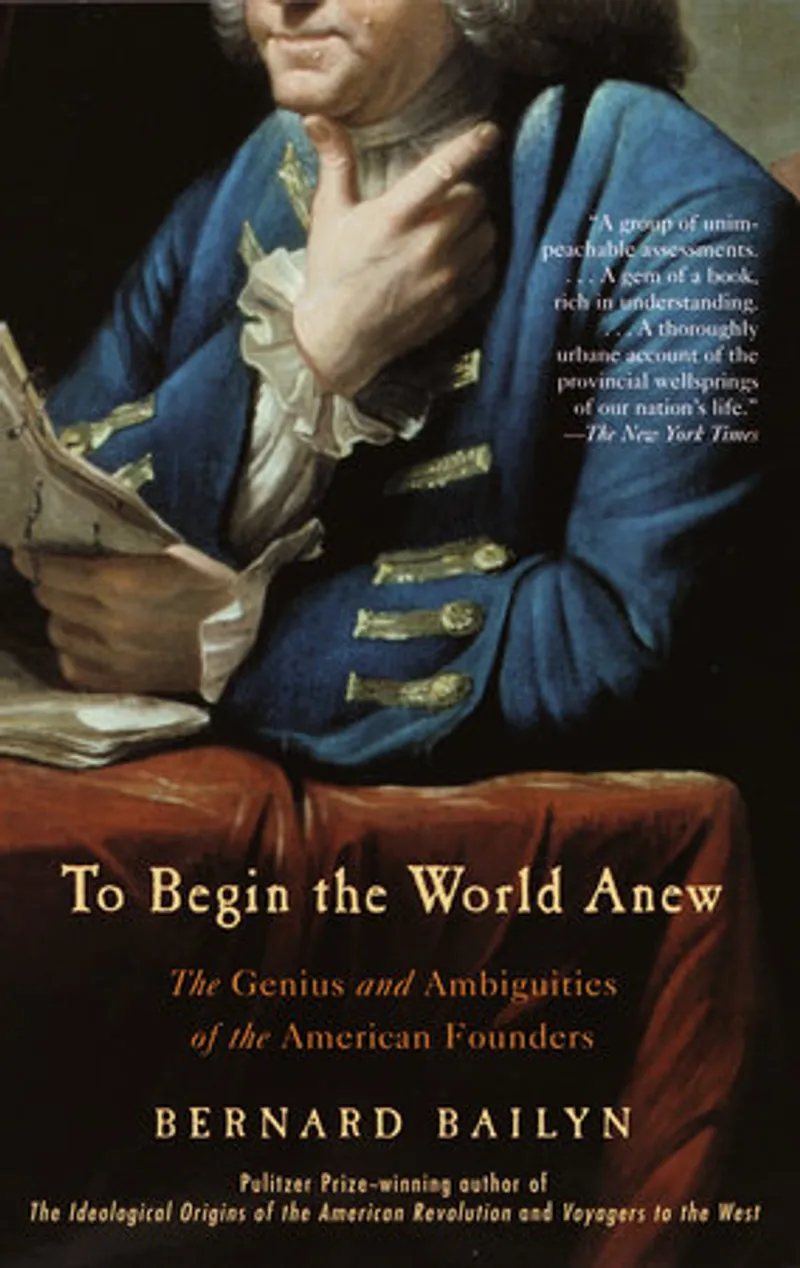

To Begin the World Anew Author: Bernard BailynPage Count: UnknownPublication Date: 2004-PRH Bernard Bailyn’s To Begin the World Anew is not just another book about the Founding Fathers—it is a masterclass in historical insight, a distillation of a lifetime’s scholarship into five razor-sharp essays that reveal the intellectual and political alchemy that forged America. A two-time Pulitzer Prize winner, Bailyn approaches his subject not as a mere chronicler of events but as an archaeologist of ideas, uncovering the hidden layers of thought that shaped the nation’s birth. What emerges is a portrait of the Founders not as mythic figures but as complex, contradictory, and profoundly original thinkers whose work still resonates across the Atlantic world. At the heart of Bailyn’s exploration is the paradox of American provincialism. In the opening essay, he argues that the very remoteness of the colonies—geographically, culturally, and intellectually—was the crucible in which a revolutionary political system was forged. Unlike Europe, where entrenched traditions and hierarchies stifled innovation, America’s periphery allowed for experimentation. The Founders, steeped in Enlightenment thought yet unbound by Old World constraints, could reimagine governance from first principles. Bailyn’s prose crackles with this tension: the colonies were both isolated and globally connected, a backwater that became the laboratory of modernity. It’s a compelling thesis, one that reframes the Revolution not as a sudden rupture but as the culmination of a long, deliberate intellectual evolution. The essays that follow are equally revelatory. Bailyn’s treatment of Thomas Jefferson is particularly nuanced, stripping away the saintly veneer to reveal a man of contradictions—idealistic yet pragmatic, a champion of liberty who owned slaves, a visionary whose contradictions shaped the nation’s future. Jefferson’s career, Bailyn shows, was a series of gambles, from the Louisiana Purchase to his battle with the Federalists, each move a calculated risk in the grand experiment of self-governance. The portrait is neither hagiography nor condemnation but a measured assessment of a man whose flaws were inseparable from his genius. Franklin, too, gets a fresh appraisal. Bailyn traces the evolution of Franklin’s image—from the humble printer to the urbane diplomat—and how his diplomacy became a model for American engagement with the world. The Federalist Papers are dissected not as dry legal tracts but as a masterstroke of political persuasion, a document that crystallized the fears and aspirations of a people teetering between order and chaos. And in the final essay, Bailyn traces the global ripple effects of American constitutional thought, showing how the Founders’ ideas inspired revolutions from France to Latin America, proving that the experiment in liberty was never just an American one. Bailyn’s style is what makes this book so compelling. He writes with the precision of a scholar and the clarity of a storyteller, avoiding jargon while never dumbing down his arguments. His sentences are tight, his transitions seamless, and his insights so well-supported that even the most skeptical reader is left nodding in agreement. He doesn’t just tell you what the Founders thought; he shows you how they thought, the intellectual currents that carried them, and the personal and political stakes of their choices. What makes To Begin the World Anew essential reading is its refusal to settle for easy answers. The Founding Fathers were not demigods, nor were they mere products of their time. They were thinkers who grappled with the same questions we face today: How do we balance freedom with order? How do we reconcile ideals with reality? Bailyn’s book doesn’t just illuminate the past—it invites us to see our own era through the lens of history. In an age where political debates often feel stale and recycled, this book reminds us that the questions the Founders asked are still alive, still urgent, and still in need of fresh answers. For anyone who wants to understand not just what America was, but how it became the nation it is today, To Begin the World Anew is indispensable. It’s a book that rewards close reading, one that will leave you with a deeper appreciation for the men who dared to begin the world anew—and for the ideas that still shape our world. #FoundingFathers #AmericanHistory #EnlightenmentThought #BernardBailyn #ConstitutionalHistory #RevolutionaryIdeas