Roman Gladiators: Glory, Fame, and Certain Death in the Arena
-
 Mark Dinn
 - 30 May, 2026 10:00
Roman Gladiators: Glory, Fame, and Certain Death in the Arena
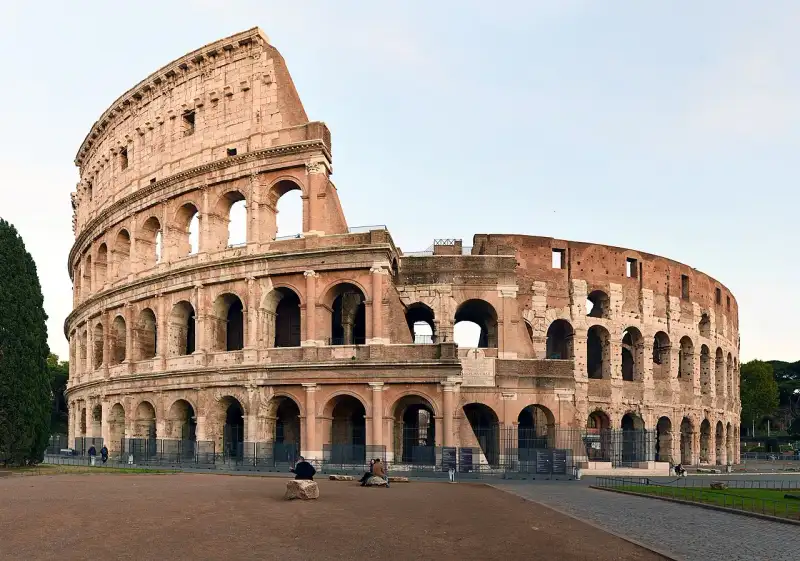
The air is thick with the coppery scent of fresh blood, mixing violently with the musk of fifty thousand sweating bodies pressing against the marble tiers of the Flavian Amphitheater. The roar of the crowd is a physical force, a tidal wave of sound that vibrates through the soles of your leather sandals. Below, on the blindingly bright sand—the harena, deliberately scattered to soak up the gore—two men circle each other. They are not merely fighters; they are demi-gods of the dirt, superstars forged in the crucibles of Roman brutality. One wields a net and trident, moving with the lithe grace of a panther. The other, encased in bronze armor that gleams like a falling sun, raises his short sword. This is not just combat. It is theater. It is politics. It is a sacrifice to the insatiable maw of Rome. #RomanEmpire #AncientHistory
Welcome to the world of the Roman Gladiator. As an author who spends his days resurrecting the ghosts of antiquity, I am endlessly drawn to these men and women who lived on the razor’s edge between immortal glory and agonizing obliteration. Their story is the story of Rome itself: magnificent, cruel, deeply disciplined, and ultimately fatal. #Gladiators #MarkDinn
The Origins of Blood: From Funerals to Spectacles
To understand the gladiator, one must look past the colossal stone arches of the Colosseum and gaze backward into the murky dawn of the Italian peninsula. The Romans did not invent this blood sport out of a mere desire for entertainment; its roots lay buried in solemn religious duty. #Etruscans #RomanHistory
The earliest recorded gladiatorial combats, known as munera, occurred in 264 BC in the Forum Boarium (the cattle market) of Rome. Three pairs of slaves fought to the death at the funeral of a prominent aristocrat, Decimus Junius Brutus Pera. This was not a sport; it was a blood sacrifice, a munus (duty or offering) to appease the spirits of the dead. The Romans likely inherited this grim tradition from their northern neighbors, the Etruscans, or the Campanians to the south. Blood spilled on the earth was believed to nourish the departed soul on its journey through the underworld.
For centuries, these games remained tied to funerals. If a patrician wanted to honor his deceased father—and simultaneously demonstrate his wealth and political power—he would sponsor a munus. What began as three pairs soon escalated. By 183 BC, a funeral hosted sixty pairs. By 65 BC, Julius Caesar, a man who understood the theatricality of power better than anyone, staged a staggering 320 pairs of gladiators wearing armor of pure silver to honor his father—who had been dead for twenty years.
The religious veneer was slipping. The munera were becoming a political weapon. If you wanted the votes of the plebeians, you didn’t just give them bread; you gave them blood. #JuliusCaesar #RomanRepublic
The Ludus: Forging Steel and Flesh
How does a man become a machine of death? The answer lies in the ludus, the gladiator training school.
To enter a ludus was to cross the River Styx while still breathing. You swore the sacramentum gladiatorium, a terrifying oath that stripped you of your humanity and reduced you to property. The oath was uncompromising: “I vow to endure to be burned, to be bound, to be beaten, and to be killed by the sword.” By speaking these words, a man surrendered his legal rights as a free person (if he had any) and became infamis, outcast, legally dead but physically alive. #Ludus #RomanLife
The schools were run by the lanista, a figure who was simultaneously despised as a flesh-peddler and courted for his invaluable assets. The most famous schools were located in Capua and later in Rome itself, such as the Ludus Magnus, which sat right next to the Colosseum and connected to it via a subterranean tunnel—a dark artery pumping life into the arena.
Life inside the ludus was a paradox of brutal discipline and exceptional care. Gladiators were an enormous investment. A prime fighter was worth a fortune, and the lanista did not want his investments dying of dysentery or breaking an ankle on uneven ground.
- The Training: Training was relentless. Recruits, called tirones, practiced with wooden swords (rudes) against a thick wooden post (palus). They were taught not just how to kill, but how to kill beautifully. The crowd demanded technique, not just butchery.
- The Brotherhood: Despite the horrific reality that they might one day have to kill the man sleeping in the next cell, gladiators formed incredibly tight-knit fraternities (collegia). They paid into communal burial funds to ensure that, if they fell, they would not be tossed into an unmarked pit. Their epitaphs, carved in stone across the empire, speak of deep friendships and surrogate families. #Brotherhood #AncientRome
Classes of Combat: The Taxonomy of Death
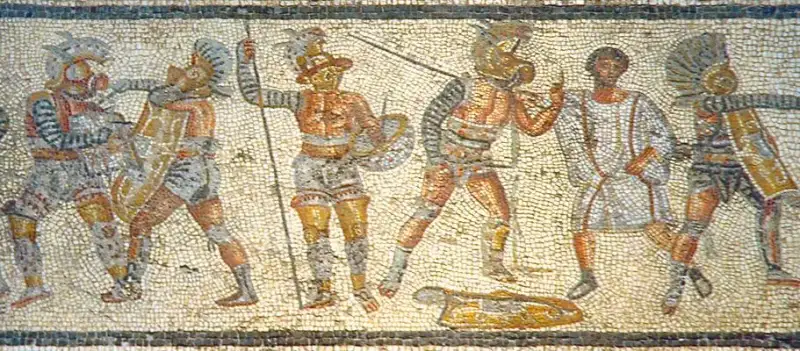
The Romans were engineers and organizers, and they applied this categorization to their blood sports. Gladiators were not merely handed a sword and told to hack at one another. They were highly specialized, trained in specific classes that were designed to fight one another in asymmetrical, carefully balanced match-ups. This ensured maximum drama and tension. #MilitaryHistory #Weapons
Here are some of the most iconic classes of the arena:
The Murmillo (The Fish Man)
Heavily armored and physically imposing, the Murmillo wore a massive helmet crested with a stylized fish. He carried a large rectangular shield (scutum) similar to a Roman legionary, and wielded the short, stabbing sword (gladius). His armor protected his head and his leading arm and leg, but left his torso exposed. He was a fortress, moving slowly but with devastating power.
The Retiarius (The Net Fighter)
The natural enemy of the Murmillo was the Retiarius, the most unique and recognizable of all gladiators. He wore virtually no armor—no helmet, no shield, no greaves. His only protection was a galerus, a metal shoulder guard on his left arm. His weapons were a weighted net (rete), a three-pronged trident (tridens), and a small dagger. He relied entirely on speed, agility, and the psychological terror of his net. The crowd loved the narrative: the nimble fisherman trying to net the lumbering sea monster. #Retiarius #GladiatorCombat
The Thraex (The Thracian)
Modeled after the fierce Thracian enemies of early Rome, this gladiator carried a small square or circular shield and wielded a sica—a wicked, curved sword designed to reach around the opponent’s shield and slash at their unprotected back or legs. He wore heavily armored greaves on both legs and a helmet distinguished by a griffin crest.
The Secutor (The Chaser)
Specifically designed to fight the Retiarius, the Secutor was similar to the Murmillo, but his helmet was smooth and round, with tiny eyeholes. Why? So the Retiarius’s net would slide right off without snagging on any crests or brims. The tiny eyeholes protected him from the trident, but severely restricted his vision and hearing, while the heavy helmet restricted his breathing. The fight between a Retiarius and a Secutor was a classic battle of endurance versus speed.
The Dimachaerus (The Two-Sword Fighter)
A rare and highly skilled class, the Dimachaerus fought with two swords, one in each hand, and wore very little armor. To survive in the arena without a shield required superhuman reflexes and a complete mastery of both offense and defense simultaneously.
The Diet of Champions: Barley Men and Bone Ash
If you imagine gladiators as ripped, lean bodybuilders akin to modern action stars, you are mistaken. The reality was much more pragmatic and fascinating. #AncientDiet #Nutrition
Gladiators were often referred to as hordearii, which translates to “barley men.” Their diet was overwhelmingly vegetarian, consisting of massive amounts of barley, beans, oatmeal, and dried fruit. Meat was a rarity. Why? Two reasons.
Firstly, barley and beans were cheap, and feeding hundreds of men was expensive. Secondly, and more importantly, this high-carbohydrate diet allowed the gladiators to build up a thick layer of subcutaneous fat. This was not a sign of poor fitness; it was biological armor. In the arena, superficial cuts were inevitable. A thick layer of fat meant a blade could slice across a gladiator’s chest or arm, producing a spectacular, crowd-pleasing spray of blood, without actually hitting any vital organs, muscles, or arteries. The fighter could continue fighting, bleeding profusely but largely unharmed, satisfying the crowd’s thirst for gore while preserving the lanista’s investment.
Furthermore, we know from bone analysis (particularly from a gladiator graveyard discovered in Ephesus, Turkey) that they consumed a strange sports drink: a concoction of plant ash mixed with vinegar. This terrible-tasting brew was essentially an ancient calcium supplement, designed to fortify their bones against fractures and aid in healing after the crushing blows of training. #Archaeology #Ephesus
Medical care was surprisingly advanced. The famous physician Galen, whose medical texts dominated Western medicine for over a thousand years, cut his teeth as a doctor at a gladiator school in Pergamum. He learned anatomy by examining the gaping wounds of fighters, treating horrific lacerations and developing advanced surgical techniques that saved countless lives.
A Day at the Games: The Symphony of Slaughter
The munera evolved into massive, state-sponsored spectacles that could last for days, weeks, or, in the case of Emperor Trajan’s celebration of his victory over Dacia, 123 consecutive days. A typical day at the Colosseum was a carefully orchestrated symphony of slaughter, divided into three distinct acts. #Colosseum #Spectacle
The Morning: Venationes (The Beast Hunts)
The day began with exotic animals. The Romans scoured the edges of their vast empire—from the Atlas Mountains of Africa to the deep forests of Germania—to bring back lions, tigers, elephants, bears, rhinos, and crocodiles. The arena was transformed into elaborate, artificial landscapes with painted trees and mechanical hills. Highly trained hunters called venatores or bestiarii would battle these beasts. It was a display of Rome’s dominance over nature itself. By the end of the morning, the sand was already soaked in blood.
The Midday: Ludi Meridiani (The Executions)
At noon, respectable citizens might leave to get lunch, because what happened next was purely brutal. This was the time for the execution of criminals, runaway slaves, and early Christians. This was not combat; it was theatrical murder. Victims were sometimes tied to posts and left to wild animals (damnatio ad bestias), or forced to act out mythological plays that ended in actual death. If the script called for Hercules to burn to death on a pyre, the condemned man was actually burned alive. It was a stark reminder of the consequences of defying Roman law. #RomanLaw #Executions
The Afternoon: The Munera (The Main Event)
As the afternoon sun cast long shadows across the arena, the main event began. The trumpets blared. The gladiators paraded in, dressed in purple and gold, displaying their weapons.
The combat was tightly regulated. A referee (summa rudis), carrying a long staff, stood in the ring to ensure the rules were followed. If a fighter dropped his shield, the fight was paused. If a gladiator was severely wounded or exhausted, he could raise one finger in the air—the signal for submission.
At this point, the combat stopped, and the gladiator’s life hung in the balance. The referee would look to the emperor, or the sponsor of the games. The sponsor would look to the crowd. If the gladiator had fought bravely, the crowd would wave their tunics and shout “Mitte!” (Let him go!). The sponsor would give the signal for missio (release), and the loser would live to fight another day.
But if the gladiator had fought cowardly, the crowd turned vicious. They would turn their thumbs—the exact gesture, pollice verso, is heavily debated by historians, but it indicated death—and yell “Iugula!” (Slit his throat!). The defeated gladiator was expected to kneel, grab the thigh of the victor, and accept the fatal thrust without flinching or crying out. To die well was the ultimate redemption. #Honor #DeathInTheArena
Gladiators Who Defied Rome
History is littered with the names of men who rose from the dust of the arena to achieve a strange, twisted kind of immortality. #HistoricalFigures #Heroes
Spartacus: The most famous of them all. A Thracian auxiliary turned slave, Spartacus led a breakout from a ludus in Capua in 73 BC. Using kitchen knives and spits, 78 gladiators fought their way out and ignited the Third Servile War. For two years, Spartacus led an army of escaped slaves and gladiators that repeatedly humiliated the mighty Roman legions. Though he was eventually defeated by Crassus and his body never found, his name became a permanent symbol of defiance against tyranny.
Flamma: The Syrian warrior who embodies the strange allure of the arena. Flamma was a Secutor who fought 34 times. He won 21 times, drew 9 times, and was granted a reprieve 4 times. What makes Flamma extraordinary is that he was offered the rudis—the wooden sword symbolizing freedom—four separate times. Four times, he was told he was a free man. Four times, he refused it, choosing to remain a gladiator. The arena was his home; the roar of the crowd was his addiction. He died at age 30, a legend of the sands.
Marcus Attilius: A rare Roman citizen who voluntarily sold himself into the arena to pay off massive debts. Attilius shocked the Roman world by defeating a champion named Hilarus on his very first day. He became a celebrity, proving that Roman blood, even when disgraced, could still dominate the arena.
Emperor Commodus: The megalomaniac who styled himself as Hercules reincarnated. Commodus was obsessed with gladiatorial combat and actually fought in the Colosseum, dragging the dignity of the imperial throne into the bloody dirt. Naturally, his fights were carefully staged. His opponents were given wooden swords, or he slaughtered wounded animals from the safety of a raised platform. His sheer insanity and debasement of the games ultimately led to his assassination in a bathtub by an athlete. #Commodus #MadEmperors
The Women of the Arena: Gladiatrices
While the vast majority of gladiators were men, the Roman arena was not exclusively a brotherhood. The gladiatrix existed, a fascinating and controversial figure in Roman history. #Gladiatrix #WomenInHistory
Female gladiators were exceedingly rare and were treated as exotic novelties. They were not permitted to wear helmets, as their gender had to be visible to the crowd. They often fought other women, or, in particularly bizarre spectacles, fought dwarves or wild boars.
One of the most famous pieces of evidence for female gladiators is a marble relief from Halicarnassus (modern Turkey) dating to the 1st or 2nd century AD. It depicts two women, heavily armed with swords and shields, locked in combat. Below them are their stage names: Amazonia and Achillia. The inscription notes that they fought to an honorable draw and were both granted a reprieve.
The existence of female gladiators deeply unsettled conservative Roman moralists. For a woman, especially one of high birth, to expose herself in the arena was considered the ultimate degradation of Roman virtue. In 200 AD, Emperor Septimius Severus finally banned women from participating in single combat in the arena, bringing an end to the era of the gladiatrix.
The Architecture of Slaughter: The Colosseum
We cannot speak of gladiators without speaking of their ultimate stage: the Flavian Amphitheater, known today as the Colosseum. #Architecture #Rome
Completed in 80 AD under Emperor Titus, the Colosseum was an engineering marvel that still staggers the imagination. It could hold upwards of 50,000 spectators, arranged in strict hierarchical seating. The Emperor and the Vestal Virgins sat at the front, senators behind them, then equestrians, then plebeian men, and finally, at the very top in the nosebleed section, women and the poorest citizens.
But the true genius of the Colosseum lay beneath the sand. The hypogeum was a massive subterranean labyrinth of tunnels, cages, and trapdoors. Hundreds of slaves worked in the suffocating heat and darkness, operating massive wooden elevators powered by capstans. A lion or a gladiator could appear seemingly by magic from a trapdoor in the arena floor, terrifying and delighting the crowd. It was a machine designed for the sole purpose of maximizing drama and bloodshed.
The Twilight of the Arena
Nothing lasts forever. Not the glory of the empire, and not the bloodlust of the arena. #FallOfRome #LateAntiquity
The decline of the gladiatorial games was a slow, agonizing process brought about by a confluence of cultural and economic shifts. The primary catalyst was the rise of Christianity. For the first three centuries of the empire, Christians had been victims of the arena, torn apart by lions for the amusement of the mob. As Christianity gained power and eventually became the state religion under Constantine in the 4th century AD, Christian writers railed against the games, viewing them as demonic, barbaric, and a sinful waste of human life.
In 404 AD, according to legend, a Christian monk named Telemachus leapt into the arena in Rome to stop a gladiatorial fight. The furious crowd stoned him to death. The Emperor Honorius, purportedly moved by the monk’s martyrdom, issued an edict permanently banning gladiatorial combat.
However, theology was not the only factor. The Roman Empire was going bankrupt. The invasions of the barbarians, political instability, and economic collapse meant that the staggering cost of maintaining the ludi, transporting exotic animals, and feeding thousands of fighters simply became unsustainable. By the 5th century, the Roman state could barely afford to pay its armies to defend the borders, let alone finance massive blood spectacles. The games faded away, replaced by the much cheaper and safer chariot races in the Circus Maximus. The Colosseum was abandoned, its marble stripped to build churches, its subterranean tunnels filling with dirt and weeds.
Echoes in Eternity: The Modern Legacy
“What we do in life, echoes in eternity.”
These words, spoken by the fictional Maximus Decimus Meridius in Ridley Scott’s 2000 cinematic masterpiece Gladiator, perfectly capture why these ancient warriors still hold us spellbound. #PopCulture #Cinema
Why do we, sitting in our comfortable, air-conditioned homes two millennia later, still care about men hacking each other to death in the dirt?
Perhaps it is because the gladiator represents the ultimate distillation of the human struggle against fate. They were men (and women) who were dealt the absolute worst hand life could offer: enslaved, brutalized, condemned to die for the amusement of others. Yet, within that hellish paradigm, they forged their own honor. They faced certain death with a cold, terrifying dignity. They created brotherhood in the abyss. They forced a society that viewed them as property to stand and applaud them as gods.
As a writer, I find their stories to be the most compelling of the ancient world. They are not the tales of emperors wrapped in silk, debating philosophy on the Palatine Hill. They are the tales of sweat, terror, and the desperate, primal will to survive one more day, one more fight, one more roar of the crowd.
The Flavian Amphitheater may be a ruin, and the blood may have long since washed out of the sand, but the spirit of the gladiator—fierce, unyielding, and eternally defiant—still echoes through the corridors of history.
Mark Dinn is a bestselling author of Historical Fiction. His latest novel, ‘The Sand and the Sword,’ explores the intertwined destinies of a Retiarius and a Roman Senator during the chaotic Year of the Four Emperors. Follow him for more deep dives into the shadows of the ancient world. #HistoricalFiction #MarkDinnBooks
#History #Gladiators