The Elegant Universe Book Review and Summary
-
 Antoine Leroy
 - 01 May, 2026 06:15
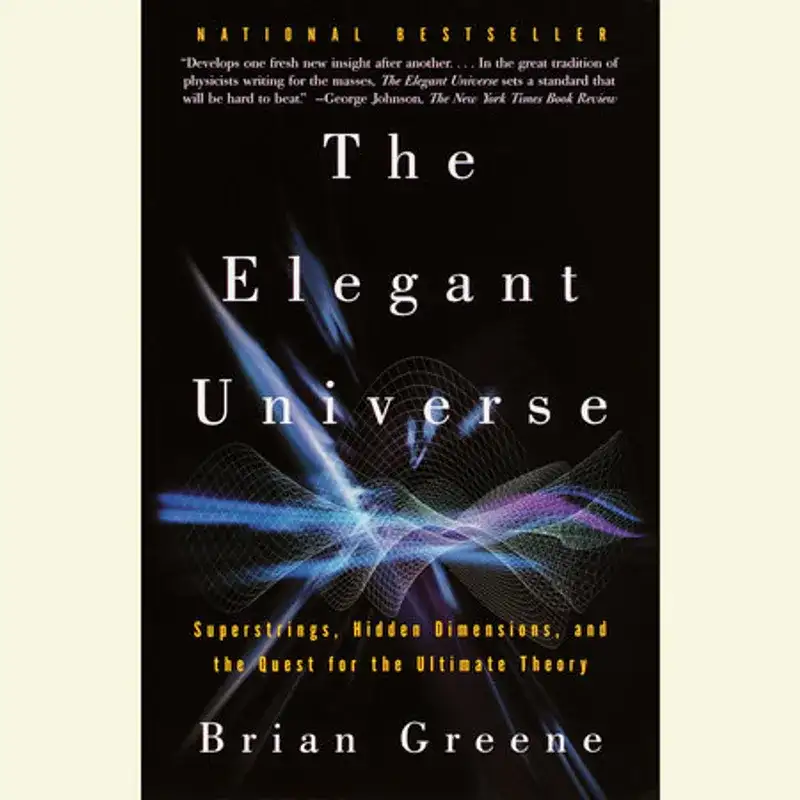
The Elegant Universe
Author: Brian Greene
Page Count: Unknown
Publication Date: 2008-PRH
Brian Greene’s The Elegant Universe is a masterclass in making the incomprehensible feel not just accessible, but exhilarating. This isn’t just a book about string theory—it’s a guided tour through the mind-bending landscape of modern physics, where the laws of the universe are rewritten in real time, and the very fabric of reality is up for grabs. Greene, a physicist and gifted storyteller, doesn’t just explain complex theories; he invites readers to experience them, weaving together the raw beauty of scientific discovery with the clarity of a seasoned communicator.
At its core, The Elegant Universe is about the quest for a single, unifying theory that could explain all the forces and particles in the cosmos—a “Theory of Everything.” For decades, physicists have been stymied by a fundamental conflict: Einstein’s general relativity, which governs the grand scales of planets and galaxies, and quantum mechanics, which rules the subatomic world. These two pillars of physics don’t play well together, like two tectonic plates grinding against each other. String theory, Greene’s chosen hero in this narrative, proposes a radical solution: the universe isn’t built from point-like particles but from tiny, vibrating strings whose harmonics give rise to all matter and forces. These strings exist in 11 dimensions (yes, 11), where space can tear and mend like fabric, and hidden dimensions curl up like forgotten garden hoses.
What makes Greene’s approach so compelling is his refusal to dumb down the science. He doesn’t shy away from equations or abstract concepts—instead, he translates them into vivid metaphors. Need to understand why extra dimensions might exist? Imagine an ant crawling on a garden hose: from a distance, the hose looks like a one-dimensional line, but up close, the ant discovers a second dimension wrapped around the tube. Greene’s analogies aren’t just clever; they’re necessary, because the universe he describes is so alien to our everyday experience that without them, we’d be lost in a fog of jargon.
His writing style is another triumph. Greene balances rigor with lyricism, shifting seamlessly between technical detail and poetic wonder. He describes the “fabric of spacetime” as something that can stretch, tear, and heal, likening it to a “cosmic trampoline” that bends under the weight of massive objects. When he turns to the concept of branes (short for membranes, the higher-dimensional objects where strings might be anchored), he conjures images of parallel universes floating like sheets in a cosmic laundry, occasionally colliding in cataclysmic events that could explain the Big Bang. It’s hard not to feel a childlike awe as he unfolds these ideas, as if he’s handing you a telescope to peer into the mechanics of creation itself.
The book’s structure is equally elegant. Greene begins with a patient primer on the crises in physics—the incompatibility of relativity and quantum mechanics, the stubborn mysteries of black holes, the elusive nature of gravity. He then introduces string theory as the most promising candidate for reconciliation, walking the reader through its evolution: from the first vibrating strings in the late 1960s (initially dismissed as a mathematical curiosity) to the dazzling M-theory of the 1990s, which unified five different string theories under a single framework. Along the way, he tackles objections head-on, acknowledging the theory’s critics and the lack of experimental evidence—yet he does so without undermining his own enthusiasm. This isn’t blind advocacy; it’s a scientist’s love letter to an idea that might be true, written with the hope that future breakthroughs will vindicate it.
Greene’s tone is one of infectious curiosity. He compares his work to that of a detective piecing together clues, or an explorer charting unknown territory. When he writes, “The universe is not only stranger than we imagine, it is stranger than we can imagine,” he’s not just quoting J.B.S. Haldane—he’s echoing his own awe. This isn’t dry exposition; it’s a conversation with a brilliant mind who’s just as thrilled by the journey as he is by the destination.
Of course, The Elegant Universe isn’t without its challenges. The deeper Greene delves into string theory’s mathematical intricacies—supersymmetry, Calabi-Yau manifolds, the holographic principle—the more the reader may feel like they’re swimming against a current. But even here, Greene’s clarity shines. He breaks down concepts into digestible chunks, often revisiting them with fresh examples until they click. The book rewards patience, not just with knowledge, but with a transformed perspective. By the end, the idea of 11 dimensions doesn’t feel like science fiction; it feels like an inevitable conclusion, a hidden layer of reality waiting to be uncovered.
What lingers most after reading The Elegant Universe isn’t just the theory itself, but the sense of wonder Greene instills. In a world where science is often reduced to headlines about black holes or multiverses, Greene reminds us that physics is more than data points—it’s a grand narrative of human ingenuity, a story of how we’ve peered into the abyss and found not chaos, but a hidden order. His book is a testament to the power of ideas, and a call to keep asking questions, even when the answers seem beyond reach.
If you’ve ever looked up at the night sky and wondered what holds it all together, this book is your guide. If you’ve ever felt the thrill of a puzzle coming together, Greene will make you feel that thrill anew. And if you’ve ever doubted whether the universe could be beautiful—well, by the final page, you’ll be convinced it is.
#StringTheory #PhysicsForEveryone #BrianGreene #TheElegantUniverse #ScienceWriting #Multiverse