The Handmaid's Tale and The Testaments Box Set Book Review and Summary
-
 Hannah Schmidt
 - 26 Dec, 2025 18:36
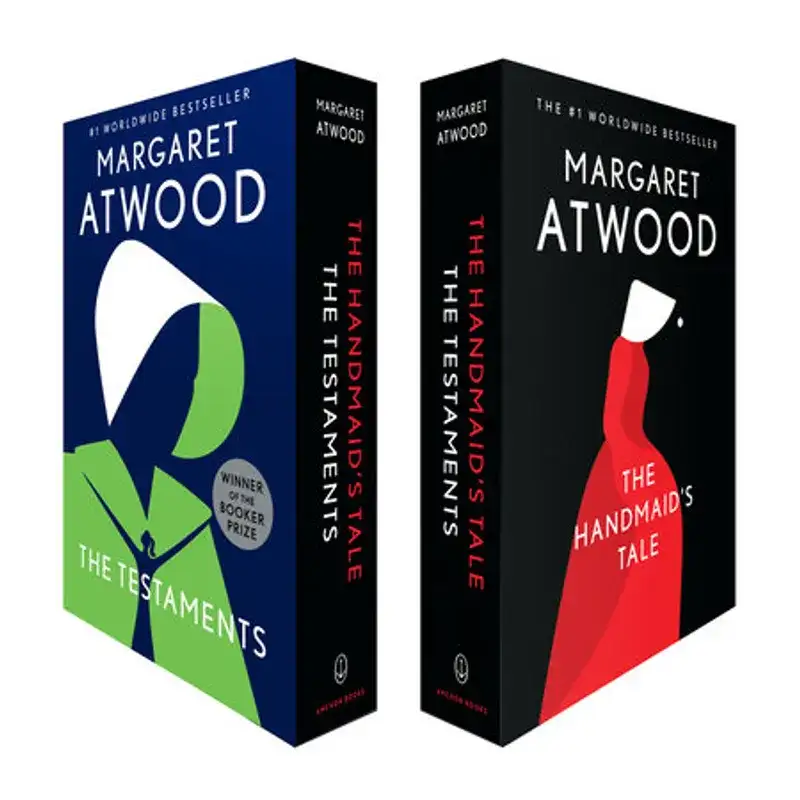
The Handmaid’s Tale and The Testaments Box Set
Author: Margaret Atwood
Page Count: Unknown
Publication Date: 2020-PRH
Margaret Atwood’s The Handmaid’s Tale and The Testaments Box Set is a masterclass in dystopian fiction—one that doesn’t just warn but haunts, doesn’t just imagine but reflects the darkest corners of human oppression. These two novels, read together, form a chilling diptych of authoritarianism, resilience, and the quiet rebellion of the human spirit. Atwood, often hailed as the patron saint of feminist dystopian fiction, crafts a world so vividly oppressive that it lingers like smoke in the lungs long after the last page.
The Handmaid’s Tale (1985), the foundational novel, introduces us to Gilead, a theocratic dictatorship born from environmental catastrophe and misogynistic extremism. Offred, its protagonist, is a Handmaid—stripped of her name, her family, her autonomy—reduced to a walking womb, a commodity in a society that treats women as either vessels or waste. Atwood’s genius lies in her ability to make the horrific feel eerily plausible. The regime’s rules aren’t fantastical; they’re extrapolations of real-world misogyny, religious extremism, and political control. The language of Gilead—where women are renamed after their Commanders (Of-Fred, Of-Warren, Of-Glen)—strips identity down to its barest, most dehumanizing form. Offred’s narration is a whisper of resistance: her memories of a pre-Gilead life, her defiance in small acts, her refusal to surrender entirely to the system that owns her.
Atwood’s prose is deceptively simple, lulling the reader with the rhythm of Offred’s voice before slamming into the brutality of her world. There are no grand speeches, no overt declarations of rebellion—just the slow, suffocating weight of oppression, made bearable only by the flicker of human connection. The novel’s power lies in its ambiguity; we never know if Offred escapes, if she survives, if she ever regains her name. The ending is a masterstroke—neither triumphant nor conclusive, but a question mark dangling over the future, forcing the reader to confront the possibility that Gilead might endure.
The Testaments (2019), the Booker Prize-winning sequel, arrives decades later to a Gilead that is rotting from within. Atwood expands the scope, weaving together the testimonies of three women: Aunt Lydia, the former enforcer turned secret dissident; Agnes, a young woman raised in Gilead’s elite; and Nicole, a Canadian teenager with ties to the resistance. Their stories converge in a narrative that is at once a reckoning and a glimmer of hope.
What’s most striking about The Testaments is its structural audacity. Atwood adopts the form of a historical investigation, framing the novel as a compilation of testimonies, news reports, and personal accounts. This device not only lends credibility to the story but also mirrors the way truth is manipulated under authoritarian regimes. The novel’s tone is darker, more urgent—less a meditation on survival than a dissection of complicity and defiance. Aunt Lydia, once a villain in The Handmaid’s Tale, becomes its most complex character, a woman who played the game to survive but who now orchestrates the regime’s downfall from the shadows. Her arc is a brutal exploration of power: how it corrupts, how it can be wielded in even the most desperate circumstances.
Atwood’s style here is sharper, more direct—less poetic, more urgent. The prose crackles with tension, especially in the sections dealing with Agnes and Nicole, whose coming-of-age stories cut through Gilead’s propaganda like a knife. The novel’s resolution is satisfying yet unsettling, offering closure without false hope. Gilead may fall, but Atwood reminds us that the roots of oppression run deep. The real victory is in the telling—the act of bearing witness, of refusing to let the past be buried.
Together, these novels form a complete, devastating portrait of a society that weaponizes fear, religion, and biology to control its citizens. Atwood’s greatest triumph is making Gilead feel inevitable—less a fantasy of the future than a magnification of the present. Her style is unadorned, precise, and devastatingly effective. She doesn’t need to invent new horrors; she only needs to hold up a mirror.
For readers who crave dystopian fiction that resonates beyond the page, this box set is essential. It’s a warning, a lament, and a defiant shout into the dark. Atwood doesn’t just predict the future; she forces us to confront the fragility of our own freedoms.
#Atwood #TheHandmaidsTale #TheTestaments #DystopianFiction #FeministLiterature #MargaretAtwood