The Wind-Up Bird Chronicle Book Review and Summary
- 25 Feb, 2025 08:38
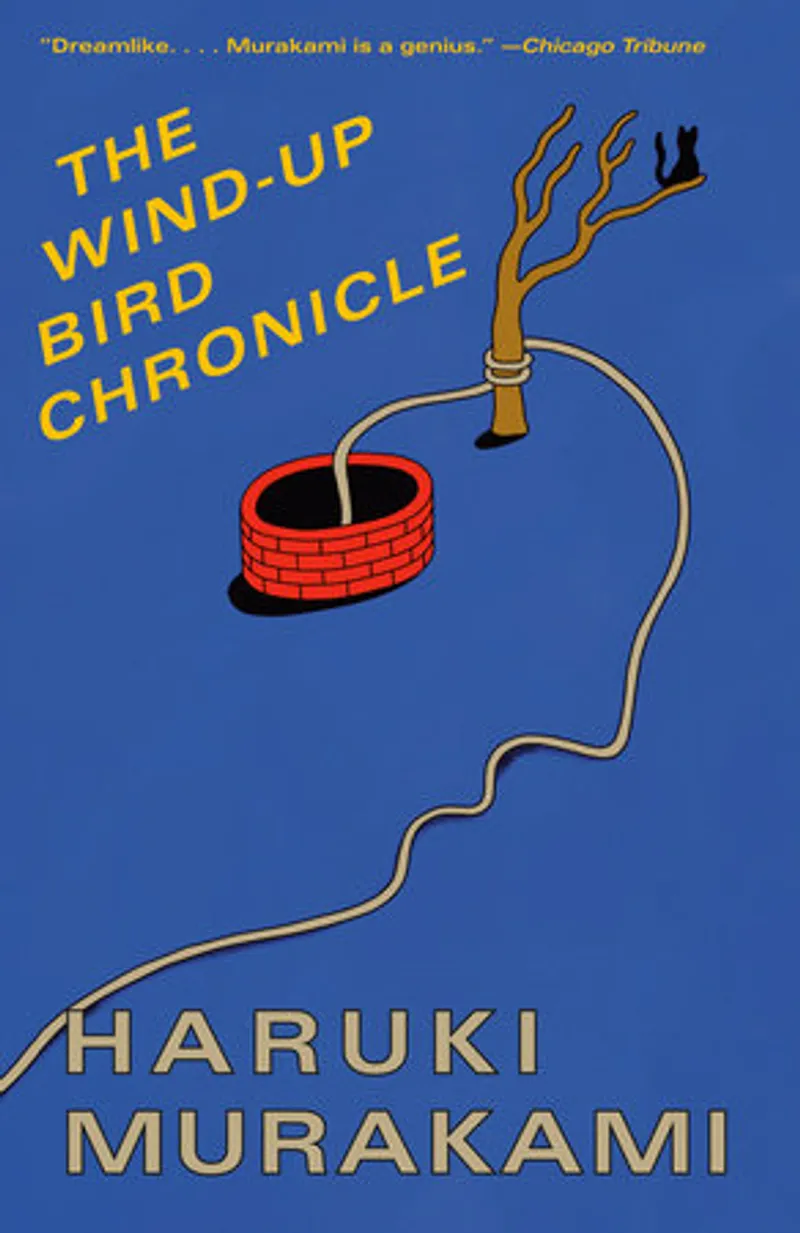
The Wind-Up Bird Chronicle
Author: Haruki Murakami
Page Count: Unknown
Publication Date: 1998-PRH
The Wind-Up Bird Chronicle: A Labyrinth of Memory, Loss, and the Uncanny
Haruki Murakami’s The Wind-Up Bird Chronicle is not just a novel—it is an experience, a descent into a world where the boundaries between reality and dream blur, where the past clings to the present like wet silk, and where the search for a missing cat evolves into a metaphysical odyssey. Published in 1998, this sprawling, hypnotic work is a detective story, a marital elegy, and a historical excavation, all woven together with Murakami’s signature blend of surrealism, melancholy, and dark humor. It is a book that lingers in the mind long after the last page, its images—dry wells, talking cats, wartime atrocities, and a man sitting in a bathtub listening to the rain—haunting like half-remembered dreams.
At its core, The Wind-Up Bird Chronicle is a meditation on absence. Toru Okada, the passive yet introspective protagonist, begins his journey searching for his missing cat, then his wife Kumiko, who has abruptly left him without explanation. What unfolds is less a traditional mystery than a slow unraveling of the self, a journey into the voids of memory and desire. Murakami’s Tokyo is not the neon-lit metropolis of cyberpunk fantasies but a city of hollows, where the ordinary—suburban houses, quiet neighborhoods, the hum of a refrigerator—hides depths of strangeness. The novel’s true mystery is not Kumiko’s disappearance but the nature of reality itself. Is Toru losing his grip on the world, or is the world itself shifting around him? The answer, Murakami seems to suggest, is both.
The novel’s most striking feature is its dreamlike structure. Murakami refuses to anchor the reader in firm ground; instead, he invites them to float in a current of shifting perspectives, unreliable narrators, and sudden, inexplicable events. Toru’s encounters—with a psychic prostitute, a war veteran with a missing eye, a mysterious woman in a well—feel less like plot points and more like fragments of a larger, unspoken truth. The well, in particular, becomes a symbol of the subconscious, a place where Toru descends to confront his own emptiness and, perhaps, the collective trauma of Japan’s wartime past. The novel’s historical layer, centered on Japan’s forgotten campaign in Manchuria, is not just backdrop but a living wound, a reminder that the past is never truly buried.
Murakami’s prose is deceptively simple, lulling the reader into a false sense of security before pulling the rug out with a sudden shift in tone or reality. His dialogue crackles with dry wit, and his descriptions—of food, of weather, of the tactile world—are so vivid they feel like sensory memories. Yet beneath the surface lies a current of unease, a sense that the world is not as it seems. The novel’s most chilling moments are not the supernatural elements (though they are unsettling) but the quiet, human horrors: the way Kumiko’s brother, Noboru Wataya, manipulates and torments Toru, or the matter-of-fact brutality of the war scenes, which Murakami renders with a clinical detachment that makes them all the more disturbing.
What makes The Wind-Up Bird Chronicle so compelling is its refusal to provide easy answers. Toru’s journey is not one of resolution but of acceptance. He does not “solve” the mystery of his wife’s disappearance so much as he learns to live with the absence, to find meaning in the void. In this way, the novel is a reflection on modern alienation, on the way we construct narratives to make sense of our lives, even when those narratives are built on sand. Murakami’s genius lies in making the reader complicit in Toru’s search, in making them feel the weight of the unsaid, the unseen.
For all its darkness, the novel is not without humor or warmth. Toru’s interactions with his quirky neighbors, his surreal conversations with a talking cat, and the occasional bursts of absurdity (a man who communicates only through written notes, a room that seems to exist outside of time) keep the story from becoming oppressive. Murakami balances the uncanny with the mundane, creating a world that is at once familiar and utterly alien.
In the end, The Wind-Up Bird Chronicle is a book about the things we lose and the things we find in their place. It is about the way memory distorts, the way desire shapes reality, and the way the past never truly leaves us. Murakami does not offer closure, but he offers something more valuable: the sense that the search itself is the point. The novel lingers like a half-remembered dream, its images and ideas echoing long after the final page.
If you’ve ever felt the ground shift beneath your feet, if you’ve ever stared into a dark well and wondered what lies at the bottom, this book is for you. It is a masterclass in the uncanny, a testament to the power of ambiguity, and a reminder that sometimes the most profound truths are the ones we can’t quite put into words.
#WindUpBirdChronicle #Murakami #MagicalRealism #JapaneseLiterature #ExistentialFiction #TokyoNoir