A Brief History of Time Book Review and Summary
-
 Elena Volkova
 - 27 Jan, 2026 08:52
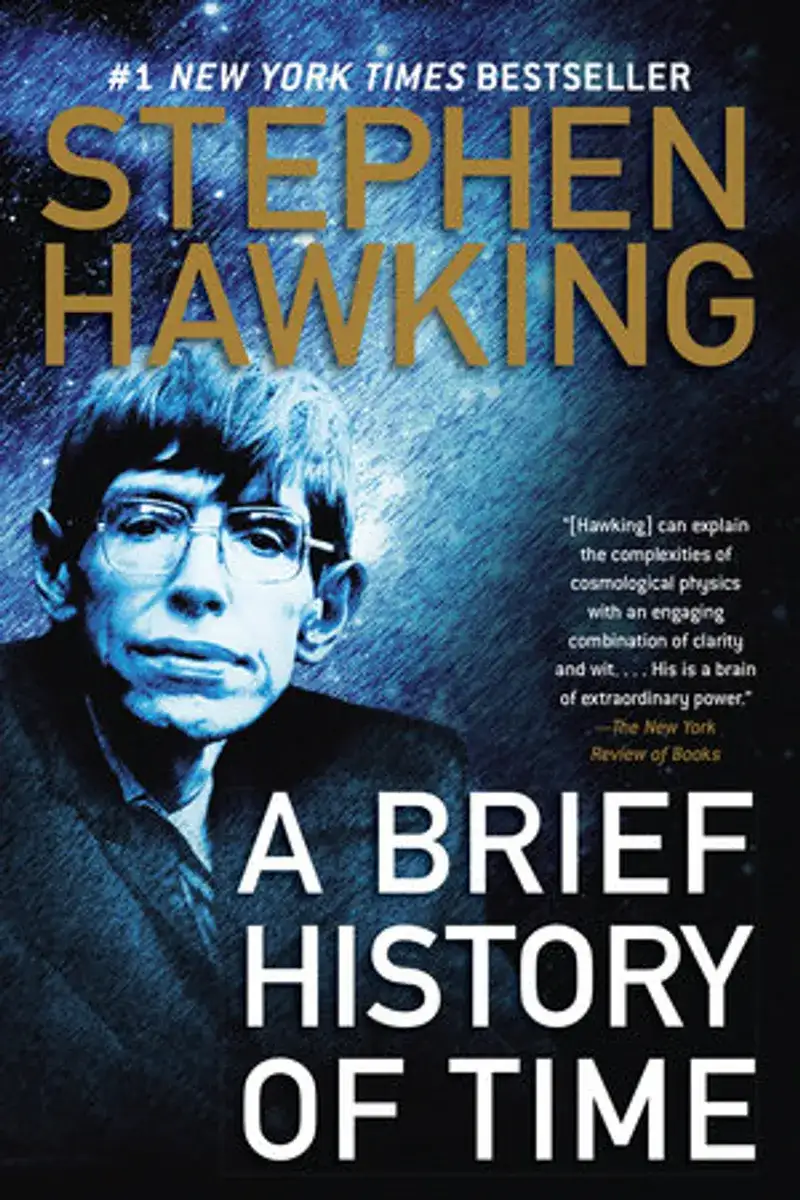
A Brief History of Time
Author: Stephen Hawking
Page Count: Unknown
Publication Date: 1998-PRH
Stephen Hawking’s A Brief History of Time is not just a book—it’s a voyage into the deepest mysteries of the universe, written by one of the most brilliant minds of our era. Published in 1988, this masterpiece has endured as a cornerstone of popular science, blending profound cosmological theories with Hawking’s signature clarity and wit. Unlike dense textbooks that alienate non-scientists, Hawking invites readers into a world of black holes, quantum mechanics, and the origins of time itself, making complex ideas feel almost tangible. The book’s enduring appeal lies in its ability to turn abstract science into a gripping narrative, where each chapter peels back another layer of cosmic wonder.
At its core, A Brief History of Time tackles the grandest questions humanity has ever asked: How did the universe begin? Will it end? Are there other dimensions beyond our own? Hawking approaches these inquiries not as a dry academic but as a storyteller, weaving together the Big Bang, the nature of time, and the enigmatic pull of gravity with a conversational ease. He doesn’t shy away from the mind-bending concepts—like the warping of spacetime or the possibility of a universe with no boundaries—but his genius lies in stripping them down to their essence. For instance, his explanation of black holes isn’t a labyrinth of equations but a vivid analogy: imagine space as a stretched rubber sheet, and a black hole as a bowling ball sinking into it, warping everything around it. It’s a trick only Hawking could pull off—making the incomprehensible feel intimate.
Hawking’s style is deceptively simple yet rigorously precise. He avoids jargon where possible, substituting it with vivid imagery and patient analogies. When discussing the “arrow of time”—why we remember the past but not the future—he compares it to a cup of spilled coffee that never spontaneously reassembles. The tone is never condescending; even when tackling topics like the no-boundary proposal (his collaboration with Jim Hartle), he maintains a sense of awe that’s infectious. His humor sneaks in, too—like when he quips that the discovery of black holes was “a triumph of pure reason” or muses that asking what came before the Big Bang is “like asking for a point one mile north of the North Pole.” It’s this blend of intellectual rigor and dry wit that makes the book so engrossing.
Yet, what truly sets A Brief History of Time apart is its philosophical undertone. Hawking doesn’t just explain science; he reflects on its implications. He ponders whether a unified theory of physics could one day answer why the universe exists at all, and whether God—a concept he revisits with nuance—has a place in a cosmos governed by mathematical laws. His agnosticism isn’t preachy; it’s exploratory. He writes, “If we find a complete theory, it would be the ultimate triumph of human reason—for then we would know the mind of God.” The line is both poetic and loaded, hinting at the awe Hawking himself felt toward the universe’s mysteries. It’s a reminder that science, for him, is not just about cold facts but about the human quest for meaning.
The book’s structure is another triumph. Hawking guides the reader from the basics of relativity and quantum mechanics to the frontiers of theoretical physics, building knowledge incrementally. Early chapters lay the groundwork, while later ones delve into cutting-edge ideas like superstring theory and the holographic principle. Even when the material grows challenging, Hawking’s clarity keeps the reader anchored. It’s as if he’s holding your hand, saying, “Trust me, we’ll figure this out together.” The result is a book that rewards both casual readers and those with a deeper scientific curiosity.
That said, A Brief History of Time isn’t without its critics. Some argue that the 1998 edition (the one referenced here) feels slightly dated, as advancements like the detection of gravitational waves or the James Webb Space Telescope’s discoveries have since expanded our understanding. Yet, the book’s core ideas remain timeless. Hawking’s insights into black holes, the Big Bang, and the nature of time are foundational, and his ability to convey them transcends the passage of years. The book is less about the latest data and more about the eternal questions—questions that feel just as urgent today as they did in 1988.
Ultimately, A Brief History of Time is a testament to Hawking’s genius—not just as a physicist, but as a communicator. He transforms the cosmos from an abstract void into a living, breathing entity, full of drama and possibility. The book doesn’t just inform; it inspires. It leaves you staring at the night sky with a new sense of wonder, wondering about the invisible forces shaping everything we see—and don’t see. In an era where science is often reduced to headlines or soundbites, Hawking’s work is a rare gem: a bridge between the ivory tower and the everyday mind.
If you’ve ever gazed up at the stars and wondered how it all began, or what lies beyond the edge of the observable universe, this book will not just answer your questions—it will ignite your imagination.
#StephenHawking #Cosmology #BlackHoles #BigBang #ScienceWriting #UniverseSecrets