Turkish Delight: A Sweet #history
Known locally as lokum, Turkish Delight is arguably the most famous confection to emerge from the Middle East. With its jewel-like appearance, delicate dusting of powdered sugar, and uniquely chewy texture, it has enchanted sweet tooths for centuries. Far from the mass-produced, gelatinous cubes often found in Western supermarkets, authentic Turkish Delight is a triumph of culinary chemistry and Ottoman imperial history.
The Legend of Hacı Bekir
The origins of lokum stretch back to the late 18th century, centering around an ambitious confectioner named Bekir Efendi. Leaving his hometown in the mountains of Kastamonu, he arrived in #Istanbul in 1777 and opened a small candy shop in the bustling Bahçekapı district. At the time, sweets in the Ottoman #empire were primarily hard candies made from crystallized sugar or fruit boiled in honey and molasses.
Bekir Efendi revolutionized the industry by incorporating a relatively new ingredient: cornstarch. By patiently boiling sugar syrup, water, and cornstarch together for hours, he achieved a soft, pliable, and perfectly chewy gel. The creation was dubbed rahat-ul hulküm, an Arabic phrase meaning “comfort of the throat,” which was eventually shortened to lokum. His confections were so spectacular that he was appointed Chief Confectioner to the Ottoman Palace, and his original shop, Ali Muhiddin Hacı Bekir, still operates in Istanbul today.
The Craftsmanship of Lokum
The magic of authentic Turkish Delight lies in the slow, meticulous boiling process. The mixture must be stirred continuously in massive copper cauldrons until it reaches the perfect consistency. Once achieved, flavorings and inclusions are added.
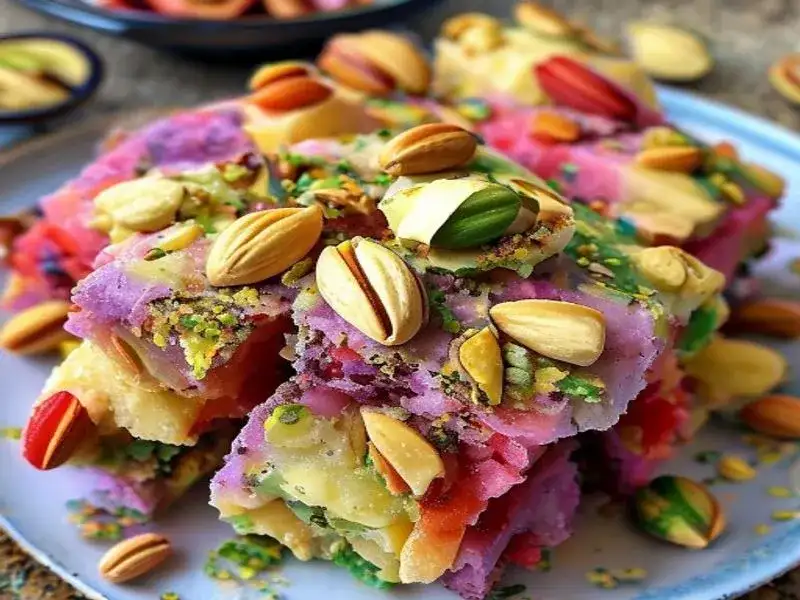
Traditional flavors rely heavily on floral and botanical essences. Rosewater, which imparts a fragrant, distinctly pink hue, is the classic standard. Mastic—a piney resin from the Aegean island of Chios—provides a sophisticated, earthy chew. Other beloved variations are heavily packed with double-roasted pistachios from Gaziantep, walnuts, or hazelnuts, and brightened with lemon or pomegranate juice.
A Global Phenomenon
Turkish Delight’s fame spread to the West in the 19th century when an unknown British traveler purchased cases of it from Hacı Bekir’s shop and shipped them to England, dubbing the sweet “Turkish Delight.” It quickly became a highly sought-after delicacy among European high society.
Today, lokum remains an integral part of Turkish #culture. It is the customary accompaniment to a strong cup of Turkish coffee, a traditional gift brought when visiting a friend’s home, and a colorful fixture during religious holidays like Eid. It is a sweet reminder of the grandeur and innovation of the Ottoman culinary arts.
#TurkishDelight #Lokum #OttomanHistory #HaciBekir #Confectionery #Rosewater #Pistachio #SweetTreats #DessertHistory #TurkishCuisine
#turkishfood #recipe #turkishdelightasweethistory #anatoliancuisine #demirsef #delicious #food