Echoes from the Cradle: My Quest for the Waxed Reed Boats of Iraq's Ancient Marshes
-
 John Explorer
 - 30 Jun, 2026 05:45
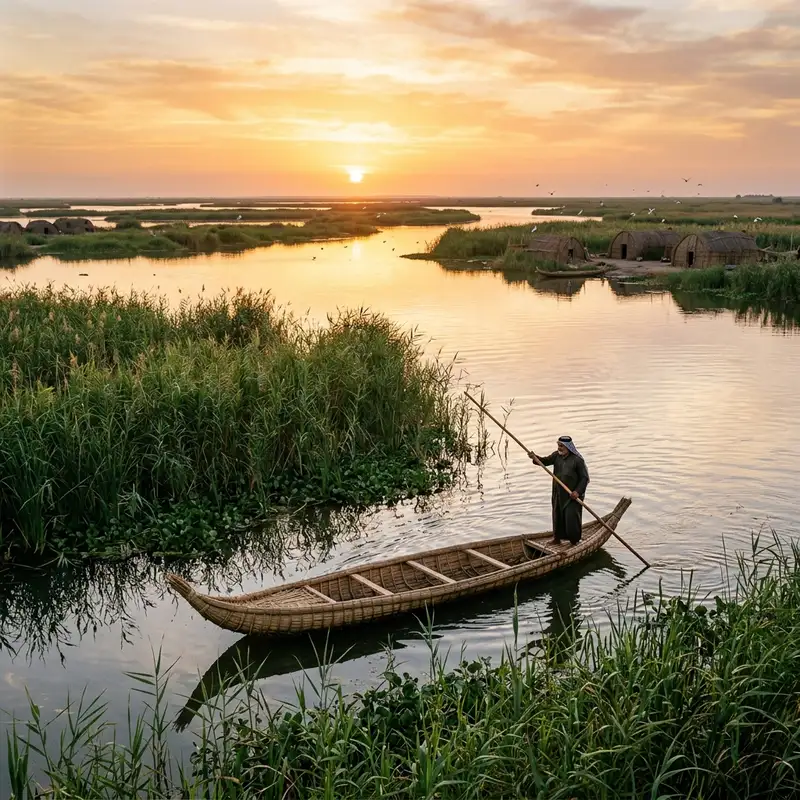
The first thing that struck me wasn’t the heat, or the dust, or even the subtle scent of #ancient earth meeting brackish water. It was the silence. Not an empty silence, but one pregnant with the rustle of reeds, the distant cry of a marsh harrier, and a profound, almost audible, hum of #history. This was the Mesopotamian Marshes, the so-called ‘Garden of Eden,’ a landscape so primordial it felt like stepping not just into another country, but another epoch entirely. My compass, however, wasn’t pointing towards archaeological dig sites or famed ziggurats. My quest was far more subtle, a chase after a living, breathing antiquity: the almost-forgotten art of the waxed reed boat, and the whispers of the last artisans who still knew its secrets.
A Flicker in the Digital Mire: The Genesis of a Niche Quest
Most #travel itineraries for Iraq, even the adventurous ones, rightly focus on Baghdad’s bustling markets, the haunting ruins of Babylon, or the sacred cities of Najaf and Karbala. The marshes, if mentioned at all, often carry caveats of inaccessibility or past conflict. But a fleeting documentary clip, a grainy photograph shared in an obscure online forum, had lodged itself in my mind like a forgotten legend. It depicted a lean, sun-weathered man, his hands caked with mud and tar, meticulously binding reeds into the elegant, sweeping form of a boat – a mashhoof or a tarada. The image spoke of resilience, of a deep connection to a place that modern civilization seemed determined to overlook, if not erase.
I’d chased lost tribes in the Amazon, trekked forgotten pilgrimage routes in Bhutan, and delved into the culinary secrets of remote Himalayan valleys. But this felt different. This wasn’t merely about witnessing a #culture; it was about understanding the essence of human adaptation, a craft that had sustained a unique civilization for millennia, virtually unchanged since the Sumerians carved similar vessels on their cylinder seals. The challenge was immense: navigating a region fraught with misconceptions, limited infrastructure, and the delicate socio-political landscape of post-conflict Iraq. But the pull of that ancient whisper, the call of a dying art form, was irresistible.
My #journey began in Basra, a city of canals often dubbed the ‘Venice of the East,’ though its reality is far grittier and more complex. From there, it was a multi-stage affair: a hired car over bumpy, sometimes non-existent roads, then a transfer to a small, motorized skiff to penetrate deeper into the labyrinthine waterways. The air grew heavier, thick with the scent of damp earth and life. The horizon transformed into an endless tapestry of towering reeds, stretching as far as the eye could see, broken only by the occasional glimpse of a mudhif – the magnificent, arched guest houses built entirely from bundled reeds – or a flock of migrating birds.
The Marsh Dwellers: Guardians of a Liquid World
The people of the marshes, the Ma’dan or ‘Marsh Arabs,’ are a resilient community whose lives are inextricably linked to the water. Their homes are built on artificial islands of compacted mud and reed, their sustenance drawn from fishing, hunting, and raising water buffalo. Their ancient way of life faced near-total annihilation under Saddam Hussein’s regime, which deliberately drained the marshes in the 1990s as a punitive measure. The subsequent ecological and human devastation was immense, a deliberate act of cultural genocide. Yet, against all odds, the marshes are slowly recovering, a testament to #nature’s tenacity and the unwavering spirit of the Ma’dan, many of whom have returned to rebuild their lives and, crucially, their traditions.
My primary objective led me to a small settlement, little more than a cluster of mudhifs and reed huts on a particularly fertile island. Here, I was introduced to Sheikh Abbas, an elder with eyes that held the wisdom of generations and hands gnarled from a lifetime of working with the marsh. His hospitality was immediate and profound, a hallmark of Iraqi culture. Over countless cups of strong, sweet chai, and plates of freshly caught fish, he began to unravel the story of the mashhoof and the tarada.
The mashhoof is the smaller, more common paddling or punting boat, used for daily tasks like fishing, transport, and buffalo herding. The tarada, on the other hand, is a larger, grander vessel, often up to 15 meters long, traditionally used for ceremonial purposes or by tribal leaders. Both are masterpieces of engineering, crafted entirely from the abundant reeds, mud, and natural bitumen found in the marshes. They are designed for stealth, stability, and speed through shallow, often densely vegetated waterways.
The Sacred Geometry of Reeds and Tar
The construction of a reed boat is not merely a utilitarian act; it is a ritual, a passing down of knowledge, a dialogue with the environment. Sheikh Abbas introduced me to his nephew, Karim, who, despite the lure of urban life, had chosen to stay and apprentice under his uncle, determined to keep the craft alive. Karim was in the midst of building a new mashhoof, and I was privileged to witness the process firsthand.
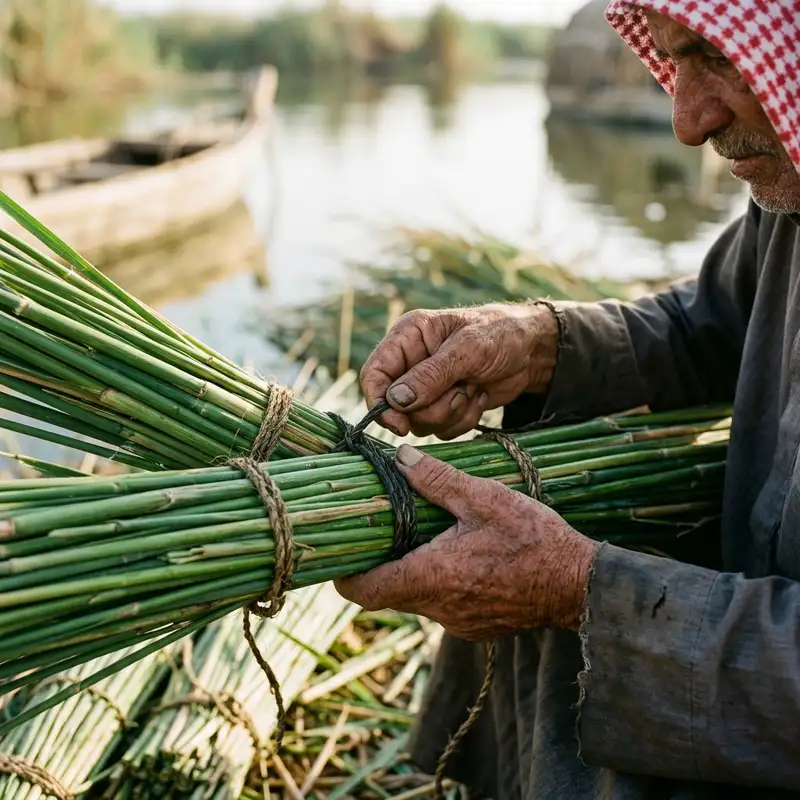
The journey begins with the reeds themselves. Only specific types of reeds, tall and strong, are harvested at certain times of the year. They are cut, dried, and then painstakingly sorted. Bundles of reeds are then carefully selected for different parts of the boat – thicker bundles for the keel and main structure, finer ones for the hull. The ingenuity lies in how these bundles are manipulated. They are not simply tied; they are compressed, twisted, and bent into shape using minimal tools, relying almost entirely on the strength and precision of the artisans’ hands.
I watched, mesmerized, as Karim and his small team worked. They began with the ‘spine’ of the boat, forming a thick, central keel from multiple bundles. Then, layer by layer, more bundles were lashed onto this frame, gradually forming the upward-curving prow and stern, and the elegant, low sides. The binding material itself is often twine made from date palm fibers or even re-purposed plastic rope in modern times, but traditionally, it would have been natural fibers. The precision required to maintain the boat’s symmetrical curvature and structural integrity is astounding, performed without blueprints or measurements, relying solely on generations of inherited skill and an innate understanding of materials.
The most crucial, and perhaps most ancient, step is the ‘waxing’ or tarring. Once the basic reed structure is complete, it must be made watertight. This is achieved by applying a thick layer of natural bitumen (tar), locally known as gīr, to the exterior. This sticky, black substance, which bubbles up naturally in certain areas of Iraq, has been used since Sumerian times to waterproof everything from boats to bathhouses. Karim meticulously heated the tar over a small fire, then, using a brush made of woven reeds, carefully spread it over the entire outer hull. The scent was pungent, earthy, and strangely captivating, an olfactory link to countless generations of boat builders.
Journey Through Time: A Ride on a Living Relic
When the mashhoof was finally complete, gleaming black and smelling of fresh tar, Karim offered me the chance to experience the marshes from its unique perspective. Stepping into it, I felt an immediate connection to the past. The boat was surprisingly stable, its shallow draft allowing it to glide effortlessly over submerged vegetation. Karim, standing at the stern with a long punting pole, navigated the labyrinthine channels with an intuitive grace that only someone born to this environment could possess.
We moved silently, the only sounds the gentle splash of the pole, the whisper of wind through the reeds, and the myriad calls of unseen birds. Fish jumped, dragonflies darted, and water buffalo grazed placidly in the distance. The marsh, so often portrayed as a desolate or dangerous place, revealed itself as an ecosystem teeming with life, a vibrant, interconnected world that demanded respect and understanding. It was easy to imagine ancient Sumerians, Akkadians, and Babylonians traversing these very waters in similar vessels, their lives as intertwined with the marsh as Karim’s own.
Sheikh Abbas later recounted stories passed down through his family, tales of how these boats were central to everything: marriages, funerals, trade, and even tribal skirmishes. The tarada, in particular, was a symbol of status and tribal power, its long, elegant lines cutting through the water like a floating monument. He spoke of the pride in crafting a boat that could endure, a vessel that carried not just goods or people, but the very spirit of the Ma’dan.
The Shadow of Modernity and the Hope for Revival
The survival of this craft, however, hangs by a precarious thread. The draining of the marshes in the 1990s devastated the ecosystem and displaced hundreds of thousands of people. While significant areas have been reflooded since 2003, and the marshes were declared a #UNESCO World Heritage site in 2016, challenges remain. Climate change brings increasing drought, upstream damming in Turkey and Iran reduces water flow, and pollution threatens the delicate balance of the environment. More fundamentally, the younger generation, facing economic hardship and drawn to the perceived opportunities of cities, are less inclined to embrace the physically demanding and often unrewarding life of a marsh dweller or artisan.
Karim, however, represents a sliver of hope. He spoke passionately about the importance of his work, not just as a means of livelihood, but as a vital link to his heritage. He dreams of establishing a small workshop, perhaps even attracting visitors who are genuinely interested in learning about the craft and the marsh culture. His efforts, and those of others like him, are crucial. If the skill of building these waxed reed boats is lost, it won’t just be a craft that vanishes; it will be a profound piece of human history, a tangible connection to the dawn of civilization, that dissipates into the reeds.
My time in the marshes was a profound lesson in resilience, human ingenuity, and the delicate balance between tradition and progress. It reminded me that the most extraordinary travel experiences often lie not in grand monuments, but in the quiet corners where ancient ways stubbornly persist, sustained by the hands and hearts of a few dedicated individuals. To witness the building of a mashhoof is to see history being forged, one reed at a time. To glide across the water in one is to journey through time, carried on the very same currents that nourished Mesopotamia’s earliest civilizations. This forgotten art isn’t just about boats; it’s about identity, survival, and the enduring human spirit.
As I left the marshes, the reeds once again dissolved into a shimmering horizon. But the silent scribe of the Shatt, the memory of those waxed reed boats, their sleek forms cutting through the water, and the quiet determination of their makers, had etched themselves indelibly onto my soul. It’s a story whispered not just by the wind through the reeds, but by every drop of water, every grain of mud, and every skilled hand fighting to keep an ancient heritage afloat.
#IraqiMarshes #ReedBoats #HiddenCulture #Mesopotamia #DyingArt
#Travel #Culture