The Crystal Spine of Afar: An Odyssey Through Ethiopia's Ancient Salt Routes
-
 John Explorer
 - 21 Jun, 2026 19:15
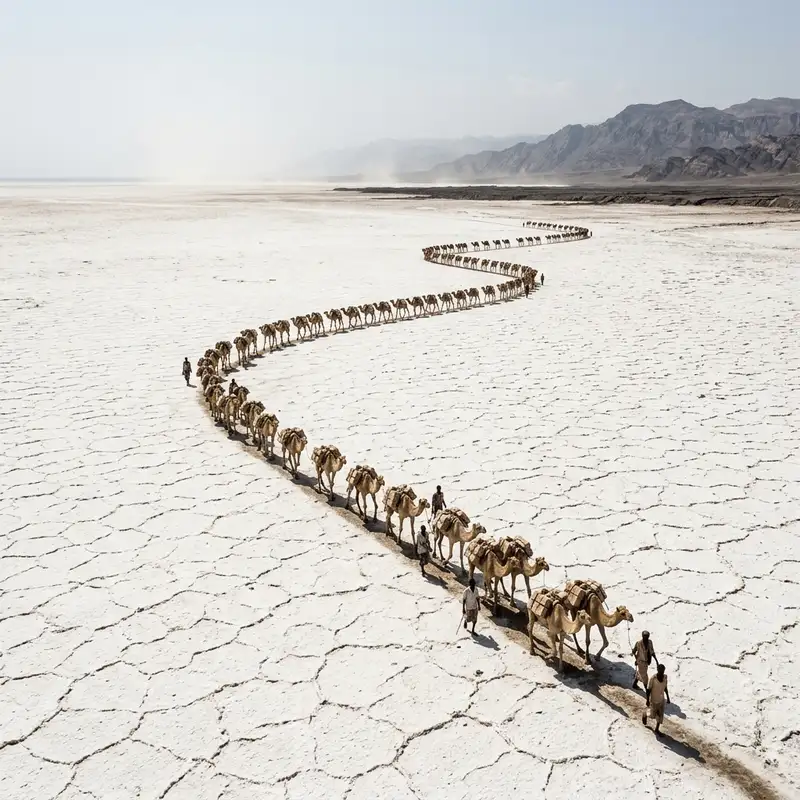
Seventy-five meters below sea level, where the Earth’s skin puckers and weeps sulfuric tears, where the air shimmers with a heat that feels less like sunlight and more like the breath of a dragon, a rhythmic clink-clack cuts through the profound silence. It’s the sound of a pickaxe striking rock, not gold, but a commodity infinitely more valuable in this landscape: salt. This isn’t a museum or a curated cultural performance; this is the Danakil Depression, Ethiopia, a place often dubbed the ‘Crucible of Creation’ and, for me, the stage for an archaeological expedition not through ruins, but through living #history: the last independent salt caravans of the Afar people.
My #journey, as always, began with a whispered rumor, a faint signal on the periphery of conventional #travel lore. While many venture to Danakil for the otherworldly Dallol sulfur springs or the fiery maw of Erta Ale volcano, my compass pointed deeper, towards the stark white plains where generations have carved out an existence from the very bedrock of the planet. I wasn’t searching for geological wonders, but for the human story etched into the salt flats – an #ancient, arduous, and almost unbelievably resilient trade route on the verge of disappearing.
The Lure of the Labyrinth: Why Salt?
To understand the allure of this quest, one must first grasp the profound historical significance of salt. For millennia, before refrigeration and modern transport, salt was not merely a seasoning; it was currency, a preservative, a symbol of wealth and power. In Ethiopia, particularly, the Amhara heartland was entirely dependent on salt from the Afar lowlands, transforming this crystalline mineral into the very backbone of their economy. Blocks of salt, known as Amole, were once used as a form of money, traded for grains, tools, and textiles. The routes connecting the Danakil flats to the highlands were Ethiopia’s arteries, pulsating with the tireless movement of caravans.
Today, much of that trade has been supplanted by modern trucking and industrially mined salt. The romantic, perilous image of camels laden with sparkling white blocks, navigating merciless terrain under an unforgiving sun, has faded from common memory. Yet, in the most remote corners of the Afar region, a stubborn few continue this ancestral practice. They are the inheritors of an extraordinary legacy, guardians of a tradition that defies the logic of the modern world. It was this defiance, this deep-seated connection to an ancient way of life, that beckoned me.
Gateway to the Underworld: Entering Afar Territory
The journey to the salt flats begins not with a gentle descent but a jarring plunge. From the relative coolness of Mekele, the capital of Tigray, the landscape quickly transforms. The asphalt gives way to corrugated dirt tracks, then to no track at all, just a path woven between jagged volcanic rocks and sun-baked earth. The air, initially warm, steadily intensifies, pressing down with a tangible weight. Even the wind, when it came, felt hot, like a blast from an oven.
Our convoy, a collection of battle-hardened 4x4s, was essential. This is not a journey for the faint of heart, nor for the unguided. The Afar region is #beautiful in its desolation, but it is also a land of tribal complexities and stark realities. Our guide, a seasoned Afar elder named Mohamud, with eyes that seemed to hold the wisdom of a hundred desert crossings, was not merely a navigator but a cultural bridge. He spoke of the land with an almost spiritual reverence, detailing its dangers – flash floods, extreme heat, and the ever-present threat of scarcity – with a calm resignation born of lifelong familiarity.
Our first night was spent under a canopy of stars so bright they seemed to hum, the silence broken only by the distant calls of unseen creatures. The heat, even after sunset, was oppressive, leaching energy from bone and muscle. But it was also a cleansing heat, stripping away the superfluous, leaving only raw presence. It felt like standing at the threshold of a different epoch, a world where humanity’s struggles against the elements were still direct, unmediated.
Echoes of a Vanished #empire: Salt as Sustenance and Coin
Before dawn, as the sky bled from charcoal to fiery orange, Mohamud recounted the history of salt. “Our ancestors,” he began, gesturing towards the vast, featureless horizon, “they say the sea used to be here, many, many years ago. When it dried, it left us this gift.” The ‘gift’ was a treasure that shaped empires. For centuries, the Abyssinian Empire relied heavily on Afar salt. The Amole currency, rectangular blocks painstakingly cut from the salt pan, facilitated trade across the Horn of Africa. Each block, standardized in size and weight, was a tangible piece of value, a testament to the labor and peril involved in its acquisition.
This historical context deepened my appreciation for the modern salt harvesters. They are not merely laborers; they are unwitting participants in a millennia-old economic saga, their sweat linking them directly to the traders and warriors of forgotten kingdoms. The methods, Mohamud explained, have changed little over hundreds of years. The tools are rudimentary, the labor back-breaking, and the rewards, by modern standards, meager. Yet, the pride in their work, in continuing an inherited tradition, is immeasurable.
The Afar Way: Guardians of the White Gold
The Afar people are renowned for their fierce independence and their profound adaptation to one of Earth’s harshest environments. Their society is structured around clan loyalties, a deep respect for elders, and an unparalleled understanding of their land. Living where the average daily temperature often exceeds 40°C (104°F) and can soar much higher, their resilience is legendary. They are nomads and pastoralists, their lives intertwined with their camel herds and, for some, the relentless rhythm of the salt flats.
As we ventured deeper into the salt plains, the true scale of their endeavor became apparent. Miles upon miles of blinding white stretched in every direction, interrupted only by the occasional mirage shimmering on the horizon. Here, the temperature was a constant, searing presence. Water became the most precious commodity, and a single breakdown could mean catastrophe. Yet, amidst this extremity, life persisted. We saw nomadic settlements – temporary shelters of sticks and woven mats – where families lived, their children playing in the dust, seemingly oblivious to the inferno around them.
These are the guardians of the ‘White Gold,’ a people whose very identity is forged by the landscape. Their traditional attire – light, flowing robes – is not merely cultural; it’s a vital protection against the sun. Their diets are adapted to the heat, their bodies lean and wiry, built for endurance. Their knowledge of the land, of where to find the best salt, the safest routes, the rare water sources, is encyclopedic – passed down orally through generations.
Journey into the Salt Plains: Where Earth Meets the Sky in White
After days of traversing volcanic fields and gravel plains, we finally reached the edge of the salt lake, or what remains of it. It’s less a lake and more an endless expanse of compacted, crystalline salt. The ground beneath our feet was hard, uneven, glittering under the merciless sun. It stretched to the horizon, a vast, flat mirror reflecting the blinding sky, the air above it vibrating with heat.
This is where the magic, and the arduous labor, begins. Far in the distance, tiny specks appeared, growing larger to reveal groups of men, their figures silhouetted against the dazzling white. These were the salt cutters. They work in small teams, often families or clan members, their movements precise and practiced, honed over countless days under this punishing sun.
Our arrival drew curious, but not unwelcoming, glances. Mohamud facilitated introductions, explaining my presence. There was no pretense, no performance. This was their life, unfolding naturally. Their faces, weathered by sun and wind, held a dignity that transcended their humble tools and back-breaking work.
The Rhythm of the Pickaxe: A Symphony of Labor
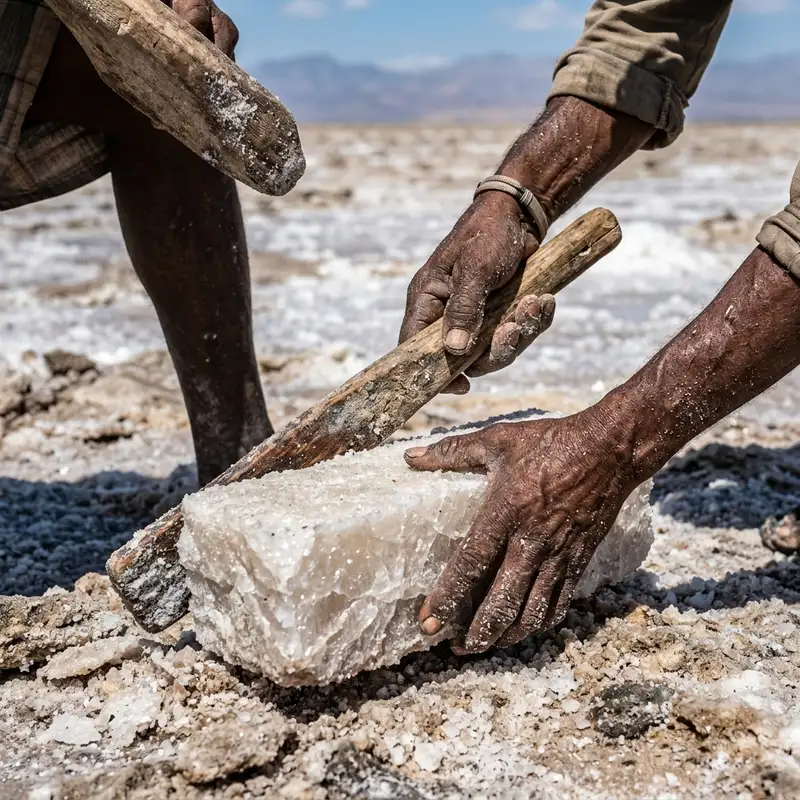
I spent hours watching them, mesmerized by the rhythm. First, a section of the salt pan is scored deeply with a long, heavy pole with a sharp metal tip, outlining future blocks. Then, using a broad-bladed pickaxe, they hack downwards, severing the blocks from the bed. The sound, clink-clack, clink-clack, was the only constant amidst the silence. It was a primal sound, a human heartbeat against the vast indifference of #nature.
Each Amole block, roughly 4kg (8.8 lbs), requires immense effort to extract. Once cut, they are carefully pried up, then trimmed and smoothed with a small axe, transforming raw salt into a standardized, marketable commodity. The process is precise, requiring strength, skill, and an intuitive understanding of the salt’s crystalline structure. The sun beats down relentlessly, reflecting off the white surface with blinding intensity. The air shimmers, distorting perception. Yet, they work on, their movements fluid and efficient, fueled by strong, sweet tea and an occasional piece of bread.
The finished Amole blocks are stacked meticulously into pyramids, ready for the next stage: the arrival of the caravans. The men often work for days or even weeks on the flats, sleeping in makeshift shelters, their existence pared down to the essentials: water, food, and the relentless pursuit of salt.
Caravans on the Horizon: The Journey Begins
The most iconic image of the Danakil salt trade, and indeed of ancient commerce, is the camel caravan. And just as I was beginning to feel the deep fatigue of merely observing the labor, a distant, undulating line appeared on the horizon. It was a ghost from the past, made flesh: a camel caravan, slowly but steadily approaching. Hundreds of camels, strung together in long lines, their slow, deliberate gait perfectly suited for this terrain.
Each camel would be loaded with approximately thirty Amole blocks, weighing around 120kg (265 lbs). This is their cargo, their entire livelihood. The camel drivers, often young men, walk alongside their animals for days, sometimes weeks, on a journey that would cripple lesser beings. Their routes twist and turn through searing plains and jagged mountains, avoiding bandits and finding the scarce water points. The destination is the highland markets, primarily towns like Berhale, where the salt is traded for other goods or cash.
Watching the caravan arrive was like stepping into a living tableau. The air filled with the grunts of camels, the quiet commands of their drivers, and the excited chatter of the salt cutters. The process of loading is an art in itself: careful balance, secure knotting, ensuring the precious cargo is stable for the long march ahead. Each block is a testament to sweat and endurance, each loaded camel a moving symbol of an unbreakable tradition.
Beyond the Horizon: The Future of a Legacy
The salt trade, in its traditional form, is undeniably under threat. Modern transportation is faster, cheaper, and less physically demanding. Roads are slowly but surely encroaching, bringing trucks directly to the salt pans. The younger generation, understandably, looks towards easier livelihoods, drawn by the siren call of modernity.
But for now, the caravans persist. They are a testament to the Afar people’s deep cultural pride, their economic necessity, and perhaps, a quiet defiance against the relentless march of progress. There’s a particular kind of stubborn beauty in witnessing such an ancient practice in an age of instant gratification.
My journey to the Danakil salt flats was more than just an exploration of an extreme landscape; it was an immersion into a profound human story. It was a reminder that some of the most compelling narratives are not found in gilded museums or crowded monuments, but in the quiet, arduous lives of people who, against all odds, continue to honor their ancestors and their land.
I left the Danakil with my skin baked, my clothes caked in salt dust, and my mind profoundly altered. The sheer scale of human endurance, the stark beauty of the landscape, and the quiet dignity of the Afar people etched themselves into my soul. This isn’t just a place to visit; it’s a profound experience, a living history lesson that reminds us of the fundamental human connection to the earth and the timeless value of labor.
The clink-clack of the pickaxe, the distant rumble of the caravan, the pervasive shimmer of heat – these are the whispers of a white inferno, carrying echoes of a past that refuses to be forgotten. And in those whispers, I found a story far richer than any modern tale, a testament to the enduring human spirit against the backdrop of one of Earth’s most formidable frontiers.
#DanakilDepression #AfarSaltCaravans #EthiopianCulture #HiddenGems #ExtremeTravel
#Travel #Culture