Wandering Through Ephesus
-
 Cemre Seyyah
 - 15 May, 2026 08:28

The air hung heavy with the scent of pine and distant citrus, a warm breeze whispering secrets through #ancient cypress trees. Beneath a sky of an impossibly vivid Aegean blue, a sprawling testament to human ingenuity and ambition lay waiting, its marble bones gleaming under the relentless sun. To step onto the hallowed ground of Ephesus is not merely to visit a ruin; it is to peel back the layers of millennia, to walk the very stones where emperors once strode, philosophers debated, and gladiators bled. It is to feel the persistent hum of #history resonating from every worn column and crumbling archway, an invitation to a conversation across time.
I have traveled the globe, sought out the echoes of civilizations past in countless corners, but few places possess the immediate, visceral impact of Ephesus. Located near the modern town of Selçuk in Turkey, this ancient city, once a bustling port and the jewel of Roman Asia, represents a pinnacle of Hellenistic and Roman urban planning and cultural sophistication. Its story is one of relentless ambition, profound spiritual fervor, catastrophic decline, and ultimately, a triumphant resurrection by the patient hands of archaeologists.
The Grand Entrance: Through the Magnesian Gate
My #journey into the heart of Ephesus began, as it often does for many, through the Magnesian Gate. This monumental entrance, while largely reconstructed, immediately sets the tone. It’s not just a passageway; it’s a portal. Passing beneath its imposing arch, one instantly sheds the modern world, the sounds of distant traffic fading, replaced by the crunch of gravel underfoot and the imagined clamor of an ancient metropolis. This was once the primary entry point for dignitaries and merchants, for legions returning from conquest, and for pilgrims seeking the famed #temple of Artemis.
The path from the Magnesian Gate leads gradually downhill, allowing the city to unfold before you like a meticulously preserved stage set. On either side, the remnants of grandiose tombs and monuments hint at the city’s early wealth and the prominent families who once resided here. One can almost picture the stately procession, the chariots rumbling, their wheels carving the very ruts that are still visible in the marble streets.
The Marble Majesty of Curetes Street
As the main artery of ancient Ephesus, Curetes Street is where the city’s pulse beat strongest. A magnificent thoroughfare paved entirely with polished marble, it stretches almost a kilometer, linking the Herculean Gate to the Library of Celsus. The sheer scale and opulence of this street are breathtaking. On either side, the foundations of shops, public buildings, and houses line the way, interspersed with monumental fountains and the pedestals of countless statues dedicated to emperors, gods, and prominent citizens.
The name “Curetes” itself is a nod to a mythical priestly class associated with the cult of Artemis, and later, to a guild or association of city officials who likely had their offices along this very street. As you wander, notice the subtle details: the intricate carvings on the surviving architectural fragments, the drains running beneath the pavement, and the occasional mosaic pattern peeking through the dust. The street was meticulously designed, not just for practical use, but to impress, to project the power and prosperity of Ephesus.
One of the most striking features along Curetes Street is the Fountain of Trajan. Though largely ruined, its scale suggests a multi-story monument, complete with a colossal statue of Emperor Trajan standing over a globe, symbolizing his dominion over the world. Water, a precious commodity, would have cascaded from its various spouts, offering refreshment and a visual spectacle. Imagine the citizens gathering here, exchanging news, children playing, and water vendors filling their amphorae.
Further along, the Temple of Hadrian stands as a testament to the intricate artistry of Roman #architecture. Its small size belies its ornate beauty. The façade, a masterful blend of Corinthian columns and relief carvings, includes a magnificent arch depicting Tyche, the goddess of fortune, and a formidable Medusa head, perhaps intended to ward off evil. The four figures in the spandrels above the arch are believed to represent various mythological or historical figures, including possibly the founder of Ephesus, Androclus. It’s a structure that demands a moment of quiet contemplation, a miniature jewel box of history.

The Scholarly Heart: The Library of Celsus
The undisputed star of Ephesus, and perhaps one of the most iconic images of the ancient world, is the Library of Celsus. Its façade, lovingly reconstructed from original fragments, stands as a testament to both Roman engineering and aesthetic brilliance. Built in 125 AD by Gaius Julius Aquila for his father, Tiberius Julius Celsus Polemeanus, a former governor of Asia, this was no ordinary library. It was also his monumental tomb, an honor rarely bestowed upon someone within a library. Celsus was interred in a sarcophagus beneath the central niche of the eastern wall.
The library’s two-story façade is a masterpiece of Roman Baroque style, employing optical illusions to make it appear even grander. The central entrance is larger, and the columns on the sides are slightly smaller, creating a sense of depth and perspective. Niches within the façade once held statues representing the virtues of Celsus: Sophia (Wisdom), Arete (Goodness), Ennoia (Thought), and Episteme (Knowledge). Imagine stepping inside, the cool air embracing you, scrolls meticulously stored in recessed wall niches, scholars poring over texts, and the scent of aged papyrus filling the air. It is estimated to have held around 12,000 scrolls, making it one of the largest libraries in the Roman world, second only to Alexandria and Pergamon.
Standing before it, one can almost hear the rustle of papyrus, the quiet murmur of intellectual discourse, and feel the weight of countless stories and treatises that once filled its shelves. It’s a powerful reminder that Ephesus was not just a commercial hub, but also a center of learning and #culture.
The Roar of the Crowd: The Great Theatre
Directly opposite the Library of Celsus, and connected by a grand processional street known as the Marble Street, lies the colossal Great Theatre. Carved into the side of Mount Pion, this amphitheater could accommodate an astounding 25,000 spectators, making it the largest in ancient Anatolia. Its sheer scale is awe-inspiring.
Originally built in the Hellenistic period, it was extensively remodeled and expanded by the Romans between 41 AD and 117 AD. The tiered seating rises steeply, offering spectacular views not just of the stage, but also, in ancient times, of the bustling harbor and the Aegean Sea beyond. The acoustics are still remarkable; a whisper from the stage can be heard with surprising clarity even from the topmost rows.
This was the pulsating heart of Ephesian public life. It hosted not only theatrical performances and concerts but also gladiatorial contests, animal fights, and crucially, political and religious assemblies. It was here that the Apostle Paul famously faced a riot instigated by the silversmiths, whose livelihoods were threatened by his preaching against idol worship, specifically the cult of Artemis. The cries of “Great is Artemis of the Ephesians!” would have reverberated through these very seats.
Climbing to the very top row, catching your breath as you turn to gaze out over the excavated city and the hazy plains beyond, is an unforgettable experience. You are standing where thousands once stood, united in shared spectacle, faith, or fury.
Glimpses of Grandeur: The Terrace Houses
While the public monuments of Ephesus are undeniably impressive, it is within the Terrace Houses that the true intimacy of daily Roman life in a wealthy city comes into vivid focus. These elite residential complexes, built into the slope of Mount Bülbül just above Curetes Street, were multi-story apartment blocks for the affluent Ephesians. Protected by a modern canopy, the ongoing archaeological work here has painstakingly revealed homes that once belonged to senators, merchants, and high-ranking officials.
Walking through the designated walkways, peering into the excavated rooms, is like stepping into a time capsule. You see elaborate mosaic floors, depicting geometric patterns, mythological scenes, and everyday objects, all preserved with astonishing clarity. Fading frescoes still adorn walls, showcasing vibrant colors and intricate designs – birds, flowers, mythological figures, and even portraits. The houses featured sophisticated amenities for their time: hot and cold running water, private latrines, and even hypocaust heating systems, where hot air circulated beneath the floors and behind the walls.

One can discern kitchens, dining rooms (triclinia) with their distinctive U-shaped seating arrangements, bedrooms, and even small private bath complexes. The sheer luxury and domestic comfort on display offer a poignant contrast to the public grandeur, providing a human dimension to the city’s inhabitants. This is where families lived, children played, meals were shared, and private lives unfolded, far removed from the clamor of the theatre or the debates in the agora. It’s a powerful reminder that history is made not just by kings and battles, but by the quiet rhythm of daily existence.
Sacred Sites and Civic Hubs
Beyond the major highlights, Ephesus is dotted with numerous other significant structures that each tell a piece of its grand narrative:
- Prytaneion: Located near the upper agora, this was the city hall and administrative center, where the sacred flame of the city (maintained by the Curetes) burned eternally. Here, important civic decisions were made, and banquets were held for dignitaries.
- Odeon: A smaller, covered theatre near the Prytaneion, designed for musical performances, concerts, and more intimate council meetings. Its excellent acoustics suggest a focus on auditory pleasure rather than grand spectacle.
- Basilica Stoa: A long, colonnaded hall that served as a judicial and commercial center. Its grandeur emphasized the city’s importance as a legal and economic power.
- Public Latrines: A remarkable example of Roman ingenuity and social custom. These communal toilets, complete with elaborate marble seating, were not just functional but also served as a social gathering place, a testament to the Roman appreciation for communal living, even in the most private of acts.
The Ghost of a Wonder: The Temple of Artemis
No discussion of Ephesus can be complete without acknowledging its most famous, yet almost entirely vanished, treasure: the Artemision, or the Temple of Artemis. Once one of the Seven Wonders of the Ancient World, it stood about 2 kilometers northeast of the city center. This colossal marble temple, dedicated to the Ephesian Artemis – a goddess blending Greek Artemis with an Anatolian mother goddess, often depicted with multiple breasts symbolizing fertility – was rebuilt multiple times over centuries, each iteration grander than the last.
At its zenith, it was an unparalleled architectural marvel, boasting over 127 marble columns, each nearly 60 feet high, some adorned with intricate carvings. Pliny the Elder described it as “the most wonderful work of the Greeks.” It drew pilgrims and worshipers from across the Hellenistic world, making Ephesus a spiritual powerhouse.
Sadly, little remains today beyond a single re-erected column, assembled from fragmented pieces, standing in a marshy field. Its magnificent stones were plundered over centuries for other constructions, including Byzantine churches like the Hagia Sophia. Yet, even in its absence, the Artemision’s ghost looms large over Ephesus, a powerful testament to the transience of even the grandest human endeavors, and a poignant reminder of its former glory as a center of cult worship.
Ephesus and the Dawn of Christianity
Beyond its pagan splendor, Ephesus played a pivotal role in the early history of Christianity. It was here that the Apostle Paul spent over two years during his missionary journeys in the mid-1st century AD, preaching, teaching, and establishing one of the earliest and most influential Christian communities. His Epistle to the Ephesians is a cornerstone of Christian theology.
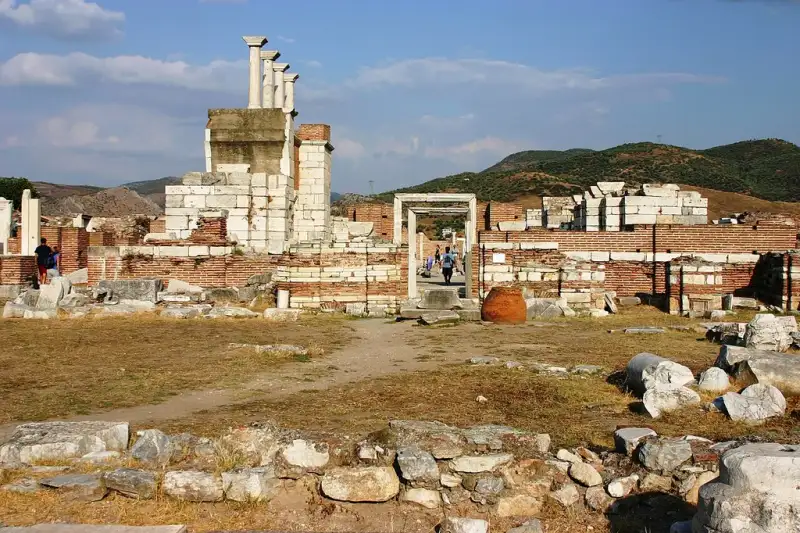
Later, the Apostle John is also believed to have lived and died in Ephesus. His presence, along with that of Mary, the mother of Jesus, further cemented Ephesus’s importance in early Christian tradition. The Basilica of St. John, located on Ayasuluk Hill overlooking Ephesus (and near the site of the Artemision), stands as a magnificent testament to this legacy. Though mostly in ruins today, its impressive foundations and surviving columns give a sense of the immense scale of the basilica, built by Emperor Justinian in the 6th century over what was believed to be St. John’s tomb. It was once as grand as Hagia Sophia itself.
A short drive from the main site of Ephesus is the House of the Virgin Mary (Meryem Ana Evi), a small stone chapel believed by many, including several popes, to be the last residence of Mary, brought here by St. John after the crucifixion. It’s a serene, deeply spiritual site that draws pilgrims from around the world, irrespective of their faith.
The Decline and Rediscovery
Ephesus’s long and glorious reign eventually succumbed to a combination of factors. The most significant was the gradual silting of its harbor by the Cayster River. What was once a thriving port became an inland city, cutting off its vital trade artery. Earthquakes, political instability, and successive invasions also took their toll. By the 6th and 7th centuries AD, the city had largely been abandoned, its grand structures falling into decay, eventually buried under layers of earth.
It wasn’t until the late 19th century that archaeological excavations began in earnest, spearheaded initially by British and later by Austrian teams. These painstaking efforts, continuing to this day, have slowly unearthed and meticulously reconstructed the city, revealing the breathtaking urban landscape we see today. The work is ongoing, a testament to the dedication of generations of archaeologists who have breathed life back into these ancient stones.
The Enduring Echoes
To wander through Ephesus is to engage with a story of triumph and tragedy, of innovation and artistry, of faith and human endeavor. It is to feel the weight of countless lives lived, loves lost, empires built and shattered, all within the confines of these ancient walls. The sheer scale of the city, the sophistication of its engineering, and the enduring beauty of its art leave an indelible impression.
It’s a place that transcends time, inviting contemplation on the cycles of history, the rise and fall of civilizations, and the enduring human spirit that seeks to build, to create, and to leave a mark. As the sun begins its descent, casting long shadows across the marble, the echoes of the past seem to grow louder. The imagined roar of the theatre, the murmur of the library, the footsteps on Curetes Street – they all converge into a single, profound sense of wonder. Ephesus isn’t just a collection of ruins; it is a living, breathing testament to an age of unparalleled splendor, a timeless journey for any true wanderer.
#EphesusTravel #AncientCities #RomanHistory #TurkishHeritage #TravelGuide
#travel #explore #guide